Do TikTok Followers Matter? Audience, Reach and Testing
- Followers can matter as an audience you have built; their total is not a direct measurement of how a particular video was recommended.
- TikTok’s dated explanations distinguish audience interactions and personalized discovery. They do not certify a universal 2026 follower-first test or completion-rate threshold.
- Compare actual posts at consistent ages, with their topics and traffic sources where available. A small change does not identify the cause of a reach difference.
- NoobClaw’s public writing and local-video records demonstrate creative drafts, not audience reactivation, recommendation success or follower growth.
Followers matter when they are people who want to return to your work. They can provide a recognizable audience, useful questions and reasons to make the next post. But a follower total alone does not tell you who watched a video, why it was recommended or what caused a reach change. Treat audience composition as something to understand through actual observations, rather than a hidden ranking formula with a universal threshold.
Ask what your audience does and which content serves it. Do not turn a follower total, a completion percentage or a short-term view change into proof of a particular recommendation mechanism.
An audience and a ranking signal are different things
A follower count describes one relationship with your account. A video’s views describe another event, and a comment describes a more specific response. Those measurements need not move together. An account can accumulate followers over time while a particular topic attracts little attention, and a post can find interested viewers who have not followed it. Neither observation alone supplies the full mechanism behind distribution.
TikTok’s June 2020 explanation said follower count was not a direct recommendation factor, while acknowledging that an account with a larger existing following might receive more views. This is a dated description of its system, not a newly audited specification of every 2026 ranking input. It supports keeping direct ranking claims separate from the practical value of an audience.
A June 2025 Malaysian announcement also describes discovery beyond creators a viewer already knows and tools for adjusting topic preferences. That is evidence of documented personalized discovery and viewer controls. It does not supply a minimum follower count for a video to take off or prove that every new upload passes an identical follower-first gate. Do not fill those missing details with a confident formula.
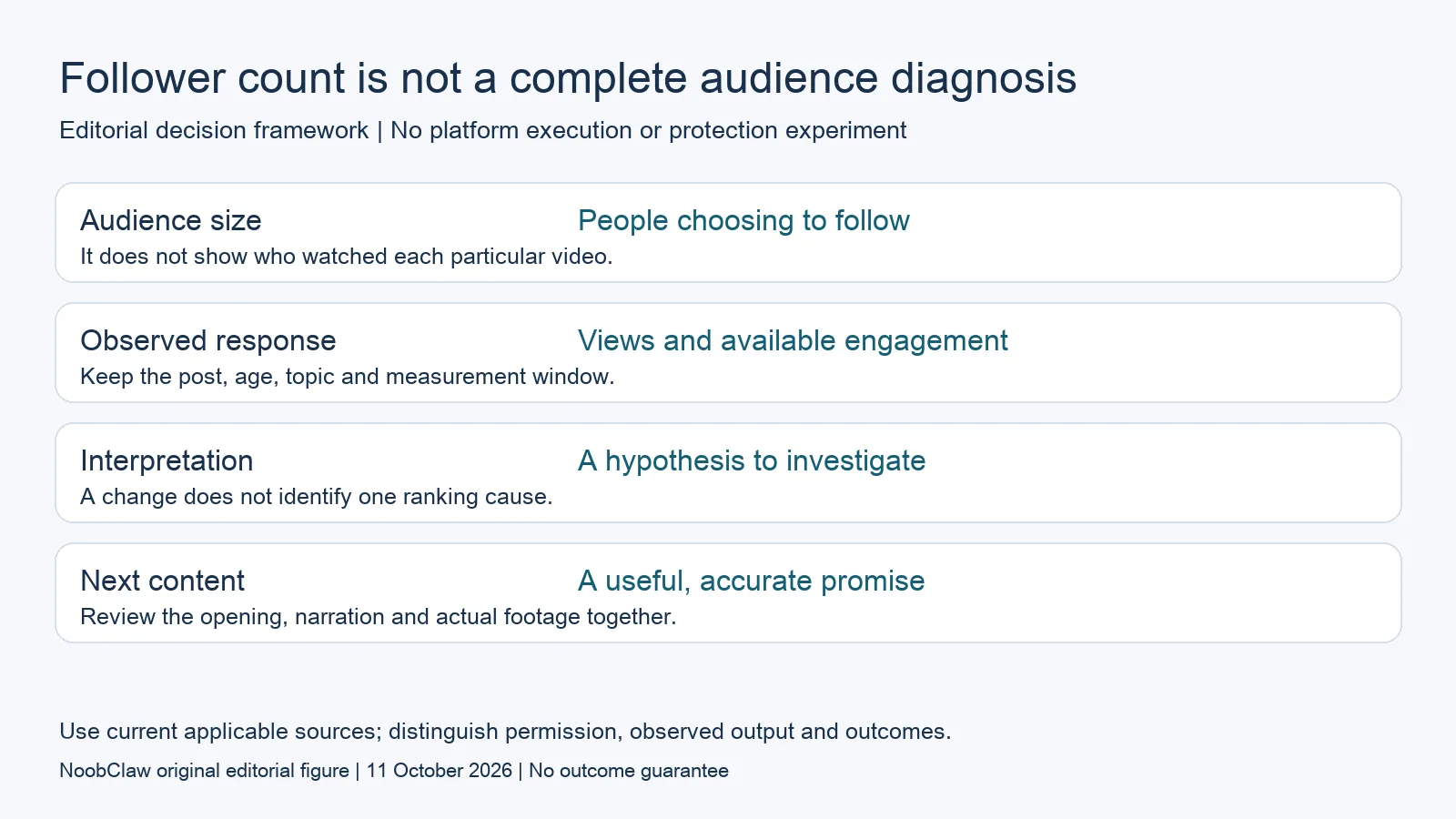
- Audience size: People choosing to follow. It does not show who watched each particular video.
- Observed response: Views and available engagement. Keep the post, age, topic and measurement window.
- Interpretation: A hypothesis to investigate. A change does not identify one ranking cause.
- Next content: A useful, accurate promise. Review the opening, narration and actual footage together.
What the sources establish and what they leave open
The 2020 explanation discusses user interactions, video information and device or account settings as parts of a personalized system. It explicitly describes ongoing adjustment to factors and weights. That background should not be converted into a permanent ordering of saves, shares and likes, or an exact completion percentage required for expansion. The cited material does not establish those numbers.
The 2025 announcement describes Manage Topics and keyword-filtering changes for viewers. A preference control can influence what a viewer wants to see without serving as an account-level penalty notice for a creator. It also does not prove that posting across several topics always causes a quantified reach loss. Any such measurement needs its original sample, time window and comparison method.
A useful hypothesis might be that an established audience responds differently to a new topic. Test that hypothesis against your available observations. It remains a hypothesis if you cannot identify which viewers saw the post or isolate other changes. A brief first-hour result is not proof of a universal seeding window, and a green status readout cannot by itself explain every distribution change.
Compare posts using the same measurement rules
Create a small record of your own posts: publication time, topic, length, opening promise and the time at which you checked the available metrics. Keep views, likes, comments and any reported traffic-source or watch-time fields separate. Note which fields the interface actually supplies rather than silently inventing unavailable audience segments. Comparing posts at different ages can confuse timing with performance.
Choose a stable observation window before examining the results. For a hypothetical comparison, you could record each post at the same age after publication and revisit it later, keeping both snapshots. The precise window is a design choice for your evaluation, not an official TikTok ranking rule. Consistency makes the observations easier to compare even though it does not create a controlled experiment.
Report the size of the sample and the spread between posts. One unusually successful clip can change an average without showing that the typical result improved. A follower change, a new topic and a revised opening happening together cannot establish that any one change caused the result. Preserve that uncertainty when deciding what to try next instead of diagnosing the audience from one disappointing video.
Use audience questions to build a clearer content brief
A recurring question from people who actually engage with your work is a useful starting point for a brief. Specify the audience, its question, the answer you can support and the evidence the video will show. This is an editorial planning method. It does not mean responding to comments automatically wakes a dormant audience or guarantees that a recommendation system will expand your reach.
Check the opening promise against the finished video. If the opening offers a comparison, the footage and narration should deliver the relevant comparison. If it offers a product demonstration, show the actual behavior rather than a generic clip that only resembles the topic. A narrow, supported answer gives you something concrete to review without claiming a universal algorithm advantage for a particular niche.
NoobClaw’s caption, hook and script tools can draft text from that brief under their current allowance conditions. The public caption record demonstrates returned text, not follower growth. Its separate desktop record demonstrates a local creative file, not audience response. Use these tools to address the creative part you can inspect, and keep any recommendation or business result as a separate, measured question. In the October 10 public local-only execution record, a supplied English script contained 441 characters and produced one 32.6-second video at 1080 × 1920 pixels and 30 frames per second. These are observed input and export specifications from one creative sample. The record also notes generic or off-topic stock footage requiring scene-by-scene review; voice quality and stock licensing were not independently approved. It contains no external TikTok publication, follower growth, recommendation or retention measurement.
Decide what to improve before abandoning an account
If several posts on the topic you want to pursue attract useful questions, those observations may support developing more material for that audience. If response varies, compare what changed: the promise, demonstration, language, publication age or available traffic sources. Those checks can guide the next brief without declaring that the follower base is broken or that a new account would recover faster.
This review does not recommend starting additional accounts as a remedy for an assumed seed failure. A new account is a separate operating decision with its own costs and applicable conditions. There is no validated rule here that a small new audience will outperform an established one, or that distributing the same asset across more handles creates independent chances of success.
Keep your stated business outcome separate from the visible follower and view counters. A visit to a product page is not a paid purchase. If you want to evaluate inquiries or purchases, use the actual records for those actions and a consistent attribution method. An audience discussion can inform creative decisions, but it cannot fill missing conversion data or prove a return on a content tool.
Choose the output you need: post-caption drafts, opening-line drafts or spoken-script drafts. These text tools have a limited anonymous allowance; they do not transcribe or publish a video.
For the related content and workflow decisions, read Free AI Social Media Post Generators: Limits and Draft Quality and AI Content Generation for Social Media: Drafts to Video. Each review has its own evidence and scope.
A reviewable brief for one recurring audience question
Imagine viewers ask how a small team can describe one product feature clearly. Write a brief with the actual feature, a supported answer and the footage you can show. Draft an opening and narration, then inspect the result before publishing through the appropriate authorized workflow. Compare the resulting post with other posts using the same observation ages and report the sample size. This is a hypothetical evaluation method. The public NoobClaw records document creative outputs, not this post, its audience or a causal ranking effect.
NoobClaw publishes this article. Its script-to-video guide and public creative execution record document a local video result, not external-platform publication. Check the current product offer against the supported action you need.
Frequently asked questions
Is there a proven 2026 follower-first test window?
The sources reviewed here do not establish a universal window or a completion-rate threshold. Dated recommendation explanations and your own observations should not be presented as a current specification of that mechanism.
Can a small account reach people who do not follow it?
TikTok’s documented discovery descriptions include finding creators beyond those already known to the viewer. That does not guarantee a particular post will be recommended or reach a target view count.
Should I replace an account because a post performed badly?
One result cannot establish that the account or follower base caused the problem. Compare multiple posts, the actual available metrics and their measurement windows before making a separate account-management decision.
Sources
Official material reviewed on October 11, 2026. Document conditions apply to their stated service and scope; the editorial examples are explicitly hypothetical.