Douyin AI Content Bots: Permission, Drafts and Limits
- Identify drafting, access and publishing as separate actions.
- Use Douyin’s own current agreement and applicable account terms.
- An exported video does not establish permission, distribution or revenue.
An AI content bot can describe very different actions: drafting a script locally, gathering platform data, accessing an account or publishing material. A decision about Douyin needs to identify the action before evaluating the tool. Douyin and TikTok have different agreements; an English-language TikTok article is not a substitute for Douyin's own terms. This article reviews the current Douyin user agreement and a limited content-production record. It contains no multi-account Douyin experiment, traffic forecast, tested posting quota or claim that a particular bot has received platform approval.
A labeled draft still needs accurate content, usable assets and an authorized destination.
Read the agreement for the action you actually propose
The current Douyin user agreement reviewed for this article was updated on February 13, 2026 and became effective on February 20. Its provisions address unauthorized use and automated programs accessing, collecting or processing information. Read the relevant provision with the proposed operation in view. A local document-generation task and a program accessing a platform are different descriptions. The fact that both can be called an AI workflow does not establish that the same permission applies to both.
Define an operation in ordinary language: what information enters, where it came from, which service is contacted, whose account is involved and what changes occur. In a hypothetical creative team, a writer may supply an original script for a locally produced video while another person reviews the result. That description is narrower than a system collecting Douyin information and publishing through several accounts. Put those additional actions into separate requirements instead of bundling them under a reassuring product label. Chrome’s official profile guide describes separating browser history, passwords and settings, while noting that someone with device access can switch profiles. That session organization is not evidence of authorization to operate Douyin.
The agreement also indicates that other applicable agreements may take priority for enterprise or institutional accounts. An agency should therefore inspect the terms attached to the actual account and use case. Neither a supplier's promotional page nor this editorial review can grant that permission. If the documentation does not answer whether a proposed access method is authorized, preserve the question and obtain an applicable answer before executing it. Do not infer an exception from the absence of a visible warning during a trial.
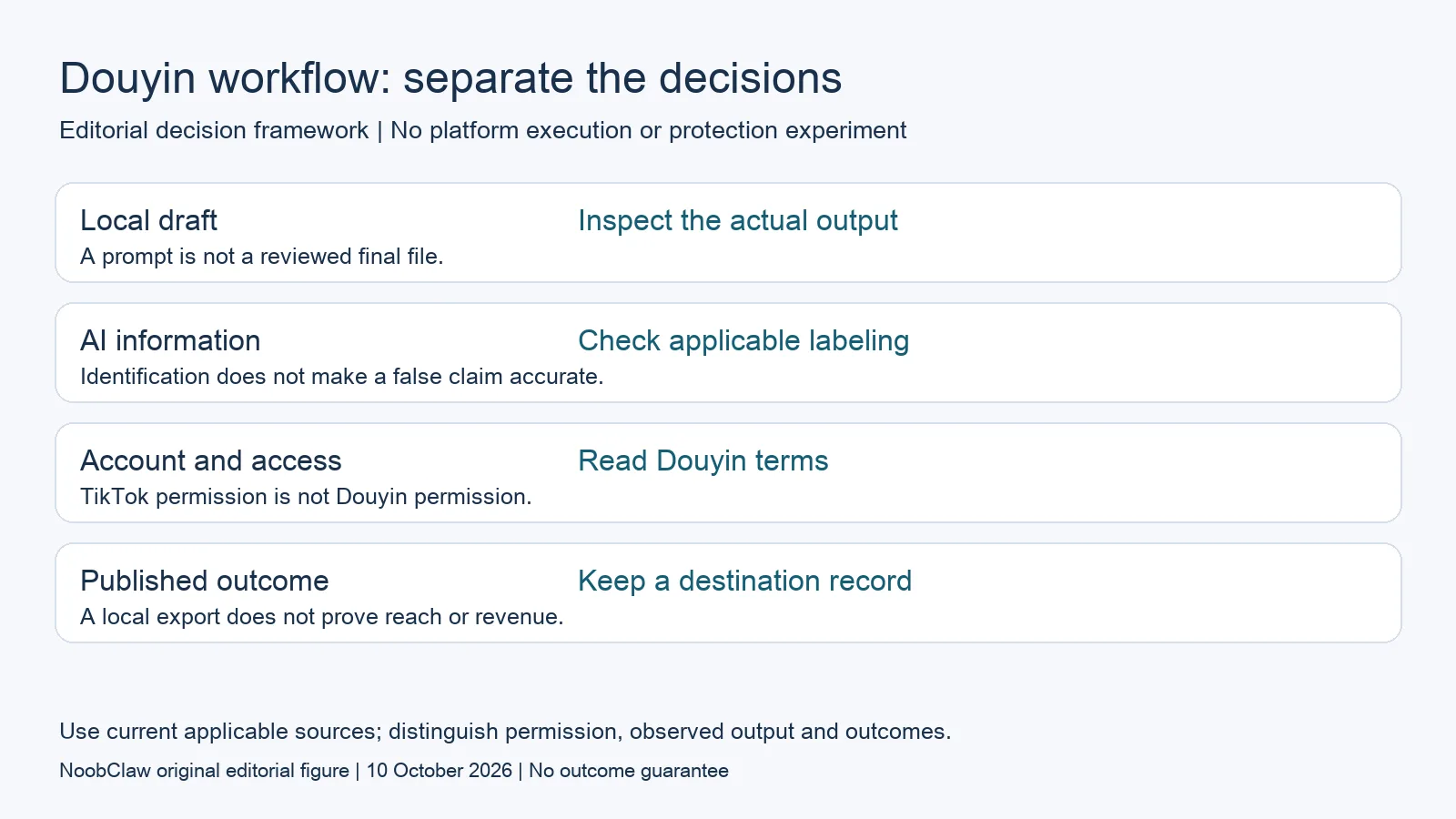
- Local draft: Inspect the actual output. A prompt is not a reviewed final file.
- AI information: Check applicable labeling. Identification does not make a false claim accurate.
- Account and access: Read Douyin terms. TikTok permission is not Douyin permission.
- Published outcome: Keep a destination record. A local export does not prove reach or revenue.
Treat AI labeling and factual accuracy as publishing requirements
The agreement includes a provision on conspicuous identification of non-real AI-generated information. This is a content requirement, not a promise that any labeled material will be accepted or recommended. Identify whether the particular draft contains that kind of material and use the applicable current requirements. Avoid converting the provision into an invented universal upload process or a claim that one label resolves copyright, impersonation and every other content question.
Consider a hypothetical business explainer containing a synthetic scene and a spoken factual claim. The reviewer has at least two distinct jobs: decide how the scene should be identified, and verify the factual claim against a reliable source. A visible label does not make an inaccurate statement accurate. A factually sound script also does not establish permission for every image, voice or brand asset used in the exported file. Record those decisions with the exact draft being reviewed.
Review the actual output rather than approving a prompt alone. Check whether the rendered subtitles match the intended meaning, whether the visuals illustrate the subject and whether any person or product is represented misleadingly. If an asset is unrelated, replacement or removal may be a better decision than adding another sentence to explain it away. Save the reviewed version so that a later edit does not silently inherit approval from a different file.
Measure the content job without inventing a growth rule
A reasonable pilot starts with a deliverable the team can inspect. A hypothetical brief might request one original explanation for a specified audience, with an identified source and a human approver. Completion means a draft exists and meets that brief. Publication requires its own record of the destination, account, permitted method and returned result. Reach and audience response require later measurements. These are different milestones even when one person handles the entire project.
The distinction matters when comparing suppliers. Ask what a product actually performs, what remains manual and what evidence supports the stated capability. A screen recording of video generation can substantiate that recorded drafting step. It cannot substantiate a claim about Douyin account approval, moderation outcomes or predictable distribution. This article does not supply a safe daily posting count because no such count has been established by the documents and case reviewed here.
For budgeting, use the current product offer and the work remaining after generation. Human review, asset replacement and destination-specific adaptation are real parts of the task. Do not turn an old token price or an undocumented personal success story into a business forecast. Compare accepted drafts and required review effort if those are measured in your own pilot; label the sample and conditions. A wider commercial conclusion needs a wider outcome record.
For the related content and workflow decisions, read AI Content Generation for Social Media: Drafts to Video and Repurpose YouTube for TikTok and Shorts: What to Verify. Each review has its own evidence and scope.
Our local video record is a drafting example
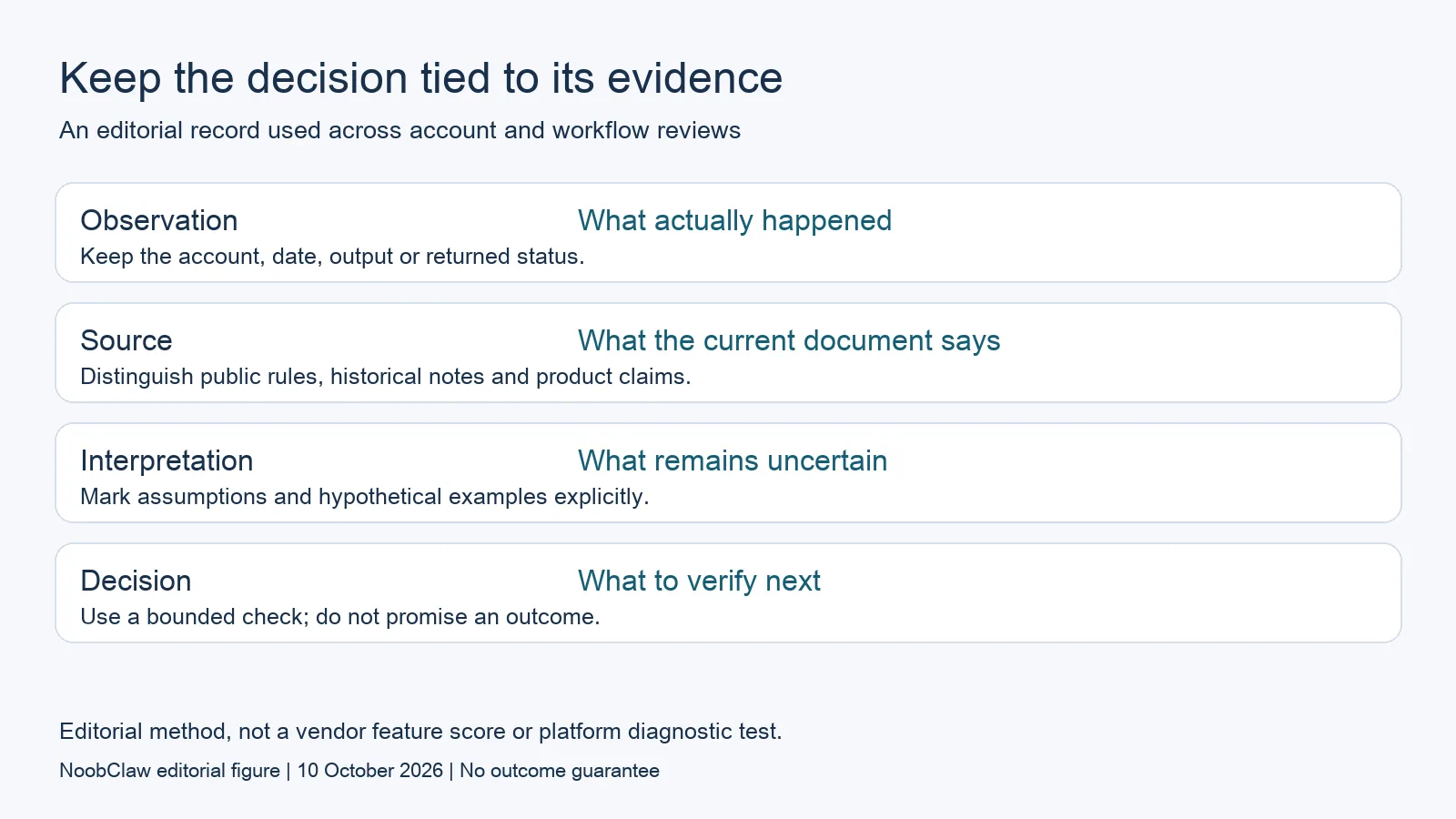
NoobClaw publishes this article and sells content tools. The linked public case documents one supplied script producing a local video draft. It includes file properties and sampled subtitle checks, together with limitations in visual relevance and audio review. It does not document access to Douyin, a labeled Douyin upload, several account identities, an accepted publishing integration or an audience result. The operating guide can help a buyer understand that local production task. A Douyin-specific decision still requires checking the actual content, assets, account terms and publishing method. A useful evaluation can stop at an accepted draft when that is the purchased job; it need not manufacture a distribution claim to justify the tool. Preserve any rejected draft and its reason alongside the accepted version so the record describes the whole pilot rather than only its best-looking output.
Inspect the public script-to-video execution record and the script-to-video operating guide. Check the current product offer against the task you need.
Frequently asked questions
Can an AI video tool automatically operate Douyin?
A demonstrated local generation task does not establish permission to access or operate Douyin. Identify the proposed action and check the current agreement, applicable account terms and the actual integration.
Do TikTok automation rules apply to Douyin?
Do not assume that they do. This review uses Douyin’s own user agreement and notes additional applicable account agreements. Check the actual service and account rather than borrowing another platform’s permission.
Does an AI label guarantee distribution?
No such result is established here. Labeling, factual review, asset permission, authorized publication and audience response are separate questions. This article reports no Douyin reach experiment.
Sources
Official material reviewed on October 10, 2026. Document conditions apply to their stated service and scope; the editorial examples are explicitly hypothetical.