
Grow a New Instagram Account: Content and Early Metrics
- New Instagram accounts operate under tighter action limits than established ones, and hitting them looks like a punishment when it is a threshold.
- The originality rules matter most to a new account: an account that primarily posts content it did not create or materially edit may not be shown to new audiences.
- Topic consistency is the single highest-leverage thing in month one, because the system has no other basis for deciding who to show you to.
- The two most-recommended growth habits — follow/unfollow and engagement pods — are the two that most reliably stall a new account.
Day 19. Eleven posts. Forty-three followers, and you know eleven of them personally. The advice you have read says to post more, use thirty hashtags, and follow two hundred accounts a day.
Two of those three will actively slow you down. Here is what the first month should actually contain.
Start with a fact that explains half of the frustration
New accounts do not play by the same limits as established ones. Instagram applies tighter thresholds to actions — follows, likes, comments, DMs — for accounts without history. Cross them and you get a temporary block that reads like a punishment for something you did wrong.
It is not a punishment; it is a threshold. But it has a real consequence for strategy: every growth tactic that depends on doing a large number of actions per day is unavailable to you right now, and the guides recommending them were written by people with three-year-old accounts.
This also means the "warm-up schedules" circulating online — day 1 do X, day 2 do Y — are guesses. Nobody official publishes one. And a perfectly regular schedule is itself the wrong shape: real human usage is irregular, and a tidy daily pattern is exactly what an automated account looks like.
A new account's biggest constraint is not that nobody knows you. It is that Instagram does not yet know who to show you to. Everything in month one should reduce that uncertainty.
The rule that hits new accounts hardest: originality
Instagram's creator guidance is unusually specific here, and it is worth reading before you plan a content strategy around reposting. The official position: if an account primarily posts reels, photos or carousels it did not create or edit in a material way, it may not be shown in recommendations to new audiences.
Crucially, the same guidance lists things that do not count as material edits: adding borders, adding watermarks, changing speed, or crediting the original creator. Those are precisely the four moves most "how to grow fast with reposts" advice recommends.
For an established account, a phase of reposting is a dip. For a new account, it is a decision about whether the account is ever eligible to reach strangers. Recovery is described as becoming eligible again when most recently posted content is considered original over a 30-day window — which, for an account with twelve posts, means nearly starting over. More on what that warning means and how the window works.
Days 1–30: the plan
Week 1 — Decide what a stranger will be able to predict
Not "pick a niche." The test is sharper: after seeing three of your posts, could a stranger correctly guess your fourth? If not, the account is too broad, and no amount of posting fixes it. This is the actual test, and it is worth failing it now rather than in month four.
Post three times this week. Same topic. Same voice. That is the entire objective.
Week 2 — Make each post do one job
New accounts commonly try to do everything in one post: hook, teach, entertain, sell. Pick one job per post. The system reads what people do after watching, and a post with one clear job produces a clear signal.
Pay attention to sends and saves rather than likes. One DM share is worth more than a pile of hearts — and for a new account, sends are the fastest route to being seen by people who do not follow you.
Week 3 — Add the free surfaces you are not using
- Alt text. Genuinely under-used, and it costs nothing. Most accounts leave it empty.
- Keywords in captions and your name field. Instagram content is increasingly searchable, including from outside Instagram — worth understanding the privacy trade before you opt in.
- Comments on other people's posts in your topic. Slow, unglamorous, and the one manual action that reliably works for a new account. Not a hundred a day — five good ones.
Week 4 — Read the data, change one thing
Twelve posts is enough for a first read. Look for which two performed above your median and what they had in common. Change one variable for the next twelve. Not five variables — one, or you will learn nothing.
The two habits that stall new accounts
- Follow/unfollow. It runs directly into the new-account action limits, it produces followers with no interest in your topic, and those followers then dilute the early engagement signal on everything you post afterwards. You are buying a number that damages the metric that number is supposed to represent.
- Engagement pods. Engagement from a fixed group of accounts that engage with everything is a pattern, not a signal. And it teaches the system to show your content to a group that was always going to engage anyway — which tells it nothing about who else might.
Both are popular for the same reason: they produce a number that moves this week. Both cost you the thing that produces numbers that move next year.
If you are launching several accounts at once
Launching three or five accounts in the same niche at once is a real strategy — it lets you test three angles in parallel instead of sequentially. It also multiplies every mistake above by the number of accounts.
Two things have to be true for it to work. First, the accounts must publish genuinely different content, not one post duplicated — otherwise you have one experiment run five times, and all five sit inside the originality rules simultaneously. Second, they must not act in lockstep: same posting minute, same action counts, same everything is the clearest signal that a set of accounts is one operation.
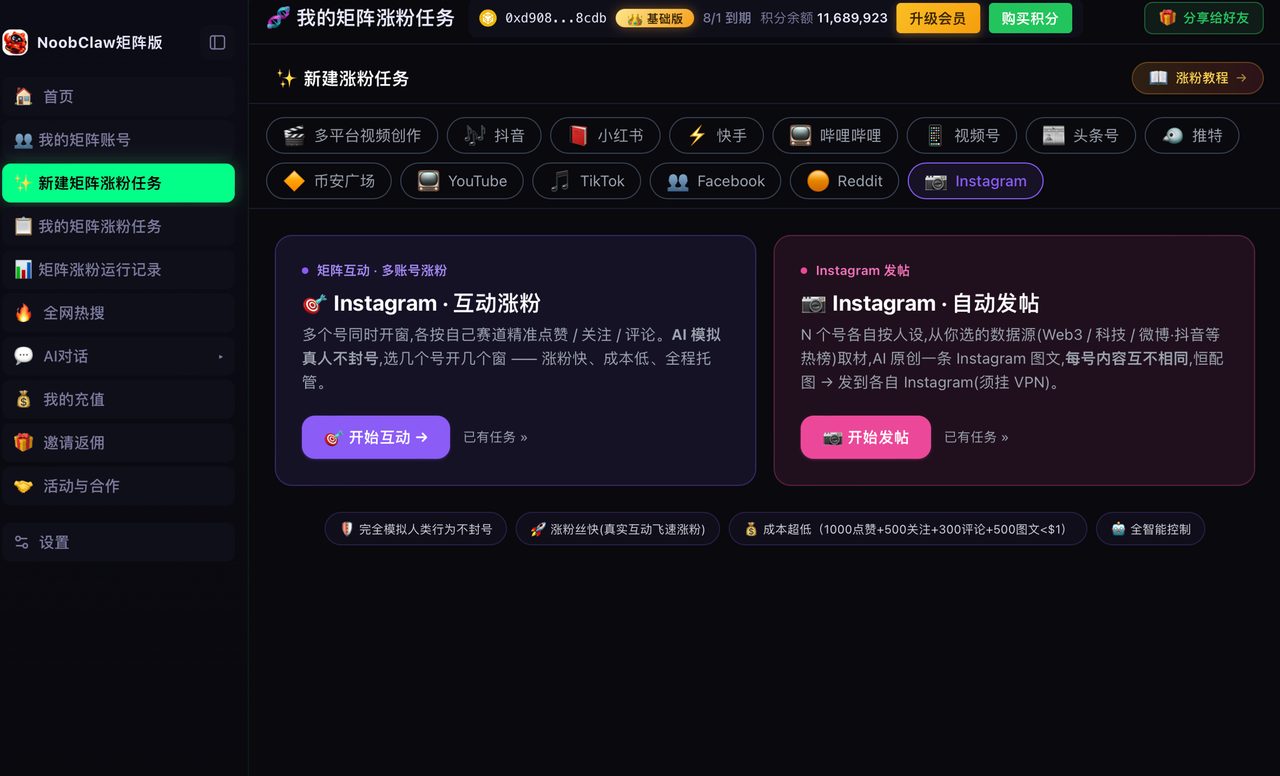
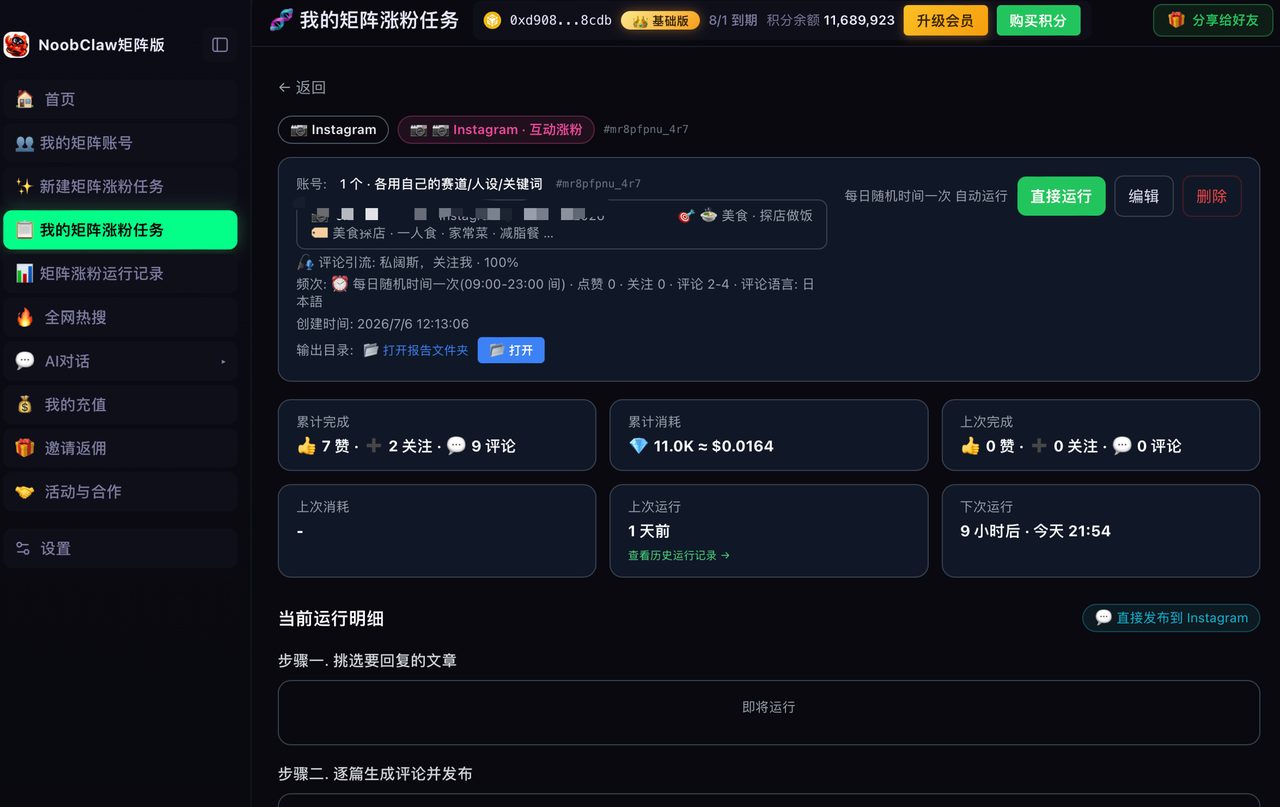
That is the shape of local multi-account tooling like NoobClaw: each account carries its own niche, persona and keywords and generates its own posts accordingly, runs in its own browser profile with its own fingerprint and route on your own machine (you log in yourself — no credentials handed over), and acts on randomized intervals rather than a fixed clock. It does not make a new account grow faster. It stops five new accounts from looking like one.
FAQ
How long before a new Instagram account starts getting reach?
There is no published timeline. What is observable is that reach tends to arrive after the account becomes predictable — when several posts in a row are clearly about the same thing. That is usually a matter of posts, not days, which is why sporadic posting across many topics extends the wait indefinitely.
Should I post reels, carousels, or photos?
Reels reach non-followers most readily, which is what a new account needs. But Instagram's originality rules apply to photos and carousels too, so the format choice does not exempt you from anything. Pick the format you can produce consistently at reasonable quality — consistency is doing more work here than format.
Do I need a professional account?
You need the insights, and those require a professional account. There are trade-offs worth knowing before you switch — four of them, none of which is reach suppression. For a new account trying to learn what works, having the data usually wins.