TikTok Account Warm-Up Before Posting: Claims and Checks
- Autocomplete alone returns 'how long', 'how many days', 'how to properly' and 'before posting' as separate questions — a settled procedure does not generate four framings.
- There is no published warm-up requirement on any platform. What the days genuinely do is build a profile that looks finished and give the recommender a signal about what you are interested in.
- The two things that plausibly matter are account completeness and consumption signal. The day count is the part everyone argues about and the part with the least evidence behind it.
- With multiple accounts the question inverts: the risk is not that they are too new, it is that they are all warming up in exactly the same way at exactly the same time.
You made the account. You have three videos ready. And every guide you find says to wait — three days, five days, seven, two weeks — while scrolling, liking and "acting like a normal user" before you publish anything.
None of them agree on the number, and almost none of them tell you what to actually do with the time. Both of those facts are informative.
The contradiction is the finding
Run the autocomplete for this and it splits into four different questions: how long to warm up, how many days, how to warm up before posting, how to properly warm up. Follow any of them and the day counts come back as one, three, five, seven and fourteen.
A real procedure does not have five versions of its own duration. The day count is not a specification anyone is reading off a document — it is a number each writer picked, and the next writer copied.
Here is the part that settles it: no platform publishes a warm-up requirement. Not TikTok, not Instagram, not any of them. There is no documented waiting period between creating an account and being allowed to post, and no statement that posting on day one reduces distribution. We went looking for the official version of this and there isn't one.
When the same instruction comes with five different numbers attached, the numbers are not the instruction. Something else is, and nobody has written it down.
What the days are actually doing
Strip out the folklore and two mechanisms remain that are worth your time. Neither is a countdown.
1. A finished profile is a different object from an empty one. An account with no photo, no bio, no username you chose, and no activity is indistinguishable from a throwaway — to the platform and, more importantly, to the first hundred humans who see your video and decide in half a second whether to tap the profile. This part takes fifteen minutes, not five days, and it is the half of "warming up" that unambiguously matters.
2. Consumption tells the recommender what you are about. Before you post, the only thing the system knows about your account is what you watch. If you watch twenty minutes of the niche you intend to make content in, you are handing it a topical signal it otherwise has to infer from your first video alone. Whether this measurably changes your cold start is unproven — but it is free, it is genuinely what a real user in that niche would do, and it costs you nothing except time you were going to spend on the app anyway.
That is the honest list. Notice what is not on it: watch-time quotas, "like exactly 30 videos a day," follow ratios, and every other numeric prescription in the guides. Those are inventions with the texture of rules.

The thing warm-up guides are quietly for
Worth saying out loud: for a lot of people, warming up is a socially acceptable way to not start.
The days are a ritual with a satisfying shape — it feels like preparation, it postpones judgement, and it has no failure condition. You cannot warm up wrong. Meanwhile the actual hard part, which is making something and watching it get 200 views, stays safely in the future.
If you have been warming up for two weeks, that is not caution. That is the thing the ritual is for. The first video is going to get a disappointing number whether you post it on day one or day thirty, because that is where the median lives — Buffer's study of 11.4 million short videos found median views hovering around 460–500 regardless of how often accounts posted. The warm-up does not move that. Nothing moves that. What moves outcomes is how many attempts you make, and warming up is the opposite of an attempt.
The multi-account version, where the question inverts
If you are starting several accounts, everything above still applies — and one new thing dominates it.
The risk with a batch of new accounts is not that they are new. It is that they are new in exactly the same way. Created within the same hour, from the same network, with profiles filled in from the same template, watching the same videos, and then publishing their first posts within minutes of each other. Any one of those is nothing. All of them together is a pattern, and a pattern is what correlation systems are built to find.
So the multi-account warm-up checklist is not longer. It is different:
- Stagger everything. Different creation days, different first-post days, different times of day. Synchronisation is the signal, not the count.
- Give each account a genuinely different interest. If all five accounts watch the same twenty videos, you have built five copies of one profile.
- Do not template the bios. Five bios with the same structure and one word swapped are more suspicious than five empty ones.
- Never open with the same video. The efficient move — one file, five accounts — is the exact pattern dedup systems catch, and doing it on day one wastes the only clean start each account gets.
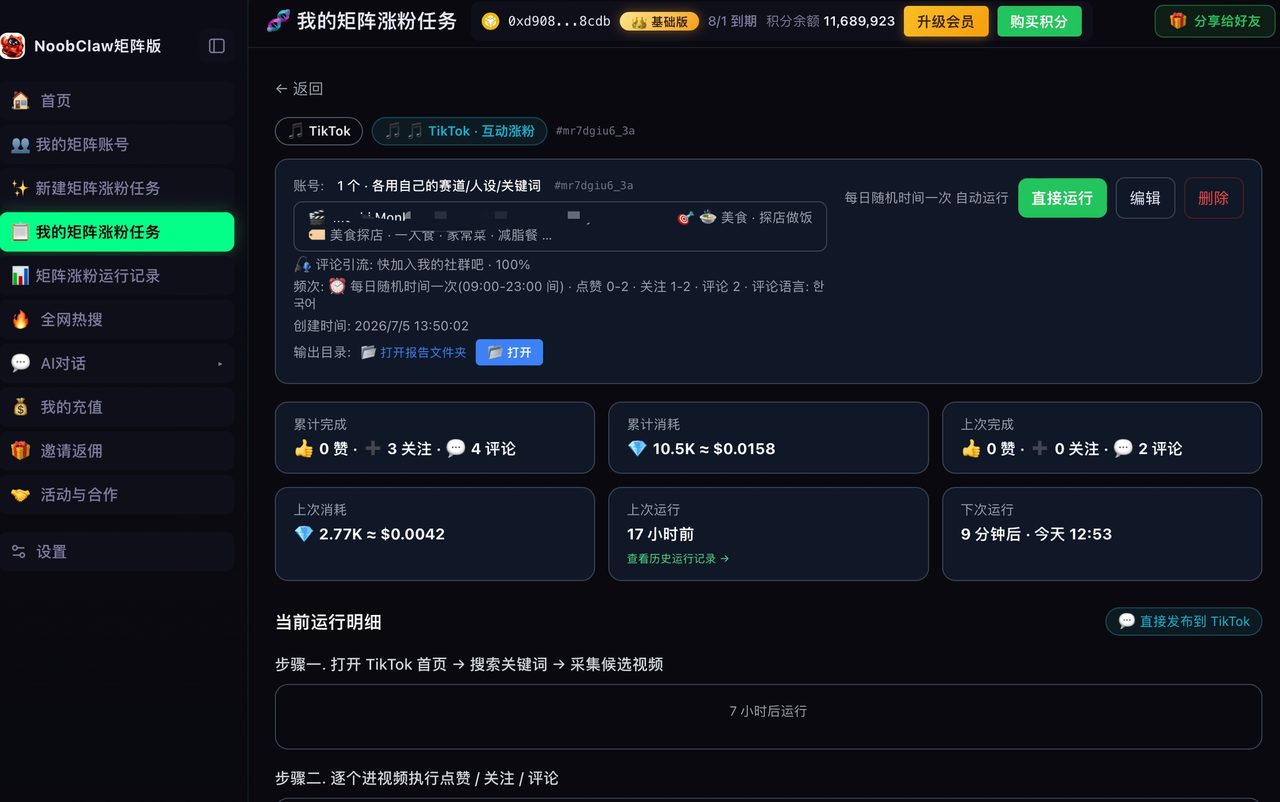
Doing that by hand across five accounts is genuinely tedious, which is why most people skip it and end up with five clones. It is also a reasonable description of what this class of tooling is for: NoobClaw runs each account in its own fingerprinted browser profile against your own login, gives each one its own niche, persona and keywords, and paces actions in randomised ranges — its scheduled mode fires at a random point between 09:00 and 23:00 rather than on the hour, for exactly the reason above. That does not make an account trusted. It stops five accounts from being one account with five faces.
Before any of that, though: decide how many accounts you actually need. The answer is usually smaller than the plan, and warming up four accounts properly beats warming up twelve identically.
The version that fits on a card
- Finish the profile properly. Photo, bio, chosen username. Fifteen minutes.
- Watch your niche for a while, because that is the only signal you can send before you post.
- Post. Not on day seven — when the profile is finished and you have something worth posting.
- If there are several accounts, stagger them and make them genuinely different from each other. That matters more than everything above combined.
FAQ
How many days should I warm up before my first post?
No platform publishes a number, and the numbers in circulation range from one to fourteen without anyone able to cite a source. Treat the day count as unknowable and use a condition instead: post when your profile is complete and you have a video you would be willing to show a stranger. If you find yourself extending the wait past that point, the extra days are not doing anything except delaying the first result.
Does liking and following during warm-up help?
Watching content in your intended niche is the part with a plausible mechanism — it is the only signal about your interests that exists before you publish. Bulk liking and following to hit a daily quota is the part with no mechanism and some genuine downside, since rapid follow and like bursts are exactly what anti-abuse rate limiting is designed to notice. Do what a real person interested in that topic would do, at the speed they would do it, and stop counting.
Should each of my accounts warm up at the same time?
No — and this is the single most consequential answer on this page. Simultaneous creation, simultaneous first posts and identical activity patterns are the combination that makes a set of accounts look like one operation rather than several people. Spread the starts across days, vary the times of day, give each account a different interest to consume, and never let two of them publish the same file. The staggering costs you nothing and removes the strongest correlating signal you would otherwise be generating yourself.