Instagram Daily Unfollow Limits: Published Claims and Cautions
- Instagram has never published a daily unfollow number. Every figure in circulation traces back to someone's blocked session, not to a policy page.
- The autocomplete family carries 2025 and 2026 variants of the same question — the cheapest possible signal that you are looking at a moving threshold, not a spec.
- Unfollowing is rate-limited alongside following, liking, and commenting; they are not separate allowances, which is why "I only unfollowed" still gets blocked.
- The follow/unfollow strategy itself is what puts you near the ceiling. If you need a daily unfollow budget at all, the ceiling is not your real problem.
You go on an unfollow spree to clean up who you follow, and forty minutes in Instagram tells you to try again later.
So you search for the safe number. And the search box hands you this:
- <code>instagram unfollow limit per day</code>
- <code>instagram unfollow limit per day 2025</code>
- <code>instagram unfollow limit per day 2026</code>
- <code>instagram daily unfollow limit</code> / <code>maximum unfollow per day instagram</code> / <code>is there an unfollow limit on instagram</code>
A published specification does not need to be re-asked every year. When the same question comes back with a new year stamped on it, the thing that changed is not the rule — it is the person asking.
Why the year suffix is the whole answer
Think about what has to happen for someone to type "2026" into that box. They read a number last year. They followed it. They got blocked anyway. The most comfortable explanation is that Instagram tightened things this year — much more comfortable than the alternative, which is that the number was never real.
The alternative is what the evidence supports. Instagram's own help documentation covers blocks in terms of behaviour — acting too fast, acting in a pattern, getting reported — and never in terms of a daily allowance you are entitled to spend. There is no page to cite because there is no number to publish.
This is the same shape as the Close Friends limit, where the only number anyone quotes comes from an error message: a precise figure, confidently repeated, with no specification behind it.
The mistake that makes this worse: assuming separate budgets
People treat follows, unfollows, likes and comments as four separate allowances. They are not. They are all write actions from the same session, and the rate limiting looks at the session.
Which produces the most common confused report on this topic: "I hadn't followed anyone all day, I only unfollowed, and I still got blocked." Of course — the two hundred likes you left that morning are in the same bucket.
| What you think you spent | What the session actually did |
|---|---|
| "Only 80 unfollows" | 80 unfollows + 150 likes + 30 profile visits + 12 story taps |
| "Nothing this morning" | Background refreshes on three logged-in devices |
| "I went slow" | Slow, but perfectly evenly spaced — which is its own signal |
That third row surprises people. Perfectly regular intervals are less human than fast ones. A person unfollowing accounts pauses to read a bio, gets distracted, speeds up, slows down. A loop does not.
Measure your own ceiling
- Count everything, not just unfollows. One running total per session across all write actions.
- Record the number at which the block appeared. Do this three times; take the lowest.
- Operate at half. The threshold moves down as your account picks up reports or as its age/standing changes.
- Vary the spacing on purpose. Irregular beats fast-and-even.
- New accounts: assume a fraction of the above. New accounts genuinely do play by different rules, which is its own topic — see why every day-by-day plan you have read is made up.
The harder question underneath
Here is the part nobody wants to hear: if you need a daily unfollow budget, you are running follow/unfollow. And follow/unfollow is a strategy whose entire economics depend on operating near the rate limit — which is exactly why the limit keeps biting you.
It also produces a specific, measurable failure: the followers it earns are people who followed you back reflexively, and reflexive followers do not watch, do not comment, and do not buy. You get a bigger number attached to a worse audience, which then shows up as three different numbers that disagree with each other.
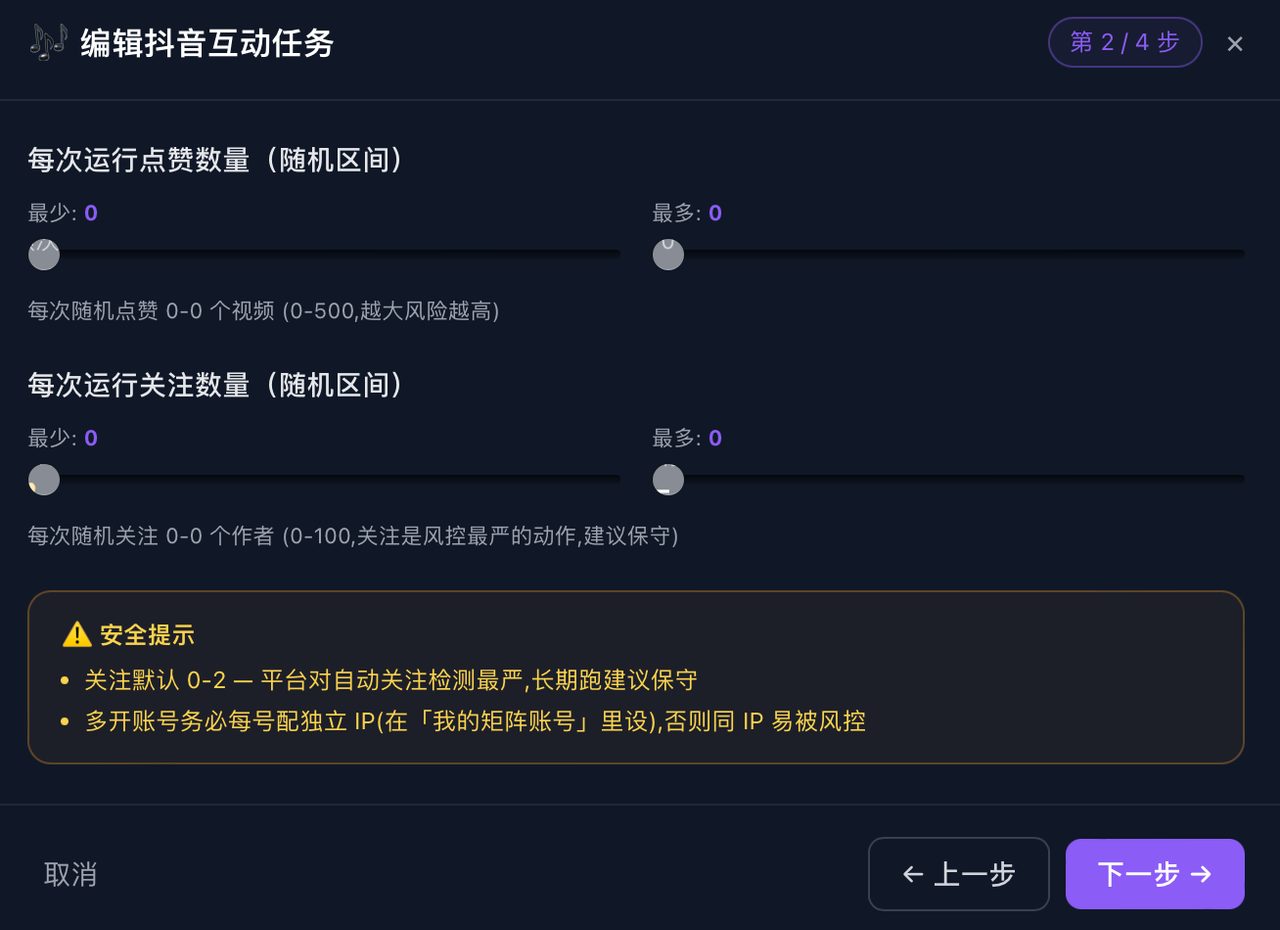
The alternative that does not fight the rate limiter is boring and slower: fewer actions, aimed at people who have a reason to care. Commenting on ten accounts in your actual niche outperforms unfollowing five hundred strangers, and it never triggers a block. When we build interaction into NoobClaw, that is the shape it takes — each account in its own browser environment, acting at human pace and volume on a targeted list, rather than sprinting toward a ceiling nobody will tell you the height of.
What to do if you are already blocked
The block itself is not the problem — how you respond to it decides whether the next one comes sooner or later.
- Stop completely for 24–48 hours. Not "slow down." The single most common mistake is resuming at 70% of the previous rate, which reads as the same behaviour with a smaller step size.
- Do not log out and back in, and do not switch devices looking for a fresh session. The restriction is on the account, and a sudden device change during a block adds a second signal on top of the first.
- Use the app normally in between. Reading, watching Stories, replying to DMs — these are not write actions in the same sense and they are what a recovering account looks like.
- When you resume, start at a quarter of whatever triggered the block, and stay there for a week before moving.
- Record the interval. If the second block arrives sooner than the first despite lower volume, the account's standing is what changed — and the answer is time, not tuning.
A rate limit responds to volume. A deteriorating account responds to nothing you can adjust. The interval between blocks tells you which one you are dealing with, and it is the only diagnostic you have.
One thing worth ruling out before you blame your pacing at all: check how many devices are currently logged in. An old phone, a browser session on a laptop you no longer use, a third-party app you authorised a year ago — each of those is producing activity attributed to your account, and none of it shows up in your mental tally of what you did today. Revoking stale sessions and unused app permissions is a five-minute job that occasionally explains a limit that made no sense.
FAQ
Does a third-party unfollow app raise the limit?
No. The limit is enforced server-side on your account, so the tool makes no difference to where the ceiling sits. What a tool can change is how machine-like the pattern looks — usually for the worse, because most of them act at perfectly even intervals.
How long does an action block last?
Instagram does not publish a duration. Reported lengths range from hours to weeks. The number worth tracking is the interval between blocks: shrinking intervals mean the account's standing is getting worse, and continuing at a slightly lower rate will not fix that.
Is unfollowing bad for my account on its own?
Unfollowing a person is not a violation. Doing it hundreds of times a day in a regular rhythm is a pattern, and patterns are what the system responds to. The action is fine; the shape of the activity is the problem.