
Multiple TikTok Accounts on the Same Email: Possible, and Not the Question You Should Be Asking
- The email branch is one of four near-identical autocomplete branches, all asking whether shared identifiers link accounts.
- Identifiers are the weakest of three linkage signals. Device fingerprint, exit IP and behaviour matter more and are harder to separate.
- For account limits and identifier rules, read the platform's current help pages — those change and any article stating them will go stale.
- The practical constraint is not how many accounts you can register. It is how many you can give genuinely different content to.
Google's completions for multiple tiktok accounts currently fan out into: same phone, same phone number, same email, on one device, one email, shadowban, issue.
Seven branches, four of which are the same question with a different identifier plugged in. When a family clusters like that, people are circling something they cannot name — and here, what they cannot name is "will running several accounts get me in trouble, and what exactly gives me away?"
The identifier is the least interesting part of the answer.
On the identifier question itself
Account creation rules — how many accounts per email, per phone number, what a shared identifier does — are set by the platform and change without notice. Read TikTok's current help pages for the rules that apply today. Any article that states these as fixed facts, including this one, would be asserting something that can go stale between writing and reading.
What we can say usefully is structural: an email address is an account recovery mechanism. Whether two accounts share one is a weak signal compared with the three below, and it is the one that people fixate on precisely because it is the only one they can see.
What actually groups accounts together
| Layer | Evidence | How hard to separate |
|---|---|---|
| Identifiers | Email, phone, recovery details | Easy — and therefore the weakest signal |
| Environment | Device fingerprint, exit IP, cookies, login sequence | Moderate — needs deliberate separation |
| Behaviour | Posting times, intervals, action mix, session shape | Hard |
| Content | How similar the published output is | Hardest |
People spend their effort on row one and are then surprised when rows two through four give them away.
Separating identifiers is a registration task you do once. Separating behaviour and content is an ongoing production problem. That is why the second one is where everybody actually fails.
The environment layer, concretely
Row two is where most of the recoverable ground is, because it is solvable with tooling rather than with more work.
What links accounts here: the same browser fingerprint, the same exit IP, the same cookie characteristics, and logging in and out of several accounts in sequence on one device.
Separating it means each account having its own browser environment and its own exit IP. One counter-intuitive detail worth knowing: fingerprint drift is itself a signal. Generating a fresh random fingerprint per session is more suspicious than keeping one, because real devices do not change every week. Bind the fingerprint to the proxy once and leave it.
The on one device branch of that autocomplete deserves a direct answer: whether several accounts on one machine is a problem depends entirely on whether they share an environment. Several isolated environments on one machine is fine. Several machines all exiting through one IP is not.
The behaviour layer, and the mistake everyone makes
Real usage is irregular. Two posts twenty minutes apart, then nothing for two days. Sessions of wildly different lengths. Watching, liking and commenting mixed in with posting.
Automated usage is regular. And here is the mistake: people learn that "posting all accounts at once looks bad," so they stagger them — every ten minutes.
That is still a pattern. It is just a pattern with a longer period. Escaping the behaviour layer means the spacing itself has to be irregular, which is a specific design decision rather than a general intention.
The content layer, which no tool fixes by itself
If ten accounts publish the same video, nothing in rows one through three matters. Identical content on one platform is the cheapest possible thing to detect — no modelling required, just comparison.
And this is where the real ceiling sits. Not "how many accounts can I register," but "how many accounts can I give genuinely different content to, every day, indefinitely?"
For most people that number is between three and ten, and it has nothing to do with email addresses.
Why the identifier question is so popular anyway
It is worth understanding why four of seven autocomplete branches are about emails and phone numbers, when identifiers matter least.
Because identifiers are the only layer you can see. You know which email you used. You do not know what your browser fingerprint looks like, you cannot inspect what the platform infers from your posting rhythm, and you have no interface showing how similar your content is to your other accounts.
So attention flows to the visible thing, which is a general property of how people manage risk rather than anything specific to this platform. The same pattern shows up wherever a system is partly opaque: people optimise the observable variable and are then surprised by the unobservable ones.
The layer you can check is rarely the layer that decides. That is not a coincidence — if it were easy to observe, it would be easy to game, so it would not be load-bearing.
The practical correction is to spend your effort proportionally to how much each layer matters rather than to how visible it is: a little on identifiers, some on environment, most on behaviour and content.
Recalculating the plan
If you are planning a multi-account setup, do it in this order:
- How many accounts can I legitimately hold? Your own, under current platform rules. Call it A.
- How many distinct pieces can I produce per day? Be honest — time a real one and multiply. Call it B.
- Take the smaller. It will be B, usually by a wide margin.
If B is three, then ten accounts means seven idle or seven duplicating — and duplicating is worse than idle.
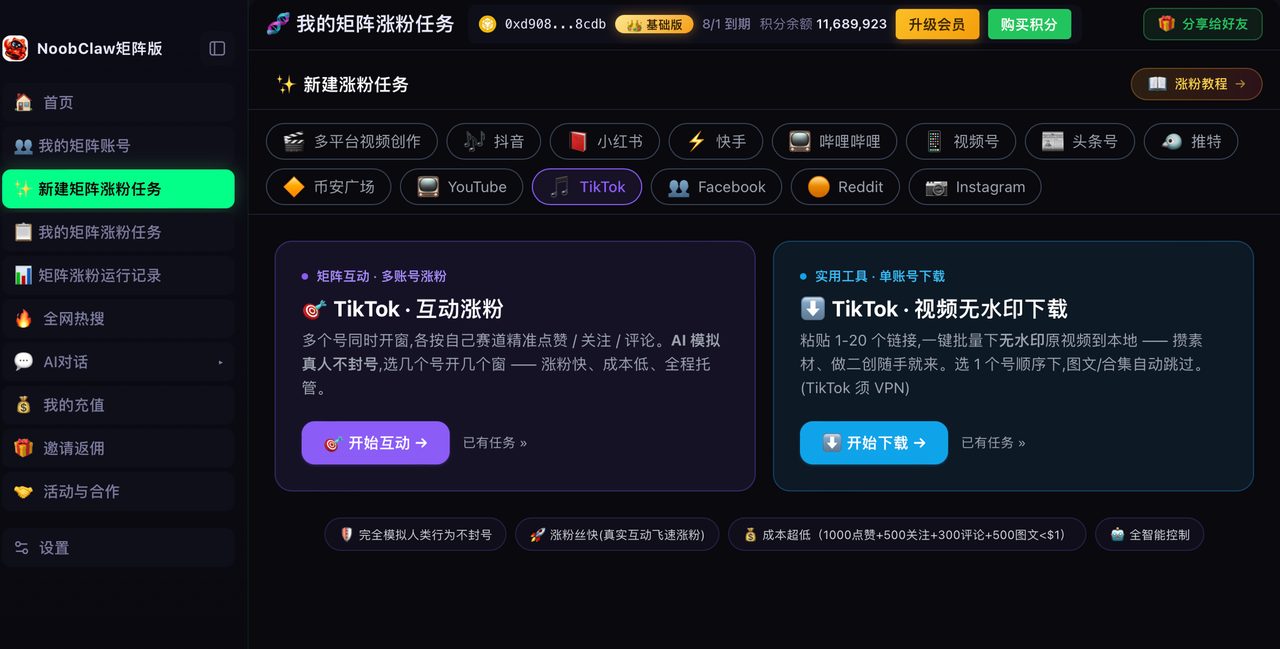
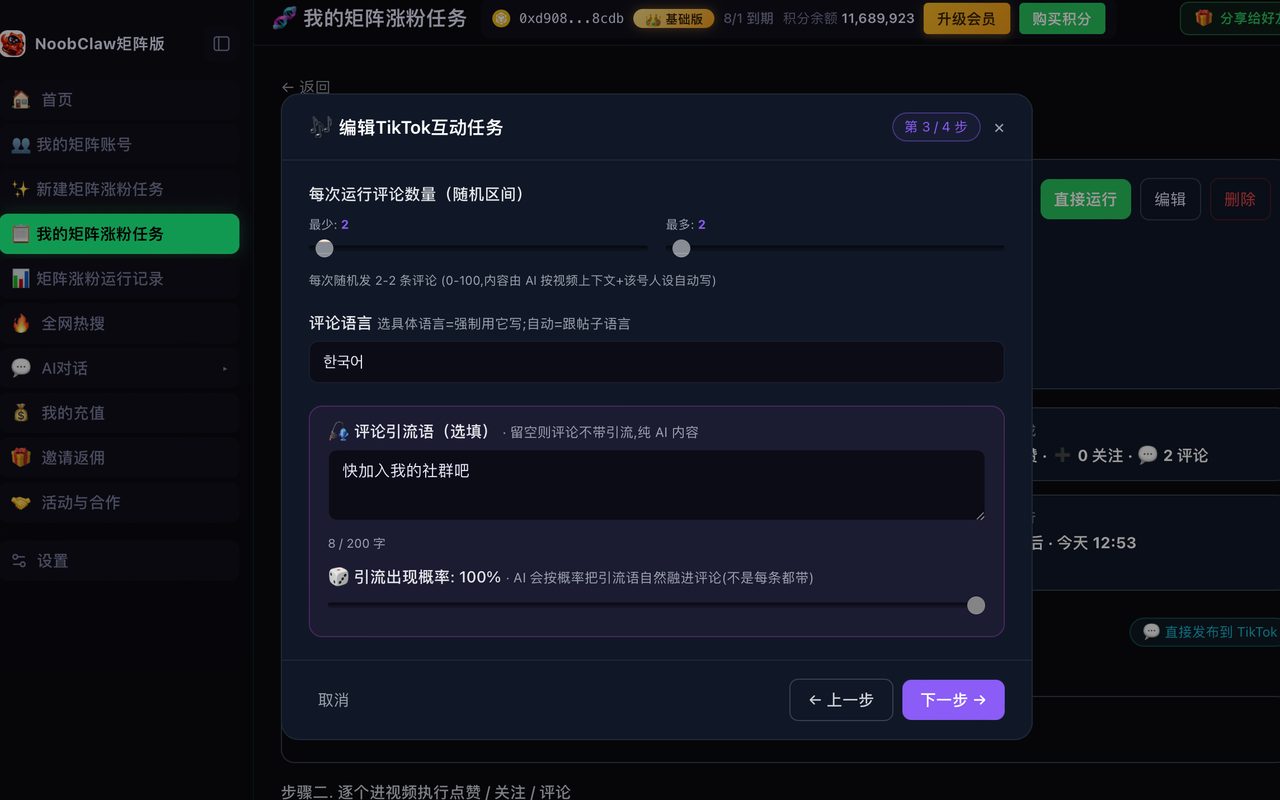
Raising B is the only move that raises the ceiling. That means either reducing the cost of producing one piece, or making difference come from configuration rather than from you editing. NoobClaw is built on the second approach: each account has its own niche, persona and keywords, and content is generated from those, so outputs differ by construction rather than by manual variation. It also handles row two — a separate fingerprint browser and IP per account, bound and stable — and row three, with every quota and interval expressed as a random range. It does not help with row one, which has exactly one correct answer: the accounts must be yours.
FAQ
Will using the same email get my accounts linked?
Check TikTok's current help documentation for the identifier rules in force today. Structurally, a shared recovery identifier is a weaker signal than a shared device fingerprint, exit IP or content pattern — so even if you separate every identifier perfectly, accounts that share an environment and publish similar content are still legible as one operator.
Does using a VPN solve the IP problem?
Partly, and it can create a new one. A consumer VPN typically routes many users through the same endpoints, so your accounts may share an IP with a large, unknown population — including whatever anyone else on that endpoint is doing. What the environment layer wants is a stable, distinct exit per account, which is a different product from a VPN that rotates you around a shared pool.
How many TikTok accounts can one person realistically run?
As many as you can supply with distinct daily content while keeping their environments separate. Ask about content capacity first and account limits second — that ordering saves people from building infrastructure for a scale they cannot feed. See managing multiple TikTok accounts from one phone for the device side of this.