
Reddit Reads Your Typing Rhythm: Behavioral Fingerprinting in 2026
- Analyses of Reddit's 2026 detection describe behavioral fingerprinting: keystroke rhythm, voting habits and on-site dwell time.
- The stated primary reason multiple accounts get actioned together is being linked to the same operator — not merely the same device or IP.
- That reframes the whole anti-association budget: antidetect browsers and proxies cover the device and network layers and leave the behavior layer untouched.
- The fixes are mostly free: stagger timing, vary session length, stop voting in identical patterns, and give each account genuinely different content and interests.
You did everything the guides said. A separate antidetect profile per account. A clean residential IP each. Different user agents, different screen resolutions, different time zones. Then one morning three of them were gone at once.
The natural conclusion is that the tooling failed. Usually it did not. It just never covered the layer that caught you.
Your proxy hides where you are. It does not hide that all five of these accounts type, scroll and vote like the same person.
What behavioral fingerprinting reportedly looks at
Analyses of Reddit's 2026 detection describe a shift toward behavioral signals, with three named repeatedly:
- Keystroke rhythm — the timing pattern between keypresses, which is remarkably individual and completely unaffected by which IP the packets left from.
- Voting habits — what you upvote, how fast, in what order, in which subreddits.
- On-site dwell time — how long you linger, how you scroll, what you open and abandon.
And the conclusion that matters most: the stated primary reason multiple accounts get actioned together is being linked to the same operator, not merely to the same device. ⚠️ These descriptions come from third-party analysis (largely from antidetect-browser vendors, who have an obvious interest in the topic), not from Reddit documentation. Treat the specifics as informed inference and the direction as well-supported.
Three layers, and where the money usually goes wrong
| Layer | What it measures | Covered by antidetect tools? |
|---|---|---|
| Device | Canvas, WebGL, fonts, screen, hardware | Yes — this is their core product |
| Network | Exit IP, ASN, consistency of IP with locale | Yes, with proxies |
| Behavior | Timing, rhythm, interests, content patterns | No |
Most anti-association budgets are spent entirely on the first two rows. That is not wrong — those layers are real and cheap to fix. It is just incomplete, and the incompleteness is invisible until the day it is not. The same three-layer structure applies well beyond Reddit; see why accounts get shadowbanned even with different IPs.
What the behavior layer actually leaks
You do not need exotic techniques to look like one operator. The everyday version is enough:
- Synchronized timing. Five accounts active in the same 40-minute block every evening, silent otherwise.
- Identical session shape. Log in, go straight to the same three subreddits, post, log out. Every time. Real people wander.
- Correlated voting. Multiple accounts upvoting the same threads within minutes — one of the oldest and clearest correlation signals there is.
- Shared vocabulary. The same phrasings, the same em-dash habits, the same opening formula. Writing style is a fingerprint you carry across every account you write from.
- The same interests. Five accounts subscribed to a near-identical subreddit set, because they were all built by one person with one set of interests.
Notice that none of these require detection sophistication. They are just patterns, and patterns are what detection systems are for.
The fixes, ranked by cost
Free, and highest impact:
- Stagger everything. Different accounts, different hours, different days of the week. Not offset by five minutes — genuinely different rhythms.
- Vary session length and shape. Some sessions should be two minutes of scrolling that produce nothing. Real accounts have unproductive sessions; farmed ones rarely do.
- Stop cross-voting. If your accounts are voting on each other or converging on the same threads, that is the single most legible signal on the list.
- Give each account a distinct interest profile. Different subreddits, different tone, different things it cares about. This is also what makes an account genuinely useful rather than merely surviving.
Costs money, still worth it: the device and network layers, which are table stakes rather than a solution. Note one counterintuitive rule that applies there: once a fingerprint is bound to an account, leave it alone. Fingerprint drift is itself an anomaly signal — real devices do not change their characteristics weekly.

Why writing style is the leak people never patch
Of everything on that list, the one that survives every technical countermeasure is how you write. You can rotate IPs forever and still hand over the same set of habits in every comment: the same sentence length, the same hedges, the same joke structure, the same three words you overuse, the same way you punctuate a list.
Stylometry is old and well-understood, and it does not require a platform to be doing anything exotic — it only requires text. If five accounts post prose that reads like one person, the simplest possible model links them.
What actually helps is not "write worse" but write as different people: give each account a persona with its own register (blunt vs chatty vs technical), its own typical comment length, its own level of formality and punctuation habits. That is genuinely hard to sustain manually across many accounts, which is why it is usually the first thing to collapse — and why it is worth deciding those personas up front rather than improvising each time.
A useful self-test: take twenty comments from across your accounts, strip the usernames, shuffle them, and see whether you can tell which came from which. If you cannot tell them apart, neither will anyone need to.
The scaling problem, stated honestly
Here is the tension nobody selling tools likes to state plainly. Everything above is easy with three accounts and hard with fifteen, because the natural way to handle fifteen accounts is to do the same thing to all of them — and doing the same thing to all of them is precisely the signal.
So the requirement for any multi-account setup is not "more automation." It is automation that produces difference rather than repetition: randomized intervals instead of fixed schedules, per-account content generated from that account's own interests rather than one file broadcast everywhere, and each account operating in its own persistent environment.
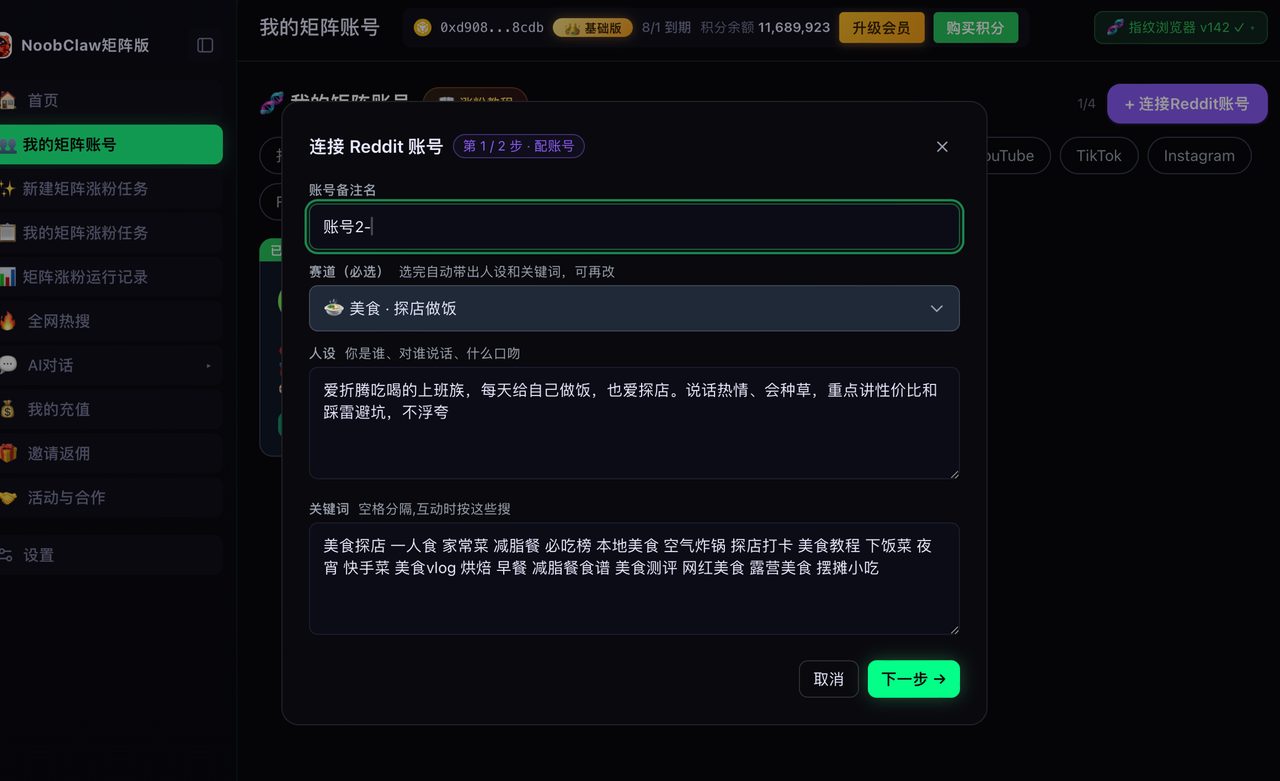
That is the shape NoobClaw is built to: each account runs in its own local browser profile logged into your own account (no passwords handed over), generates content from its own niche and persona, and runs engagement on randomized quotas and intervals rather than uniform ones. On Reddit specifically, its posting path uses the official API and interaction happens in your own logged-in session. It cannot make detection impossible — nothing can, and any tool claiming otherwise is selling you something — but it removes the mechanical uniformity that makes fifteen accounts look like one operator.
More on the general principle: managing multiple Reddit accounts and how many accounts one person can realistically manage.
FAQ
Is having multiple Reddit accounts against the rules?
Multiple accounts are not inherently prohibited — many people keep separate accounts for separate interests. What gets actioned is using them to manipulate: vote manipulation, astroturfing, ban evasion, coordinated promotion. The detection discussed here exists to find manipulation patterns, which is why accounts doing genuinely separate things tend to be fine.
Can keystroke rhythm really be measured in a browser?
Timing between input events is available to any web application, so measuring it is technically straightforward. How heavily any given platform weighs it is not published. The safe assumption is that anything observable is potentially observed — and to notice that the practical countermeasure (different people, or genuinely different usage patterns) is the same either way.
Does a better antidetect browser solve this?
It solves the device and network layers well, and those are worth solving. It does not touch the behavior layer at all. If your accounts are being linked because they act identically, upgrading the browser changes nothing — see the three-layer breakdown.