
TikTok's September 24 Update Adds Five Words to the Ban Sentence: "Including Associated Accounts"
- The enforcement sentence in the "Accounts and Features" chapter goes from "we may ban all of their accounts." to "we may ban all of their accounts, including associated accounts." Five words, and they
- The line TikTok draws has not moved. In the same rulebook: multiple accounts are explicitly permitted, and what is prohibited is using automation to deceive or bypass TikTok systems. Those two sentenc
- The popular claim that "the September 24 version changed nothing" is only true of four chapters — Safety and Civility, Integrity and Authenticity, For You feed Eligibility Standards, and Enforcement.
- Nothing here is a way to hide a link between accounts. The clause you would be trying to get out from under literally reads "tries to dodge enforcement." The useful exercise is knowing your blast radi
You run four TikTok accounts. The oldest one carries the followers and two years of goodwill. The newest one is a side experiment you barely think about, and last month it collected a strike for something you would have to scroll to even find. Until now, those two facts lived in separate drawers in your head.
On September 24, 2026, a new version of TikTok's Community Guidelines takes effect. Across the whole rulebook, exactly one sentence changes in a way that speaks directly to you — and it changes by five words.
The five words, with the old sentence next to them
This is the enforcement sentence from the "Accounts and Features" chapter, as it reads in the version live today and as it reads in the version dated for September 24. Both were pulled from tiktok.com on 2026-09-21, the second one via the publisher's own preview parameter for the 2026 H2 update:
Current version: "If someone seriously breaks the rules or tries to dodge enforcement, we may ban all of their accounts."<br><br>Effective September 24, 2026: "If someone seriously breaks the rules or tries to dodge enforcement, we may ban all of their accounts, including associated accounts."
"Including associated accounts." That is the entire change to that sentence. It does not define "associated." It does not say how association is determined, or whether a human reviews it, or whether the other accounts get their own notice. It states that the scope of a ban may reach them.
One more edit sits in the same paragraph, and it is easy to skim past. The list of things that can trigger that ban used to end with "or pretending to be someone else." In the new version it reads "or inauthentic behavior (e.g. pretending to be someone else)." A single named act has been turned into a category, with the old act demoted to an example. Categories grow; examples do not. That is the second thing worth writing down.
Quote these two sentences together, or do not quote them at all
Before anyone tells you what this means for a multi-account setup, check whether they showed you both halves of TikTok's own position. The "Integrity and Authenticity" chapter contains these two sentences, and a block-by-block comparison of that chapter on 2026-09-21 found all 23 text blocks verbatim identical between the current version and the September 24 version:
"You can have multiple accounts—for example, for fan content or creative expression—but not to deceive others or break the rules."<br><br>"We strictly prohibit automation tools, scripts, or other tricks designed to bypass our systems."
Read together, they say something fairly specific: having multiple accounts is something the platform explicitly permits; what it prohibits is using automation to deceive people or get around TikTok's systems. The dividing line is drawn around what the automation is doing — not around how many accounts you have, and not around whether your content repeats.
Both one-sided readings are wrong, and both are common. Quote only the first sentence and you have manufactured a permission slip for automated multi-account operation that TikTok never issued. Quote only the second and you have erased a permission the platform wrote down in its own words. Whether a given setup counts as "designed to bypass our systems" is a call TikTok makes — it is not something any tool, including ours, can certify about itself.
About the claim that the September 24 version changed nothing
That claim circulated widely after the update was published, and we repeated a version of it here on September 20. It needs correcting, and the correction has a specific shape — it is not "actually everything changed."
A chapter-by-chapter comparison run on 2026-09-21 found these chapters verbatim identical, block for block: Safety and Civility (32 of 32 blocks), Integrity and Authenticity (23 of 23), For You feed Eligibility Standards (its single block), and Enforcement (3 of 3). Those four chapters carry the rules most creators actually live under, including the multi-account and automation language quoted above and the rule that reused content without creative edits is ineligible for the For You feed. Nothing in that list moved.
Two chapters did move. Accounts and Features has three changed blocks, including the five words this article is about. Regulated Goods, Services, and Commercial Activities had 7 of its 11 blocks rewritten, adding new regulated categories and changing the business-account bar from "registered" to "verified." So:
- Accurate: "The multi-account, automation, reused-content and enforcement language is unchanged on September 24."
- Not accurate: "The new version is basically the same as the old one."
- Also not accurate: "TikTok tightened the rules," or "TikTok loosened the rules." The accounts chapter widened the reach of a ban and wrote down a route back that did not exist before. Those pull in opposite directions in the same chapter.
One more date, because almost nobody has it: the new version's own footer reads Released August 25, 2026, Effective September 24, 2026. The version live today reads Released August 14, 2025, Effective September 13, 2025. The update was not sprung on anyone — it sat in public for a month.
The question to ask this week (it is not "how do I hide the link")
Let us be blunt about the thing some readers came here for. This article does not tell you how to sever associations between accounts, and that is not squeamishness — the sentence you would be trying to get out from under contains the words "tries to dodge enforcement." Working around it is the behavior it names.
The productive version of the question is: if my weakest account goes down, what goes with it, and can I live with that? The surfaces that can tie accounts together are not secret — in most cases you configured them yourself, on purpose, because it was convenient:
- The same phone or laptop, signed into everything.
- The same home or office network.
- The same email address, or the same recovery email behind different addresses.
- The same phone number for verification.
- The same payout or payment details.
- The same business documents used for verification.
- Your own cross-promotion: each bio pointing at the next account.
Knowing that list is not a plan to break it. It is a blast-radius map, and it supports three decisions you can make today. First: do not park anything you cannot afford to lose behind an account you are still experimenting with. Second: if a strike lands anywhere in the group, treat it as a group-level event and handle the appeal immediately instead of shrugging because "that one does not matter." Third: keep every account in the group something you could defend out loud — its own topic, its own material, its own posting rhythm, with a human who has actually watched what went out.
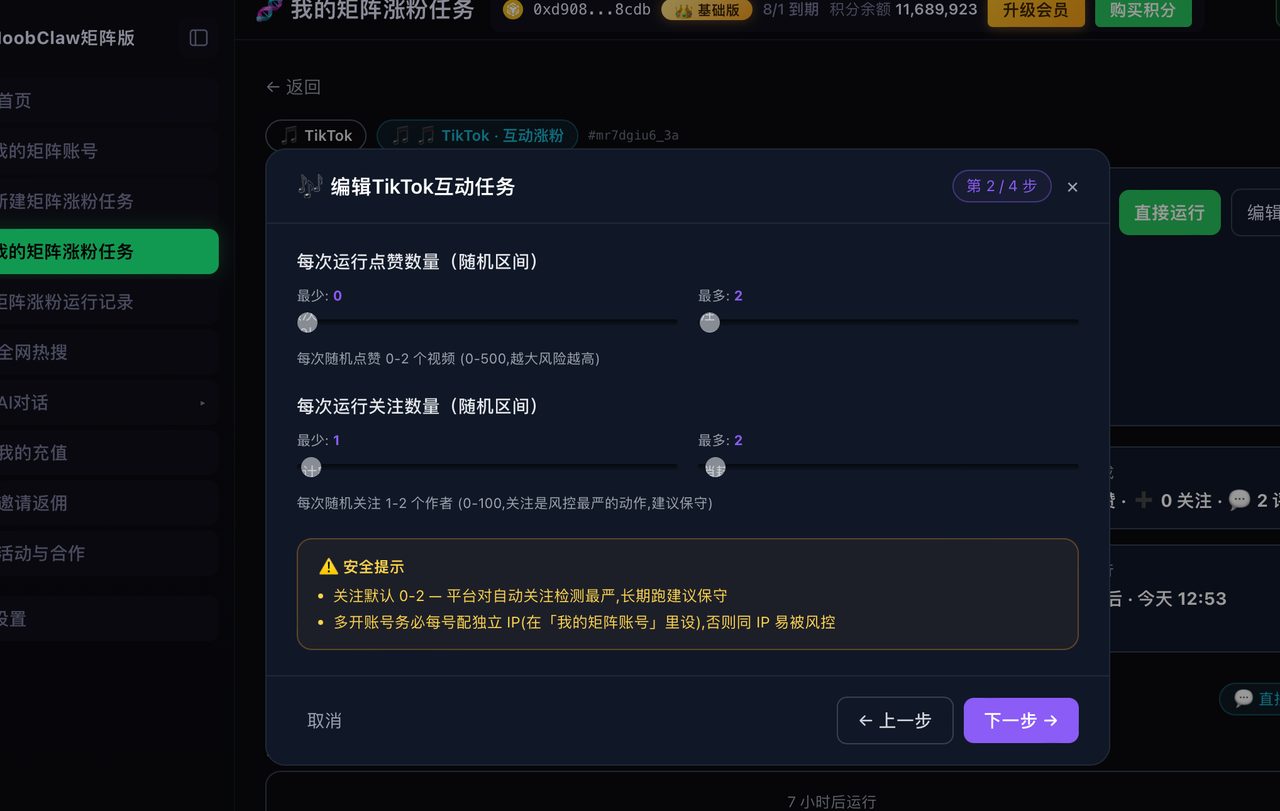
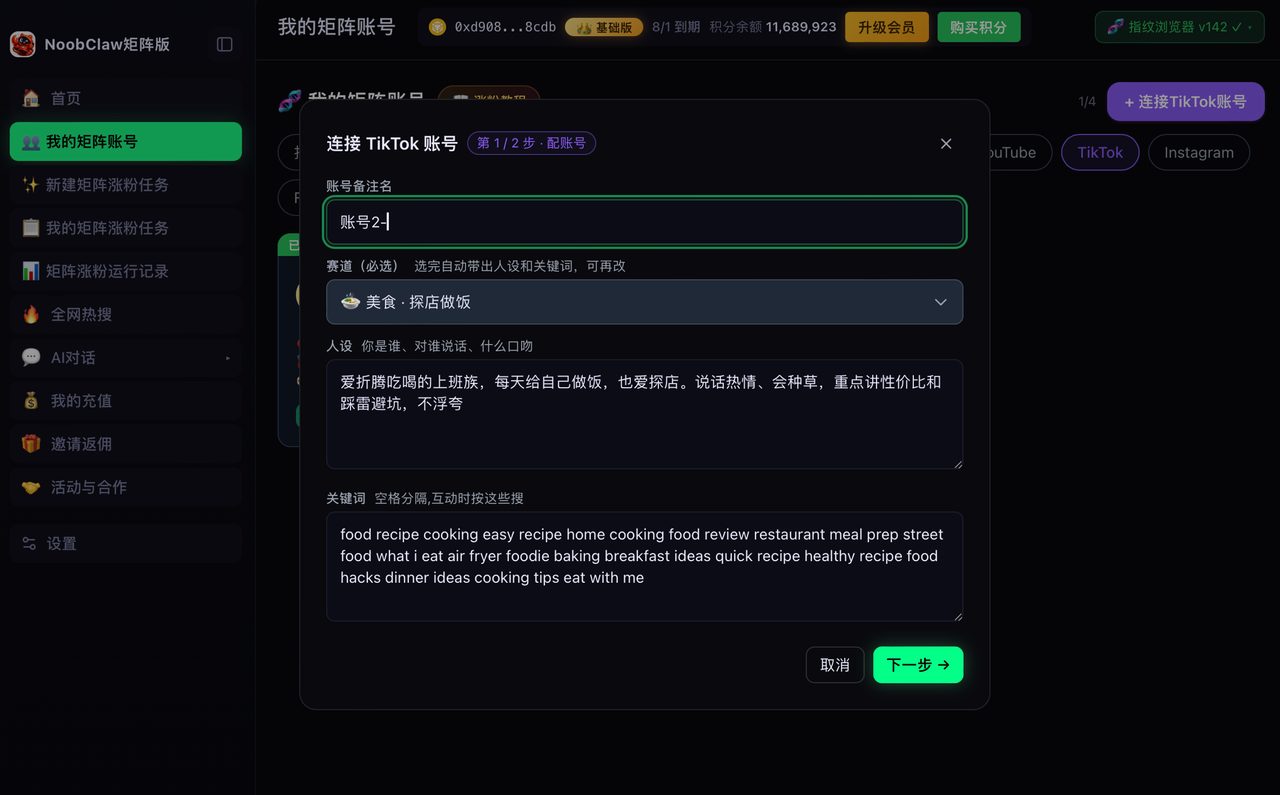
That last point is where a tool either helps or quietly hurts. NoobClaw is built as an AI matrix follower-growth engine that signs into your own accounts in a local browser, never takes your passwords, generates content separately per account against its own niche and persona, and runs on randomized pacing with daily caps and rest days — with a human review step kept in the loop. That is a description of how the workflow is shaped, not a compliance claim; see also our writeups on how many TikTok accounts one device can carry and posting the same video to multiple accounts.
FAQ
Does "including associated accounts" mean TikTok will now automatically ban my other accounts?
The text says "we may ban all of their accounts, including associated accounts." It is permissive, not automatic, and TikTok does not publish the criteria for association or a threshold at which the wider ban applies. What changed is that the wider reach is now written down. Anyone who tells you it triggers automatically, or that it never will, is filling in a blank the rulebook left empty.
Does this mean running multiple TikTok accounts is now against the rules?
No, and the same rulebook says so in the Integrity and Authenticity chapter: "You can have multiple accounts—for example, for fan content or creative expression—but not to deceive others or break the rules." That sentence is unchanged in the September 24 version. What sits next to it, also unchanged, is the prohibition on "automation tools, scripts, or other tricks designed to bypass our systems." The boundary is about deception and bypass, not about a headcount.
One of my accounts got a warning. Should I expect the rest to go down?
Nothing in the text supports predicting that, and nothing supports ruling it out. The same chapter notes that consequences range from a warning to a temporary feature or account restriction to a full ban, "depending on what happened" — and the September 24 version adds that in some cases users may be offered optional policy training to restore full access. We have written that one up separately in what TikTok's new policy-training sentence does and does not promise. The practical move is to appeal the strike you actually received rather than to guess at the reach of a penalty that has not been applied.
Five words is a small edit. It is also the only edit in this release that reads like it was written about you. Go find out what your group shares before someone else does.