Twitter DM Auto-Reply Tools: Consent and Workflow Checks
- An open inbox or a follower relationship is not sufficient consent for automated DMs.
- Review private DM rules separately from public automated and AI reply conditions.
- Ask for a real opt-out and handoff demonstration for your requested support workflow.
An X/Twitter DM auto-reply tool should serve a requested conversation, make stopping easy and hand unresolved questions to a person. It is not a way to turn open inbox settings into permission for automated outreach. X's current automation rules prohibit unsolicited bulk or automated DMs and require recipient intent and an opt-out. Before choosing a product, describe the support job and ask for evidence of the actual messaging connection. This article supplies a buying framework and hypothetical review cases. It has no documented three-tool trial, account-ban comparison or measurement proving that one reply system grows an audience.
A requested answer and an unsolicited campaign are different jobs.
Define the support conversation before comparing tools
A hypothetical software team may want to answer a customer who asks where to find a setup guide. Write that request and the permitted response beside the support goal. A different user asking about an invoice needs a different handling path. A generic promotion sent to everybody who follows the account is another proposal entirely. The feature label auto-reply hides these differences, so compare the intended conversation rather than an advertised number of daily messages.
Decide what the first response should accomplish. It might acknowledge a request, provide a relevant public help page or explain that a person will review the issue. Keep the answer short enough that the user can see the next step. Avoid requesting sensitive details merely because a template has room for them. An account problem that needs private verification should go to the appropriate support channel. A generated response should not invent account status, available refunds or a completed action.
Ask the vendor to demonstrate the full sequence with an authorized test user: request, response, opt-out, then the system's behavior after the opt-out. A screenshot of the first reply does not show the stopping behavior. A dashboard counter does not prove that each counted message arrived or answered the question. Request the actual delivery state and how exceptions reach an operator. Keep the evidence associated with the test configuration rather than assuming a different campaign inherits the same result.
X's DM help explains receiving messages and request settings. Technical ability to receive a message is a different question from expectations for automation. Keep the consent record with the requested use, rather than interpreting an available Send button as permission for follow-ups. Once the support need changes, check that the proposed response remains within that request. A previous conversation should not become an unlimited marketing audience.
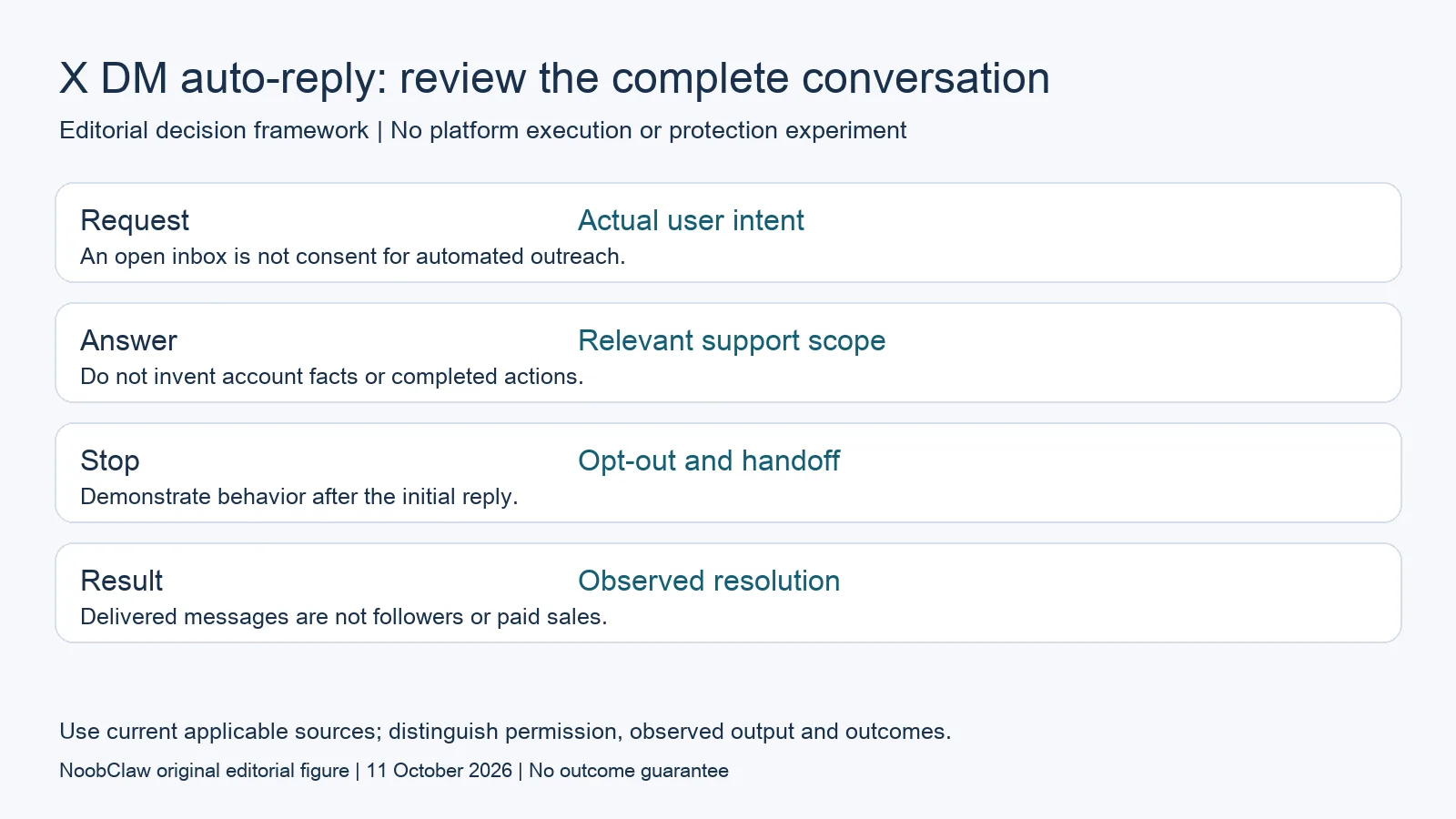
- Request: Actual user intent. An open inbox is not consent for automated outreach.
- Answer: Relevant support scope. Do not invent account facts or completed actions.
- Stop: Opt-out and handoff. Demonstrate behavior after the initial reply.
- Result: Observed resolution. Delivered messages are not followers or paid sales.
Check DM conditions without mixing them with public reply rules
X requires advance recipient intent for automated DMs and a clear opt-out that is promptly honored. It also restricts follow-up after a user-initiated interaction ends without further permission. Its public AI reply-bot section separately requires prior written approval. These clauses have distinct scopes; that public-reply condition should not be presented as an identical blanket rule for every private DM.
Build the review around the specific operation. Is the tool drafting an answer for a person to approve, or sending it without an active operator? Is it handling a private conversation, mentioning a public user, or replying to a public post? Is the triggering event an actual request or only a keyword match? Write down the answers before enabling a workflow. A platform rule about one action does not automatically authorize a different action offered in the same interface.
The current rules also prohibit non-API automation such as scripting X's website. Browser interaction should not be marketed as a safer substitute for a required connection. Conversely, the presence of an API does not by itself resolve the recipient's consent, message content or privacy requirements. Ask for the method and the intended action together. The vendor should be able to explain which responsibilities remain with the account owner and where the current official conditions are documented.
For a hypothetical evaluation, keep the initial request, response purpose and stopping event visible to the reviewer. A privacy-sensitive question needs a narrower answer and an appropriate handoff, rather than more confident generated text. Test the awkward cases as well as the easy one: an unclear question, an opt-out with ordinary wording and a request outside the knowledge provided. Do not turn a successful happy-path demonstration into an account-protection guarantee or a claim that every unexpected message will be handled correctly.
Measure answered requests instead of inventing a growth result
A support review needs a definition of a resolved request. An acknowledgement may be delivered while leaving the question unanswered. A relevant guide may answer the question without producing another message. A referral to a person is useful only if the handoff is actually received. Keep these outcomes separate in the test record. The number of generated replies is a workload count, not evidence of improved service, more followers or paid demand.
For a hypothetical request log, record the question category, response version, delivery state, stopping status and reviewer decision. Mark an unresolved delivery as unresolved. Describe why a draft was rejected, whether it misstated a product fact or did not answer the request. Review the rejected cases before expanding the workflow. A polished template can still fail when the customer asks a different question. These observations help improve the support content without pretending the tool was tested across every account and situation.
Cost comparisons should cover the requested deliverable and the billing unit actually offered. A local content draft, a scheduling workspace and a live messaging integration are different purchases. NoobClaw's public record below covers local creation; it does not establish a working X inbox integration. The related content and commercial reviews can help identify the earlier production stage. Do not substitute those examples for a DM demonstration or describe them as a head-to-head support result.
If a team later measures a live, permitted support workflow, preserve the period, eligible request count and actual outcomes. Note changes in the knowledge base, staffing and question mix that could affect the comparison. A shorter response time cannot on its own isolate the effect of a tool. Neither a delivered DM nor a link click is a completed sale. Report the observations at their actual scope and leave follower growth, account restoration and commercial return unpromised.
For the related content and workflow decisions, read NoobClaw vs Hypefury: Current Support, Prices and Fit and Buffer Alternative for AI Content: Compare the Actual Job. Each review has its own evidence and scope.
The NoobClaw example covers a different production stage
NoobClaw publishes this article and sells content tools. Its public execution record demonstrates one supplied script producing a local video draft, with recorded dimensions, duration and sampled subtitle checks. It also records imperfect stock-image relevance and the need for full visual and audio review. The record contains no X messaging operation, account warm-up trial, follower measurement or destination publication. Use it to inspect the documented content output, not to validate a different action. A purchaser who needs to prepare an explanation may find that creation stage relevant. A purchaser seeking a live inbox or account-management integration needs separate evidence. The guide describes the local controls, and the current product offer should be checked against the intended task. Neither the example nor a subscription capacity establishes platform permission or a promised commercial result.
Inspect the public script-to-video execution record and the script-to-video operating guide. Check the current product offer against the task you need.
Frequently asked questions
Can I auto-message anyone with an open inbox?
The ability to receive a message does not establish the intent required for automated DMs. Check the requested conversation and current conditions before sending.
Does using an API make every DM acceptable?
No. Method, recipient intent, stopping behavior and content need their own checks. An API connection is not blanket permission.
Has NoobClaw been tested as an X DM support tool here?
No. The cited execution record concerns a local video draft. No live DM integration, support result or account-protection experiment is documented.
Sources
Official material reviewed on October 11, 2026. Document conditions apply to their stated service and scope; the editorial examples are explicitly hypothetical.