
AI Social Media Manager: Four Very Different Products Are Selling Under That Name
- Four categories hide behind the same phrase: caption generator, scheduler with AI features, analytics copilot, and an agent that actually performs actions on accounts.
- The dividing question is simple: does it write, or does it act? Everything that only writes still leaves the whole publishing and engagement workload with you.
- Free tiers cluster in the writing category because text is cheap. Anything that acts on accounts costs more because it carries operational risk.
- Pick by which stage of your workflow is actually the bottleneck — most people buy a writer when their bottleneck is publishing.
Type "AI social media manager" into a search bar and you will get a caption generator, a scheduling app, an analytics dashboard, and something that logs into your accounts — all describing themselves with the same three words.
They are not competitors. They solve different stages of the same job, and buying the wrong one means paying monthly for a bottleneck you did not have.
The four categories
| Category | What it does | What it leaves you doing | Typical pricing shape |
|---|---|---|---|
| Caption / content writer | Generates post text, hooks, hashtags from a prompt | Everything else: assets, scheduling, publishing, replies | Free tier common; cheap paid tiers |
| Scheduler + AI features | Queues posts, plus AI captions and best-time suggestions | Producing the assets; all engagement | Per channel or per seat, monthly |
| Analytics copilot | Reads your metrics and explains them in plain language | Deciding and doing anything about it | Add-on to an analytics plan |
| Agent that acts | Produces content and publishes and engages, per account | Direction, review, and accountability | Higher; usage-based or per account |
The only question that separates these four: does it write, or does it act? A tool that writes hands you a document. A tool that acts changes something on a platform. The price difference between them is mostly the difference in risk.
Why the free tiers all live in one category
There is a structural reason free "AI social media manager" tools are almost always writers. Generating text is cheap and stateless — one prompt, one response, no account access, no liability. That is why ai social media manager free is such a common search and such a disappointing one: the free thing is real, it just does the smallest slice.
Anything that touches an account carries ongoing cost and ongoing risk: sessions to maintain, platform changes to track, failures to handle. Nobody gives that away.
So the useful reframe when comparing prices is not "which is cheaper" but which stage of my workflow is actually the bottleneck. We took the same angle on the scheduling category in social media automation vs scheduling, and it applies here with more force, because "AI" makes four different products sound like one.
Find your bottleneck in ninety seconds
Answer honestly, then buy the matching category.
- "I stare at a blank caption box." → Writer. A free tier is genuinely enough. Do not buy a platform.
- "I have the content but I post inconsistently." → Scheduler. Note that Instagram now schedules natively for free, which changes the math — see Instagram schedules natively now, so what are you paying for.
- "I have the data but I do not know what it means." → Copilot, or honestly, a decent free calculator and one hour. Start with is my engagement rate bad.
- "I have five accounts and I spend every evening logging in and out." → Agent. This is the only bottleneck the first three categories cannot touch.
Most people who search this term are in situation 4 and buy for situation 1, because situation 1 has the cheapest options and the loudest marketing.
What "acts on your accounts" should mean in 2026
If you are shopping in the fourth category, the differences that matter are not feature lists. They are three architectural choices.
1. Where the action happens. A tool that runs through a platform's official API is constrained to what that API allows, which on most consumer platforms is publishing and little else. A tool that operates a real browser session on your machine can do more, but you should know which model you are buying — the tradeoffs are laid out in API or browser.
2. Whether it wants your password. Handing credentials to a third party is a category of risk that has nothing to do with AI quality. Local browser login, where the session stays on your machine, avoids it entirely. We tested this distinction in three growth services took my Instagram password.
3. Whether every account gets different content. This is the one that decides whether the tool is an asset or a liability in 2026. Platforms have moved judgment to the account level — TikTok has been testing detection aimed at accounts dedicated to posting AI-generated spam (TikTok Newsroom, July 2026), and Instagram removes accounts posting mostly untransformed reposts from recommendations. A tool that clones one post across five handles is optimizing you into exactly the pattern those systems look for.
Where NoobClaw sits, stated plainly
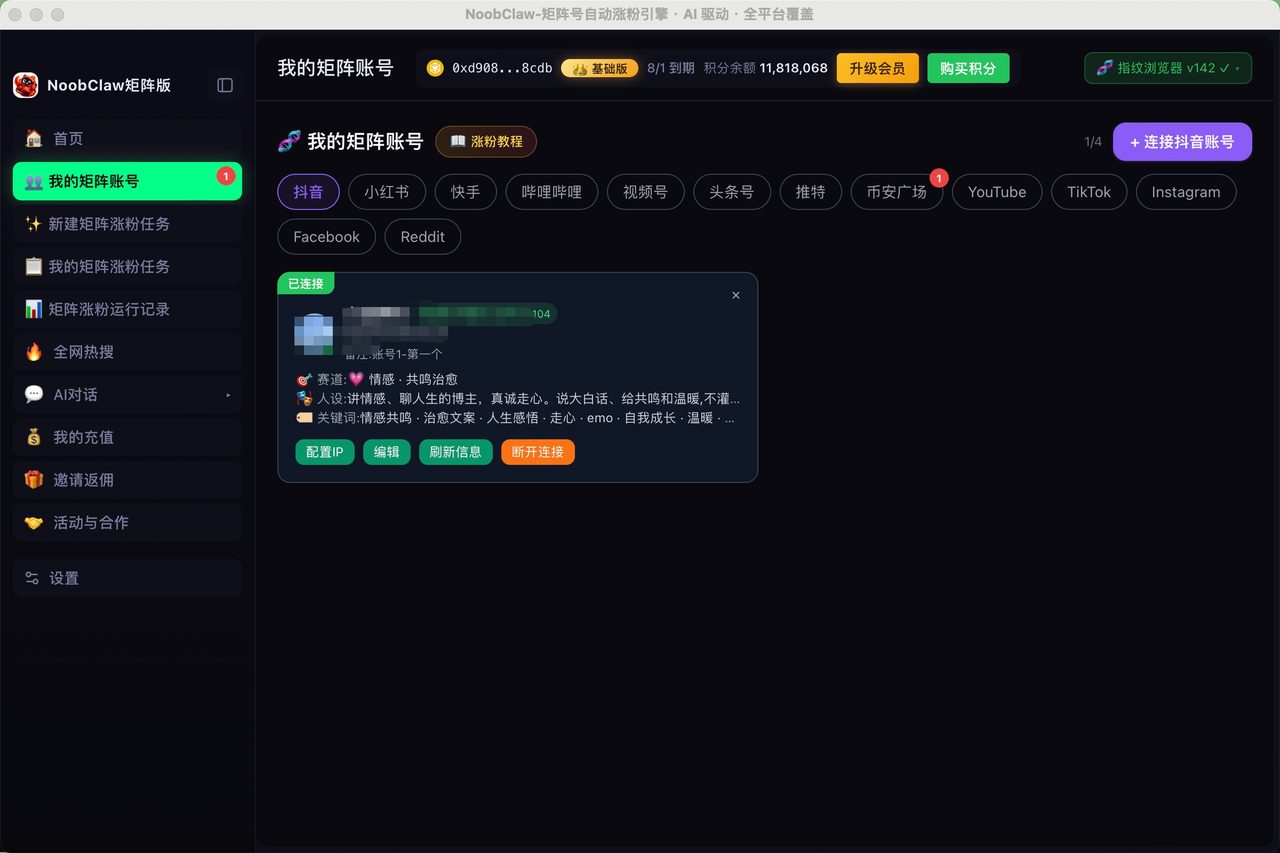
NoobClaw is in the fourth category. Accounts log in locally through fingerprint-isolated browser profiles — no passwords handed over — and each account generates its own content from its own niche, persona, and keywords rather than reusing one post. Actions run on randomized intervals rather than fixed schedules, and it covers publishing plus engagement plus replies rather than publishing alone.
What it does not do, and no tool in this category should claim: it does not decide what your accounts are about, it does not approve what goes out, and it does not carry responsibility if something breaks a rule. Those three stay with a person. That distinction is not marketing — it is increasingly the thing platforms are actually checking.
Questions to ask any vendor before paying
- Does this write, schedule, analyze, or act? If the answer is more than one, which one is actually mature?
- Do you need my password, or do I log in myself?
- If I connect five accounts, do they produce five different posts or one post five times?
- What happens when one platform fails mid-run — does the whole job stop?
- Is the pricing per seat, per account, per action, or per token? Model my real volume, not the headline tier. Four pricing shapes and where each one bites are in social media tool pricing models.
The pricing trap specific to this category
AI tools introduced a pricing shape the older scheduling category did not have: credits. Credits are consumed by generation, and generation is the thing you do most when the tool is working well. That produces a distinctive failure — the better the tool fits you, the faster you run out.
| Shape | Scales with | Where it bites |
|---|---|---|
| Per seat | Team size | Solo operators subsidizing multi-user design |
| Per channel / account | Number of accounts | Multi-account operators, steeply |
| Per post | Output volume | Predictable, until you scale output |
| Credits / tokens | How much you use it | Mid-month, right when it is working |
Before subscribing, model one real month: your account count times your posting frequency times any regeneration you would realistically do. Then check that against the tier, not the headline. Almost every plan in this category has a second ceiling behind the advertised one, and it is rarely the one in the comparison table.
Credit pricing punishes exactly the behavior that means the tool is working. Model your real month before you pick a tier, not the month you wish you had.
FAQ
Is a free AI social media manager good enough?
If your bottleneck is writing captions, yes — genuinely. Free tiers in the writing category are competent. They stop being enough the moment your problem becomes volume across multiple accounts, because writing was never the expensive part of that job.
Will using an AI social media manager get my account banned?
Platforms do not ban AI writing as such. What they act on is machine-like behavior and unoriginal output at scale — the full picture is in platforms do not ban AI writing. The risk lives in how a tool behaves, not in whether a model wrote the words.
Can one tool replace a human social media manager?
It can replace the repetitive execution — publishing, first-pass drafting, routine replies. It cannot replace the judgment calls: what the account is about, what does not go out, and who answers when something goes wrong. In 2026 those are also the parts platforms are increasingly checking for.
One thing to take with you: before you compare a single price, finish this sentence out loud — "the part of this job that takes my evenings is ______." Whatever fills that blank is the only category you should be shopping in.