
Buffer Gives Every Plan an API. Your Plan Decides How Far Your Agent Gets
- Buffer reportedly offers a GraphQL API plus a hosted MCP server at mcp.buffer.com/mcp, with first-party setup guides for Claude, Claude Code, ChatGPT, Cursor, Perplexity, Raycast, n8n and Zapier.
- API access is included on every plan, Free included — but your plan sets the request ceiling your agent runs into.
- The second, larger limit is rarely mentioned: the API can only do what Buffer does. Buffer schedules and publishes; it does not produce content or run engagement.
- Free is capped at 3 channels, a hard limit. For multi-account work that ceiling binds long before the request ceiling does.
"Connect Claude to your social scheduler" is a sentence that has launched a thousand tutorials this year. Almost none of them get to the second question, which is the one that actually decides whether the setup is useful: once it is connected, how much is it allowed to do?
Buffer is a good case study, because it is unusually open about the first half and quiet about the second.
What Buffer actually ships
Per third-party reviews — we did not verify this against buffer.com directly, so treat the specifics as second-hand — Buffer offers a GraphQL API and a hosted MCP server at <code>mcp.buffer.com/mcp</code>, with first-party setup guides for Claude and Claude Code, ChatGPT, Cursor, Perplexity, Raycast, n8n, and Zapier.
The genuinely notable part: API access is included on every plan, Free included. That is not the industry norm. Most tools in this category treat programmatic access as an enterprise upsell.
And then the qualifier, which is where the tutorials stop: your plan sets the request ceiling your AI agent runs into.
Everyone gets a door. What you pay for is how many times you are allowed to walk through it.
We covered the MCP server itself when it launched in what the Buffer MCP server can do. This piece is about the ceilings.
What a request ceiling actually constrains
Here is the thing people miscalculate: they estimate their ceiling by counting posts. Agents do not work that way.
A single "schedule this week's content" instruction from an LLM typically involves listing your connected channels, fetching the existing queue, checking for conflicts, creating each draft, and then reading back to confirm. That is a handful of requests per post, not one. And when something fails, the agent retries — which costs more.
So the practical questions are:
- How chatty is your agent? An LLM-driven workflow that reads state before every decision consumes far more than a deterministic script doing the same job.
- How often does it run? An agent checking every fifteen minutes for something to do burns its ceiling on finding nothing.
- Does it fail loudly? Hitting a rate limit mid-workflow, with a partial batch scheduled, is worse than not running — and this is exactly the failure mode that makes assembled automation fragile, as we found in the n8n limitations piece.
None of which is a knock on Buffer. Every API has a ceiling. The point is that "included on every plan" and "usable on every plan" are different claims, and only the first one appears in the marketing.
The limit that matters more than the rate limit
Suppose the rate limit is generous. There is a second ceiling that no upgrade lifts: the API can only expose what the product does.
Buffer schedules and publishes. That is its job and it does it well. So your agent, connected via MCP, can queue posts, manage the calendar, and read analytics. What it cannot do — because Buffer does not do it — is:
- Produce the content. Your LLM can write text, but video production, voiceover, subtitling, image generation are outside the loop.
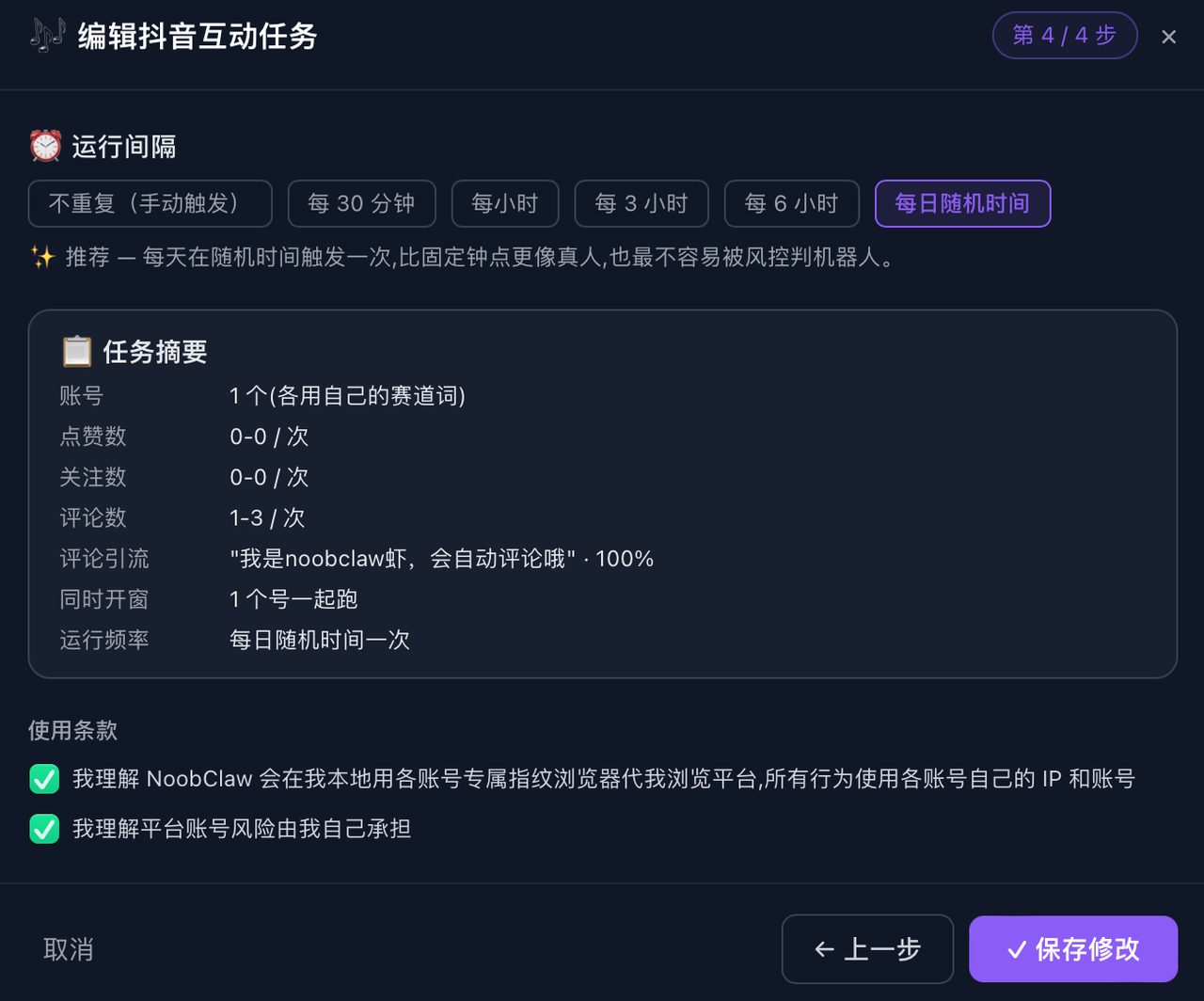
- Run engagement. Liking, following, commenting, replying to comments — none of that is in scope.
- Adapt per platform beyond formatting. The real cost of cross-posting is that each platform now ranks on a different primary signal, and that is an editorial problem no scheduling API solves.
This is the same conclusion we reached across the whole MCP category in the MCP server roundup: MCP fixed the connection problem. It did not touch the permission problem or the scope problem.
Worth saying plainly where we stand: NoobClaw covers a different part of this stack — content generation and engagement running locally in fingerprint browsers with your own logins — and that is a different shape of tool, not a strictly better one. If your content pipeline is already solved and you want an agent to handle scheduling, a scheduling API is exactly the right piece and you should not overbuy. The mistake is assuming that connecting an agent to a scheduler automates the whole job, when scheduling was the cheap part.
A related trap worth flagging: agents are much better at starting workflows than at knowing when to stop. A scheduling agent that cannot see its own remaining quota will happily burn through it on retries and status checks, then fail on the part you cared about. If you build this, put the limit somewhere the agent can read, and give it an explicit instruction about what to do when it is close — otherwise you have built something that works in testing and fails on your busiest week.
The ceiling most multi-account users hit first
One last number that binds earlier than any of the above: Free is capped at 3 channels, and it is a hard cap — connect a fourth and you are prompted to upgrade. Paid tiers are reported at roughly $5 per channel per month (Essentials) and $10 per channel per month (Team).
Per-channel pricing is linear, which means it is fine at 3 channels and structurally awkward at 20. If you are running a genuine multi-account operation, you will hit the channel ceiling long before you hit the request ceiling — the API conversation turns out to be a distraction from the pricing model. That is a pricing-model problem rather than an API problem, and no tier upgrade resolves it.
Zooming out, the reason this distinction matters beyond Buffer specifically: 2026 was the year connecting an AI agent to a social tool became trivially easy, and the discourse has not caught up to what that did and did not solve. Connection is now a solved problem across most of the category. What remains unsolved — and what no MCP server addresses — is that the agent inherits every limit the underlying product has, plus every limit the social platforms impose on whatever it does. Two ceilings, neither of them lifted by the integration. The useful question to ask about any "connect your AI" announcement is therefore not "can it connect" but "what could this product do before, and is that the part I actually needed?"
FAQ
What are Buffer's actual rate limits per tier?
We could not find published per-tier numbers in the sources we checked, only the general statement that your plan sets the ceiling. Check Buffer's developer documentation for current figures rather than trusting any third-party summary, this one included.
Is a hosted MCP server better than building my own integration?
For most people, yes — a hosted server means no infrastructure, no OAuth handling, and no maintenance when the API changes. The tradeoff is that you are bounded by what the vendor exposes. Build your own only when you need something their server does not expose and you are prepared to maintain it.
Does having an API mean the automation is compliant?
No, and this conflation is common enough to be dangerous. A vendor API means that vendor permits the access. The social platforms have their own rules about automated behavior, and those apply to whatever ultimately posts on your behalf. See what actually gets AI agents banned — the short version is that platforms care about social actions and frequency, not about which API you routed through.