
What It Costs to Post to 100 Social Accounts in 2026, Priced Four Different Ways
- At exactly 100 accounts the same job costs $99, $318 or considerably more, depending on whether the vendor meters accounts, tiers or credits.
- Post Bridge Pro is $99 for unlimited accounts; Zernio is $318 at 100; tier-based tools mostly do not reach 100 at all.
- Software is rarely the largest line at this scale — IP addresses and content production usually are.
- The hard constraint is not price, it is that 100 accounts posting similar content is a detection problem no subscription solves.
A hundred accounts is where pricing pages stop being comparable and start being a maze. Half the tools in this category do not have a tier that reaches it. The ones that do disagree by a factor of ten.
So we priced it directly, first-hand, on 14 September 2026, at exactly 100 connected accounts.
The four meters at 100 accounts
| Vendor | Meter | Cost at 100 accounts | Per account |
|---|---|---|---|
| Post Bridge Pro | Tier, top tier unlimited | $99 | $0.99 |
| Zernio | Per account, banded | $318 (2 free, 8 at $6, 90 at $3) | $3.18 |
| Postiz | Tier, max 30 channels | Not offered self-serve | n/a |
| Blotato | Credits plus accounts | Agency $499, account count not stated | $4.99 if it reaches 100 |
The spread is the finding. Same job, $99 to $499, and two of the four best-known tools in the category cannot do it at all without a sales conversation.
At ten accounts the meter is a detail. At a hundred the meter is the entire bill, and the brand you preferred at ten may not have a row for you at all.
Why tier tools stop and meter tools keep going
This follows a rule that finally became clear this month after pricing thirteen vendors.
Tools that sell tiers do not give volume discounts. Tools that meter per unit do. SocialPilot rises from $4 to $5 per account as you climb. Loomly rises every tier. Plann is a flat $12.50 per brand at all three levels. Tailwind is not even monotonic.
Against that, Zernio runs $6, then $3, then $1 above 100 accounts, and Post Bridge runs $5.80, $2.60, $1.18, then unlimited. Both get dramatically cheaper as you scale, because the pricing object is a unit rather than a package.
The practical consequence for anyone planning past 50 accounts: filter the market by meter shape before you compare features. A tier-based tool will either not reach you or will price you as an enterprise, and you will have spent a week evaluating something you cannot buy.
The lines that are bigger than software
At this scale the subscription is often not the largest number on the page, and budgeting only for software is how people get surprised in month two.
- IP addresses. If accounts need to be isolated from each other, that is a hundred addresses of some quality. Residential and mobile proxies price per address or per gigabyte, and this line frequently exceeds the software line several times over.
- Content. A hundred accounts posting once a day is 3,000 pieces a month. If they post the same piece, see the next section. If they post different pieces, this is the real cost centre and it dwarfs everything else.
- Account acquisition and recovery. Phone verification, email infrastructure, and the steady attrition of accounts that get locked. Nobody budgets for this and everybody pays it.
- Someone to watch it. A hundred accounts generates enough small failures daily that unattended is not a real operating mode.
We worked the equivalent arithmetic for a smaller matrix in the cheapest scheduler measured per account, and the ratio holds: the more accounts, the smaller a share the software becomes.
The constraint no subscription removes
Here is the part that decides whether the whole operation works, and it is not on any pricing page.
A hundred accounts posting the same content, from similar IP ranges, on similar schedules, is a pattern. Platforms are extremely good at patterns — that is essentially the entire job of their integrity systems. The cheapest way to lose a hundred accounts is to make them easy to group.
Which means the meaningful spend at this scale is not on distribution at all. It is on difference: different content per account, different posting rhythms, different device identities, different networks. Distribution is the cheap part, and every tool priced above compares on the cheap part because it is the part that is easy to price.
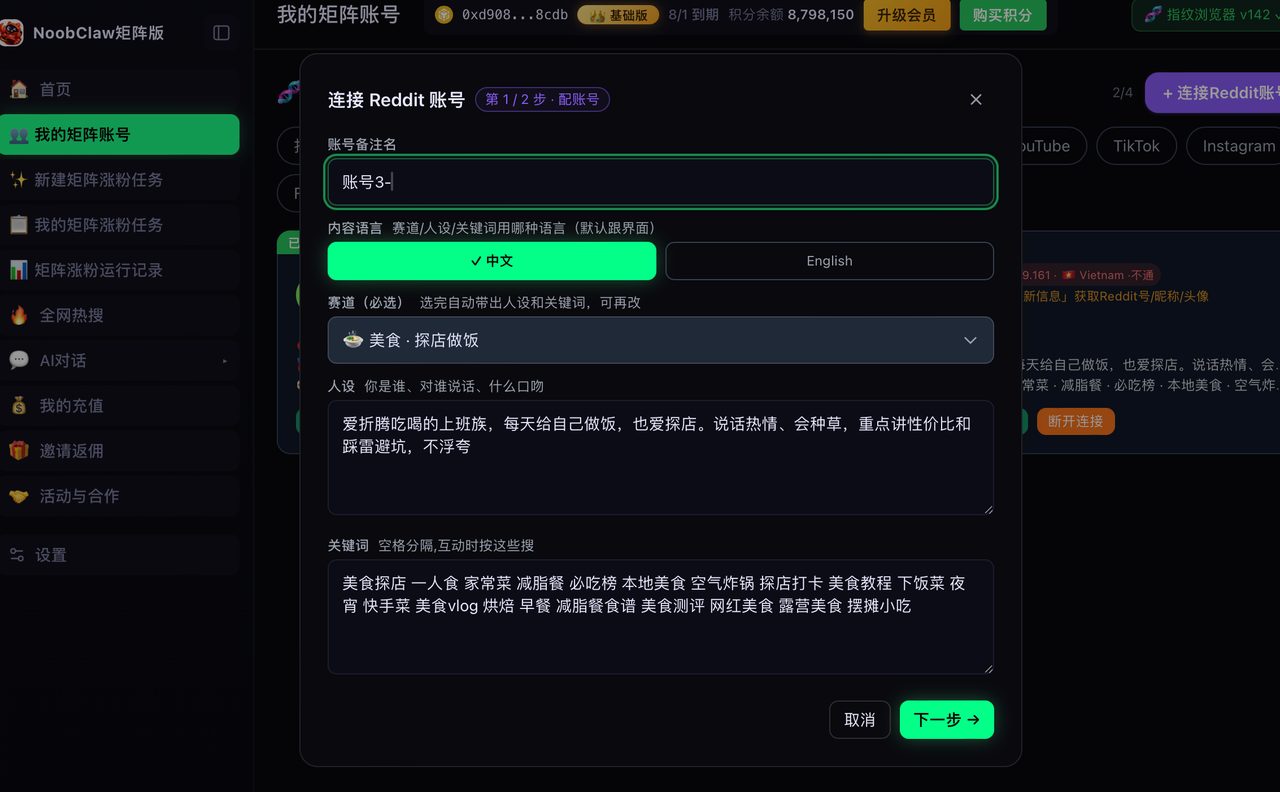
That is the gap our own product sits in — each account with its own niche, persona and keywords generating content that differs by account rather than being syndicated, one fingerprint browser profile per account on the operator machine, randomised intervals rather than fixed clock times. It is a production and identity architecture rather than a cheaper scheduler, which is a different purchase from anything in the table above. Background on the identity half in what an antidetect browser actually solves.
And whichever route you take, the platform caps still apply: TikTok limits unaudited API clients to five posting users per day, Instagram to 100 API posts per rolling day, Threads to 250. Details in the five-user ceiling.
The staged build that does not waste money
Almost nobody should go from zero to a hundred accounts. The ones who do it successfully almost always did it in stages, and each stage answered a question before the next one was funded.
| Stage | Accounts | Question it answers |
|---|---|---|
| 1 | 2 to 3 | Does this niche and content format get any traction at all? Free tiers cover this entirely |
| 2 | 8 to 12 | Can the accounts be told apart, and does the content hold up when it has to be different each time? |
| 3 | 30 to 50 | Does the identity and network setup survive scale, and what is the real attrition rate? |
| 4 | 100+ | Purely an economics question by this point. Everything else was answered earlier |
Stage two is where most operations actually fail, and it fails for a reason that is worth stating plainly: at three accounts you can write three different things without noticing the effort. At twelve you cannot, so you start duplicating. The duplication is not a discipline failure, it is an arithmetic one — and it is exactly the point at which the accounts become groupable.
Which means the thing to test at stage two is not whether the tooling works. It is whether you have a repeatable way of producing genuinely different content per account. If the answer is no, stage three converts a content problem into a hundred-account content problem and adds a proxy bill on top.
Scaling does not fix a sameness problem. It buys more copies of it, and pays rent on each one.
The cheapest possible version of this test costs nothing: run eight accounts for a month, then look at them side by side as a stranger would. If you cannot tell which is which without reading the handle, do not fund stage three yet.
FAQ
Is $99 for unlimited accounts real?
It is the published Post Bridge Pro wording as of 14 September 2026 and the only such tier we track. Confirm in writing before migrating a hundred accounts to it, because it is unusual enough to be worth a support ticket.
Do I need a separate IP per account?
Not always, but sharing one address across a hundred accounts in the same niche is the single clearest grouping signal you can produce. Whatever you spend here, spend it on stability rather than quantity — an address that changes is worse than one that is shared.
Can one person run 100 accounts?
Mechanically yes, with the right tooling. Editorially, that is 3,000 pieces of content a month, and content is the binding constraint long before scheduling is.