Douyin vs TikTok for Marketing: Platform and Content Rules
- Same company, two apps: ByteDance calls TikTok "available outside of China" and lists Douyin as "specific to the China market". Accounts and content do not cross over.
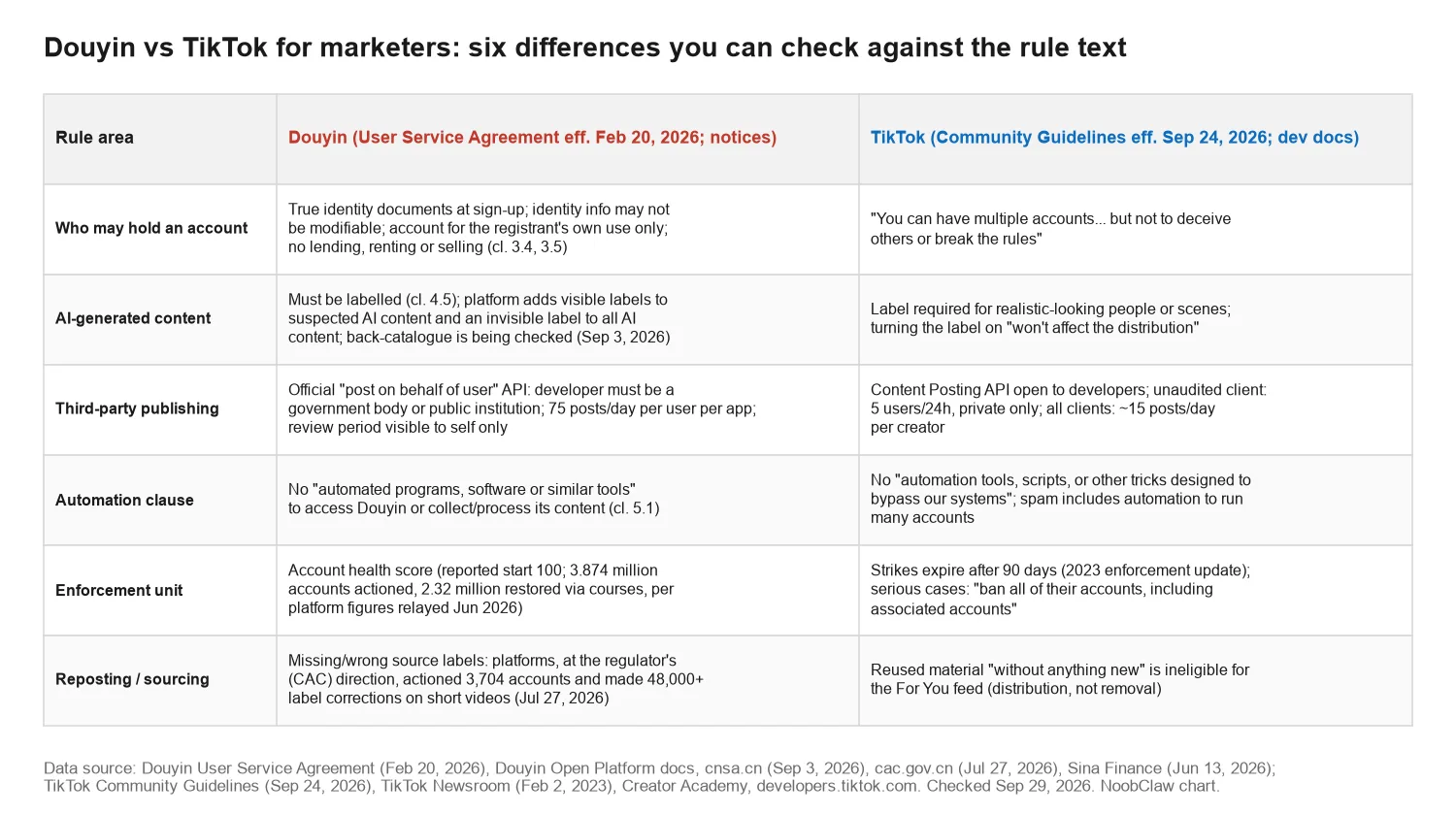
- Identity: Douyin requires true identity documents and limits an account to its registrant's own use; TikTok says "You can have multiple accounts" but bans tricks "designed to bypass our systems".
- Tools: Douyin's post-on-behalf API is only for government bodies and public institutions (75 posts per user per day in any one app); TikTok's unaudited API clients get 5 users a day, private only.
- Douyin adds AI labels itself and the regulator names accounts that repost without a source; TikTok asks you to label realistic AI content, expires strikes after 90 days, and demotes reused material.
Douyin and TikTok have the same owner and are not the same app. ByteDance's corporate page says it launched Douyin in September 2016 and, "approximately a year later", launched "its global short video product, TikTok"; it describes TikTok as "available outside of China" and lists Douyin among "products and services specific to the China market" (ByteDance). TikTok said in 2019 that it "does not operate in China, nor do we have any intention of doing so in the future" (TikTok Newsroom, October 24, 2019). Accounts, posts and followers do not cross over.
For a marketer the question underneath "Douyin vs TikTok" is whether one setup can serve both. Our answer is no, and not because of the algorithm, which neither publishes. It is six readable rules: who may hold an account, how AI content is labelled, whether a tool may post for you, what the automation clause says, what unit enforcement counts in, and how reposting is judged. We read the Douyin User Service Agreement (effective February 20, 2026) and TikTok's Community Guidelines (effective September 24, 2026) on September 29, 2026. Douyin's clauses are given in our translation with clause numbers, and the Chinese text prevails; TikTok's are quoted verbatim.
This article stays on rules and tools. The engagement signal that trips cross-border accounts is in Douyin vs TikTok: the one difference; the Chinese-language walkthrough of Douyin's publishing API and who qualifies for it is 抖音 API 能发布视频吗.
Who is allowed to hold an account on Douyin and on TikTok?
Douyin's agreement, clause 3.4, says the account is for the registrant's own use and may not be given away, lent, rented, transferred or sold; clause 3.5 requires true and valid identity documents at registration and warns that the user may be unable to change initial registration information, real-name information and other verification information. Clause 16.1 applies the law of the People's Republic of China and clause 16.2 sends disputes to the courts of Beijing's Haidian District.
TikTok's Integrity chapter starts from the other end: "You can have multiple accounts—for example, for fan content or creative expression—but not to deceive others or break the rules." The limits follow at once: "We strictly prohibit automation tools, scripts, or other tricks designed to bypass our systems", and, since September 24, 2026, "we may ban all of their accounts, including associated accounts" for serious violations or dodging enforcement (Integrity and Authenticity).
On Douyin every account is registered with true identity documents and may be used only by its registrant; the agreement does not say how many accounts one identity may hold. On TikTok several accounts are allowed on their face, and the risk is written as association between them, not the count.
Can a third-party tool post for you?
Douyin's Open Platform does have a "post content on behalf of the user" capability. Its capability page says it is available only to website applications, only for government or media organisations' internal media platforms, and that the developer entity must be a party or government organ or a public institution; the usage rules forbid homogeneous content, defined as a similar video posted repeatedly on one account or to multiple accounts (Douyin Open Platform, our translation). The API reference adds that a created video is visible only to the poster during review, and error code 2114007 caps one user at 75 posts per day per application (create-video reference). For a brand or an agency there is no official API that posts on its behalf; the official hand-off opens Douyin's own publisher for the user to post. Clause 5.1 of the user agreement prohibits automated programs, software or similar tools that access Douyin or collect or process its content.
TikTok's path is open and gated. Any registered developer can use the Content Posting API, but "Unaudited API Clients can allow up to 5 users to post in a 24 hour window. All user accounts using the API client to post must be set to private at the time of posting", and all clients face a cap "typically around 15 posts per day/ creator account" shared across all API clients (Content Sharing Guidelines, last updated August 4, 2026). The intended-use rules on the same page list "An app that copies arbitrary contents from other platforms to TikTok" as unacceptable.
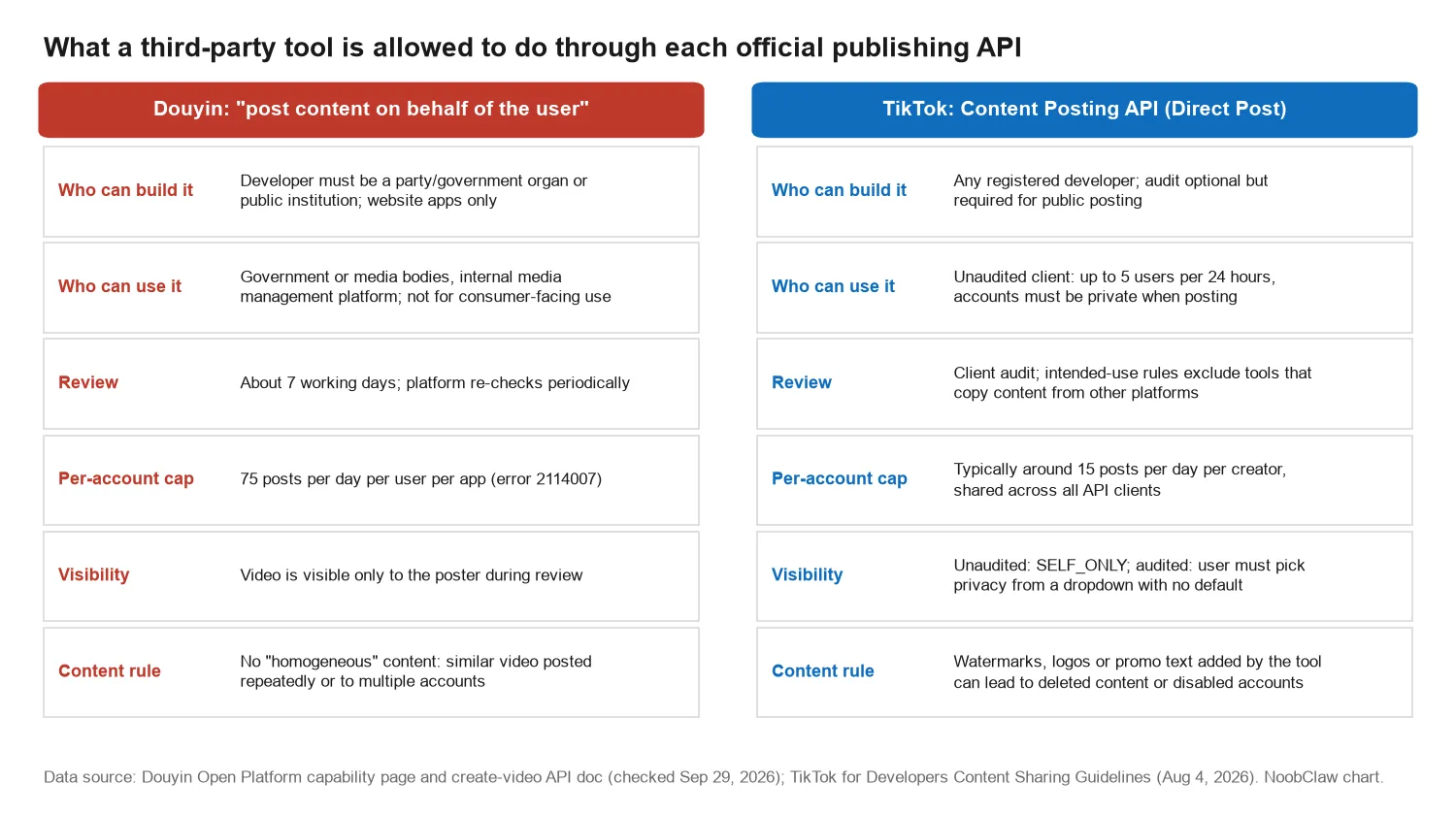
On TikTok the official door for tools is narrow. On Douyin, for a business, there is no official door that posts for you.
How does each platform treat AI-generated content?
Douyin's agreement, clause 4.5, requires content made with deep learning, virtual reality or generative AI that shows non-real audio or video, or could confuse the public, to be labelled prominently. The platform then does the rest itself. Its September 3, 2026 notice on the first year of China's AI labelling measures says a May 2026 Douyin specification requires the "content generated by AI" label whether the content came from the platform's own AI effects or from third-party tools; that Douyin adds a visible label to suspected AI content; that it adds or updates an invisible label on all AI content posted to Douyin; and that it is reviewing the back catalogue (Douyin notice via cnsa.cn, our translation).
TikTok's rule is narrower and the consequence is stated: "You must label content that uses AI or includes significant edits to show realistic-looking people or scenes", and its Creator Academy says "Turning on the AI-generated content setting won't affect the distribution of your video as long as it doesn't violate our Community Guidelines" (Creator Academy, updated September 26, 2026). TikTok also labels at scale, "over 3 billion videos" (TikTok Newsroom, July 10, 2026). Which Douyin caption patterns cross the line is in AI-written Douyin captions.
What unit does enforcement count in, and how is reposting judged?
Douyin scores the account. Its account health score, launched with the 2025 rules against "malicious marketing accounts", starts at 100 according to a Xinhua commentary on the launch (Xinhua, April 29, 2025); by June 2026, under the malicious-marketing rules and the health score, Douyin said it had actioned 3.874 million accounts, of which 2.32 million recovered points through compliance courses and tests (Sina Finance, June 13, 2026, platform figures as reported). Above the platform sits the regulator. On July 27, 2026 the Cyberspace Administration of China reported that platforms, at the regulator's direction, actioned 3,704 accounts and made more than 48,000 corrections to missing or wrong source labels on short videos, and named a Douyin account among those that directly reposted or simply compiled international news without stating the source (CAC notice, our translation). On September 2, 2026 its AI-abuse cases included Douyin accounts that drove traffic to AI "hosting" software, simulating real people running accounts and interacting in comments and generating large volumes of low-quality, homogeneous copy (CAC notice).
TikTok counts strikes and then accounts. A removed video adds a strike, thresholds are set per feature or per policy, and "Strikes will expire from an account's record after 90 days" (TikTok Newsroom, February 2, 2023). Reposting is judged by distribution rather than removal: "Content is also ineligible for the FYF if it includes unoriginal or reused material without anything new." Accounts that post "a lot of content that's ineligible for the FYF" may themselves be made ineligible and "harder to find" (Accounts and Features), and the spam list names "Using automation to run many accounts or send repetitive content". What that and the associated-accounts sentence mean for a set of TikTok accounts is in the associated accounts clause; which tools the rules name is in TikTok automation bot rules.
What does this mean for your setup?
Three things have to be built separately.
- Accounts. A Douyin account is registered with true identity documents, used only by its registrant, under an agreement governed by Chinese law; a TikTok account is one of several a person may hold, judged by what the accounts do and whether they are associated.
- Content. Douyin's API rules (for users of its one posting API) forbid a similar video posted to multiple accounts, and its platform adds AI labels you did not add. TikTok demotes reused material and asks you to label realistic AI content yourself.
- Tools. On Douyin there is no official API that posts on a business's behalf, and clause 5.1 bars automated tools. On TikTok the API exists, gated by the audit and the per-creator cap. A vendor promising "one click to both" is describing something at least one platform has no door for.
Where the two are alike is the judgment they keep for themselves: what counts as "designed to bypass our systems" on TikTok, and what counts as a tool interfering with normal operation on Douyin, is decided by the platform, not the vendor's brochure.
For operators who run both, NoobClaw is one desktop tool that treats them as two platforms: it publishes video and runs engagement on Douyin and on TikTok from your own logged-in browser, adds image-text posts and fan replies on Douyin, generates each account's content from its own niche and persona, and never asks for the account password. It changes neither rulebook, and offers a local-only mode so posts can be reviewed before publishing.
FAQ
Are Douyin and TikTok the same company?
Yes, both are ByteDance products, but they are separate apps with separate accounts and separate rules; TikTok has said it does not operate in China.
Can I post the same video on Douyin and on TikTok?
You can upload your own video to both. On Douyin, AI content must carry the label and reposted news needs a stated source; on TikTok, reused material "without anything new" is ineligible for the For You feed and realistic AI content needs your label. Someone else's watermark is a problem on both.
Is Douyin available outside China?
ByteDance lists Douyin among products "specific to the China market", and its user agreement is governed by Chinese law with disputes heard in Beijing.
Sources
- About ByteDance — ByteDance — checked September 29, 2026 — https://www.bytedance.com/en/
- Statement on TikTok's content moderation and data security practices — TikTok Newsroom — October 24, 2019 — https://newsroom.tiktok.com/en-us/statement-on-tiktoks-content-moderation-and-data-security-practices
- 抖音用户服务协议 (Douyin User Service Agreement) — Douyin — effective February 20, 2026 — https://sf3-cdn-tos.douyinstatic.com/obj/ies-hotsoon-draft/douyin_agreement/agreements.html
- 代替用户发布内容到抖音 (capability page) — Douyin Open Platform — checked September 29, 2026 — https://developer.open-douyin.com/capacity-center-page/capacity-detail/7224121299067469881
- 创建视频 (create video, API reference) — Douyin Open Platform — checked September 29, 2026 — https://developer.open-douyin.com/docs/resource/zh-CN/dop/develop/openapi/video-management/douyin/create-video/video-create
- 抖音关于落实《人工智能生成合成内容标识办法》一周年工作成效的公告 — Douyin via cnsa.cn — September 3, 2026 — http://www.cnsa.cn/art/2026/9/3/art_1957_49264.html
- 网信部门严管"自媒体"未规范标注信息来源行为 — Cyberspace Administration of China — July 27, 2026 — https://www.cac.gov.cn/2026-07/27/c_1786897886145841.htm
- "清朗·整治AI技术滥用"专项行动典型案例 — Cyberspace Administration of China — September 2, 2026 — https://www.cac.gov.cn/2026-09/02/c_1790099041364574.htm
- 抖音账号健康分上线 — Xinhua — April 29, 2025 — http://www.news.cn/tech/20250429/231eae948cfd496d86b76ef41ed838b1/c.html
- 抖音披露账号健康分治理成效 — Sina Finance — June 13, 2026 — http://finance.sina.com.cn/wm/2026-06-13/doc-inichhas8252537.shtml
- Community Guidelines: Integrity and Authenticity — TikTok — effective September 24, 2026 — https://www.tiktok.com/safety/en/policies-and-engagement/integrity-authenticity
- Community Guidelines: Accounts and Features — TikTok — effective September 24, 2026 — https://www.tiktok.com/safety/en/policies-and-engagement/accounts-features
- Content Sharing Guidelines — TikTok for Developers — last updated August 4, 2026 — https://developers.tiktok.com/doc/content-sharing-guidelines
- AI-generated content label — TikTok Creator Academy — last updated September 26, 2026 — https://www.tiktok.com/creator-academy/en/article/ai-generated-content-label
- Helping people spot and understand AI generated content on TikTok — TikTok Newsroom — July 10, 2026 — https://newsroom.tiktok.com/helping-people-spot-and-understand-aigc-on-tiktok?lang=en-150
- Supporting creators with an updated account enforcement system — TikTok Newsroom — February 2, 2023 — https://newsroom.tiktok.com/en-us/supporting-creators-with-an-updated-account-enforcement-system