
Free SEO Tools for TikTok: The Best One Is Inside the App, and It Answers a Different Question Than You Think
- No third-party tool has TikTok search volume. What they show you is derived from scraped results and autocomplete, which is a proxy, not a metric.
- The strongest free sources are first-party: in-app search suggestions, the Creative Center, and your own analytics search-term data.
- Autocomplete is the cheapest real signal you can get, and it is free on every platform — including the one that tells you a term is dead.
- The step where a tool genuinely helps is not finding keywords. It is producing enough distinct content to test them.
Search free tools tiktok and Google will finish the phrase for you in several directions: likes, followers, editing, ai, and — increasingly — seo. That last branch is the interesting one, because it is the only one where the free option is genuinely better than most paid ones.
It is also the branch where the marketing is furthest from the mechanism.
First, the uncomfortable part: nobody has the volume numbers
Every SEO habit people bring from Google assumes one thing — that somewhere there is a number telling you how many people search a term per month. On Google, that number exists because Google publishes it to advertisers.
TikTok does not publish per-keyword organic search volume to creators. So when a free tool shows you "Search volume: 18,400" for a TikTok phrase, that number is derived. Usually from some combination of autocomplete ordering, how many results come back, and how the tool's own model weights those.
That is not fraud. Derived signals can be useful. But it changes how you should read them:
Treat every TikTok keyword number as an ordinal, not a cardinal. "This term is bigger than that term" is a claim the data can support. "This term gets 18,400 searches" is not.
Once you stop looking for a number that does not exist, the free sources get a lot more attractive.
The free sources that are actually first-party
1. In-app search suggestions
Type a partial phrase into TikTok's own search bar and read what it completes to. This is the platform telling you, in its own voice, what people type. It costs nothing, requires no login beyond your own, and it is not a model's estimate of anything.
Read it the way you would read Google autocomplete, with one extra move: look at what the suggestions are made of. If a term's suggestions are dominated by tool names ("... downloader", "... viewer", "... free"), that usually means people are looking for a capability the platform does not provide — and a market has grown to sell it to them. That is a content opportunity and a warning at the same time.
2. TikTok Creative Center
TikTok's own free research surface shows trending hashtags, sounds, and creatives. The important caveat is one people constantly miss: its output pipe points at advertising, not at your profile. Trends there are trends among ads and commercial content, which is not always the same population as organic search.
3. Your own analytics search-term data
The single most underused free source. Your own account's analytics tell you what people searched before they landed on your video. That is not a proxy — it is the actual behaviour of the actual audience you have. Ten rows of this beat a thousand rows of anyone's estimated volume.
What the free third-party tools are good for
Having said all that, the free tier of a third-party tool does two things the first-party sources do not:
- It puts many suggestions on one screen. Manually typing 40 prefixes into the app is tedious; a tool doing it for you is a real convenience. You are paying for aggregation, not intelligence.
- It shows you competitor coverage. Which accounts already rank for a phrase is observable data, and useful.
What they are not good for: telling you whether a term is worth doing. That judgement needs something none of them have — knowledge of what you can actually produce.
The real bottleneck, measured
Here is a test worth running before you install anything. For one week, write down two numbers:
- How many keyword ideas did you collect?
- How many of them did you turn into a published video?
If the ratio is under 20%, your constraint is production, not research. A better keyword tool will widen the top of a funnel that is already blocked further down — you will end up with a longer list and the same output.
This is the same shape we keep finding elsewhere: the tool that fixes "I do not know what to make" is a different category from the tool that fixes "I cannot make enough." Most people buy the first when they need the second.
A cheap check that tells you a term is dead
One more free technique, because it costs a single request and saves whole afternoons.
When you are considering a topic, read its autocomplete family and ask what the suggestions are made of. Three patterns worth recognising:
- Tool-shaped words dominate (viewer, downloader, free, without account) → the platform probably does not provide this capability, and a market grew to sell workarounds. Write about what those tools actually do, not about "how to do X" — because X does not exist.
- Multiple conflicting numbers appear (stuck at 100 / 200 / 500 / 1000) → that threshold is not a real specification. A genuine platform limit has exactly one value. Several competing integers mean people are reporting where they personally stalled.
- The family returns nothing at all → the need may still exist, but under a different phrase. Go find the phrase people actually use before concluding there is no demand.
All three are answerable with one autocomplete request and no tool subscription. That is a better return than any keyword volume estimate you can buy for this platform.
A note on the "free tools" neighbourhood
The free tools tiktok family sits next to some ugly neighbours — free tools tiktok likes, free tiktok tools followers. Those are a different product entirely: engagement purchase, dressed as utility.
The practical filter is blunt. Anything free that asks you to log in with your TikTok credentials is not a tool; it is a credential harvester. Keyword research never needs your password. Neither does a hashtag generator, an engagement calculator, or a downloader. If the login box appears, close the tab.
We went through what each category of "free TikTok tool" actually does to an account in this piece, and the free AI branch in this one.
Where a tool earns money in this workflow
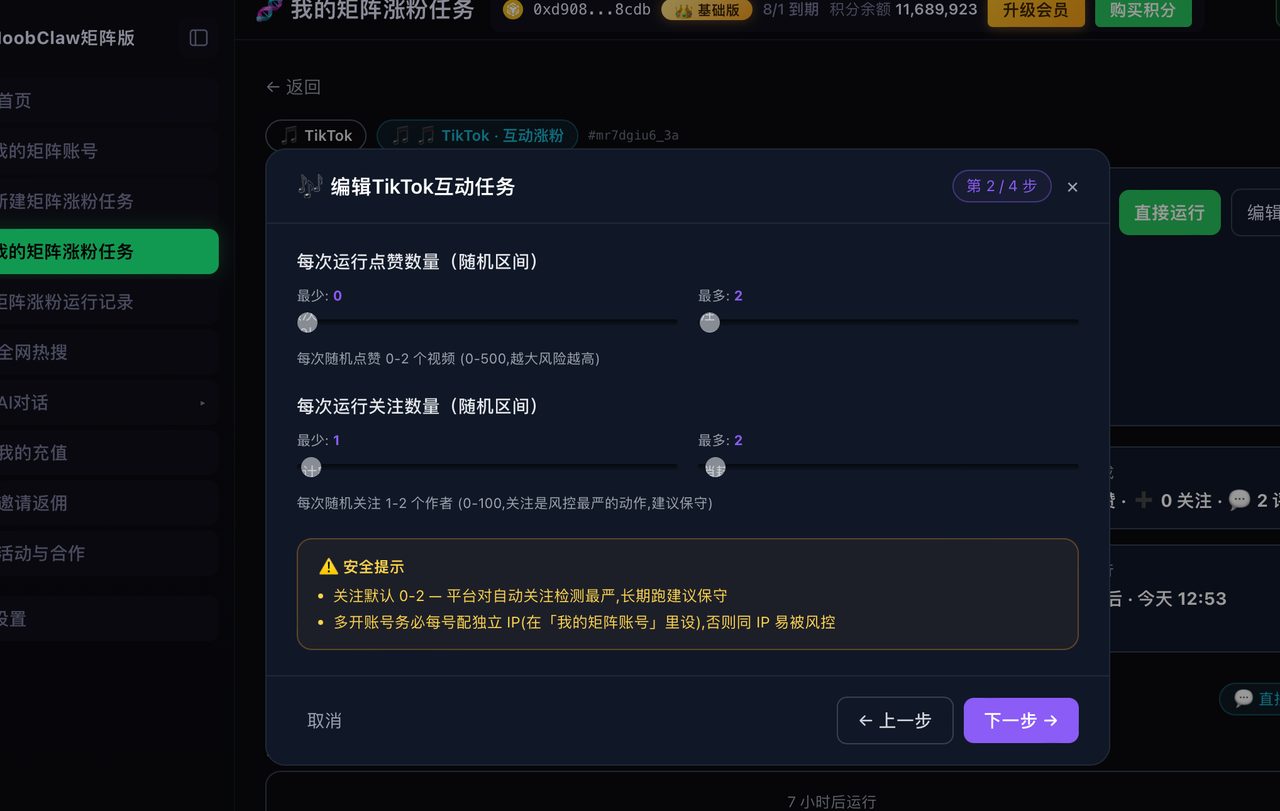
If research is free and production is the bottleneck, the honest place for paid tooling is the production side: turning one researched topic into enough distinct videos to actually test it.
That is the problem NoobClaw is built around — several engines that take a topic to a finished vertical video (stock footage plus AI script and voiceover, trending-topic pieces that pull source material before writing, template motion graphics, local footage remixes), with each account generating from its own niche and persona so the outputs are not copies of each other. Whether that is worth paying for depends entirely on that ratio you measured above. If your ratio is already above 50%, you do not need it.
FAQ
Does TikTok SEO actually work?
Search is a real surface inside TikTok and videos do get discovered through it, so optimising for it is not imaginary. What does not transfer from Google is the precision: no volume numbers, no rank tracking in any reliable sense, and no official documentation of ranking factors. Plan it as "make the topic legible in the text, caption and on-screen words" rather than as a technical exercise.
Which free tool gives the most accurate search volume?
None of them, because the underlying number is not published. The tools differ in how they estimate, not in how accurately they read something. If you need a defensible number for a report, use your own analytics search-term data — it is small, but it is real.
Is the Creative Center useful for organic creators?
Partly. It is free, first-party, and good for spotting sounds and formats early. Just remember its population skews commercial, and its natural next step is Ads Manager rather than your profile. Use it for trend awareness, not for deciding what your organic audience searches.