
Free TikTok Bots: What You Actually Get, and What It Quietly Costs
- Four categories hide behind the same phrase: engagement sellers, credentialed cloud tools, browser scripts, and local automation of your own account.
- Purchased likes and follows aren't just against the rules — they corrupt the signal the recommender uses to decide who to show you to.
- 'Free' usually means you pay in credentials, in a shared IP reputation, or in being the product. Ask what's being monetised before you connect anything.
- The only durable version is automating actions you'd take yourself, in your own session, with human-shaped variance — and it grows nothing on its own.
You searched "free TikTok bot." Somewhere behind that query is a real and reasonable problem: you're doing the same twenty minutes of manual work every day and you suspect a machine should be doing it.
That instinct is fine. The category you've landed in is not one category, though — it's four, and they have almost nothing in common except the word.
The four things called "TikTok bot"
- 1. Engagement sellers. You pay (or don't) and likes, views or followers appear. The delivery mechanism is other people's compromised or farmed accounts.
- 2. Credentialed cloud tools. You hand over your login, and a server somewhere acts as you. The automation is real; so is the fact that your credentials now live on someone else's machine.
- 3. Browser scripts and extensions. Code running inside your own browser that clicks things. Quality ranges from thoughtful to actively malicious, and you usually can't tell which by reading the listing.
- 4. Local automation of your own account. Software on your own machine, driving your own logged-in browser session, performing actions you would otherwise perform by hand.
These sit at wildly different points on the risk curve, and lumping them together is exactly why the advice on this topic is so bad. Only the fourth is defensible, and even it has real limits.
The question isn't "is automation allowed." It's "is a real person's genuine action being carried out, or is a signal being manufactured?"
Why bought engagement is worse than "against the rules"
Everyone knows purchased engagement violates platform policy. The more useful argument is what it does to your distribution even when nobody enforces anything.
Recommendation systems work by finding the audience your content resonates with, then showing it to more people like them. To do that, they need your engagement signal to describe a real audience. Purchased engagement replaces that with noise: accounts with no coherent interests, in the wrong regions, engaging in patterns no human produces.
The result is quietly disastrous. You've taught the system to show your content to people who will never care. Your visible numbers go up and your actual reach into a real audience goes down, and — worst of all — you've destroyed your own ability to tell whether your content is any good. That's the mechanism spelled out in is buying followers bad.
Platforms have also moved this judgement up a level. TikTok's treatment of mass-produced, templated AI content now operates at the account level, which means deleting the offending posts does not remove the classification — see TikTok's account-level AI judgement. The same structural logic applies to inauthentic engagement: the label describes the account's behaviour, not one post.
Why the free ones are free
Four business models, none of them charity:
- You're the inventory. Free engagement services usually run on exchange — your account performs actions for strangers in return for actions on yours. You're not a customer, you're a node.
- Credentials are the product. A session token for an account with an audience has resale value. "Free" tools that require a login are the highest-risk shape in this whole category.
- It's a funnel. The free tier is deliberately just useful enough to hurt — heavily rate-limited, or missing the one feature that makes it safe.
- Shared infrastructure. Free cloud tools route thousands of users through the same address ranges. You inherit the reputation of everyone else using it, and you can't see who they are.
What defensible automation looks like
The line that survives scrutiny is this: automate the actions you would genuinely take, in your own session, at a rhythm a person could plausibly produce. Concretely that means:
- Your own login, on your own machine. No credential handover. If a tool needs your password on their server, that's a different risk category entirely — the trade-offs are laid out in API versus browser automation.
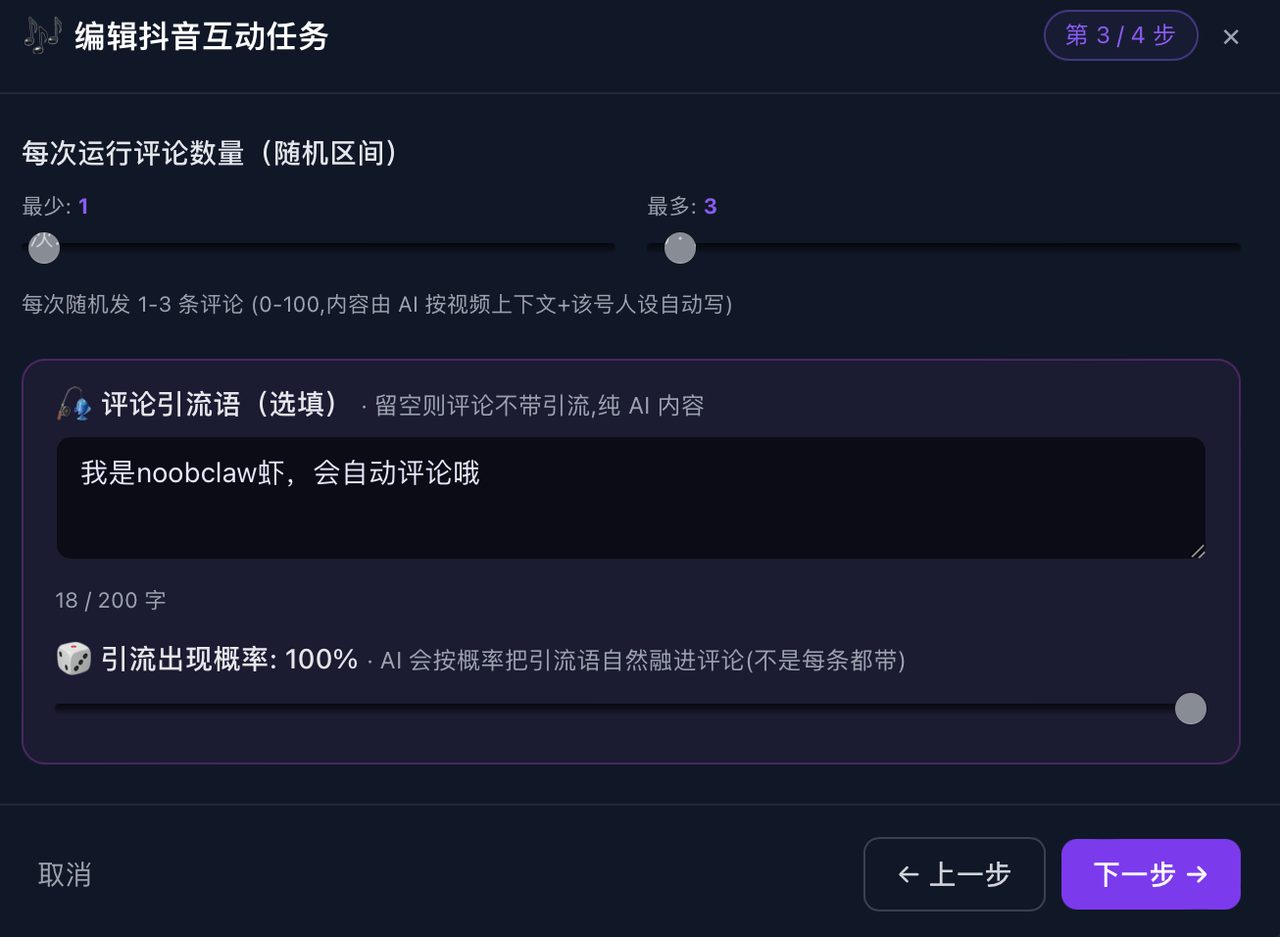
- Ranges instead of quotas. "Between three and eight likes, at intervals that vary" produces a plausible session. "Exactly 50 likes every hour" produces a signature.
- Content that isn't produced by the same process across accounts. Automation multiplies whatever you feed it; if you feed it one video and five accounts, it multiplies the problem.
- Actions that reflect real judgement. A comment generated from the video's actual content and your account's actual persona is a different object from a rotating list of "🔥 great post."
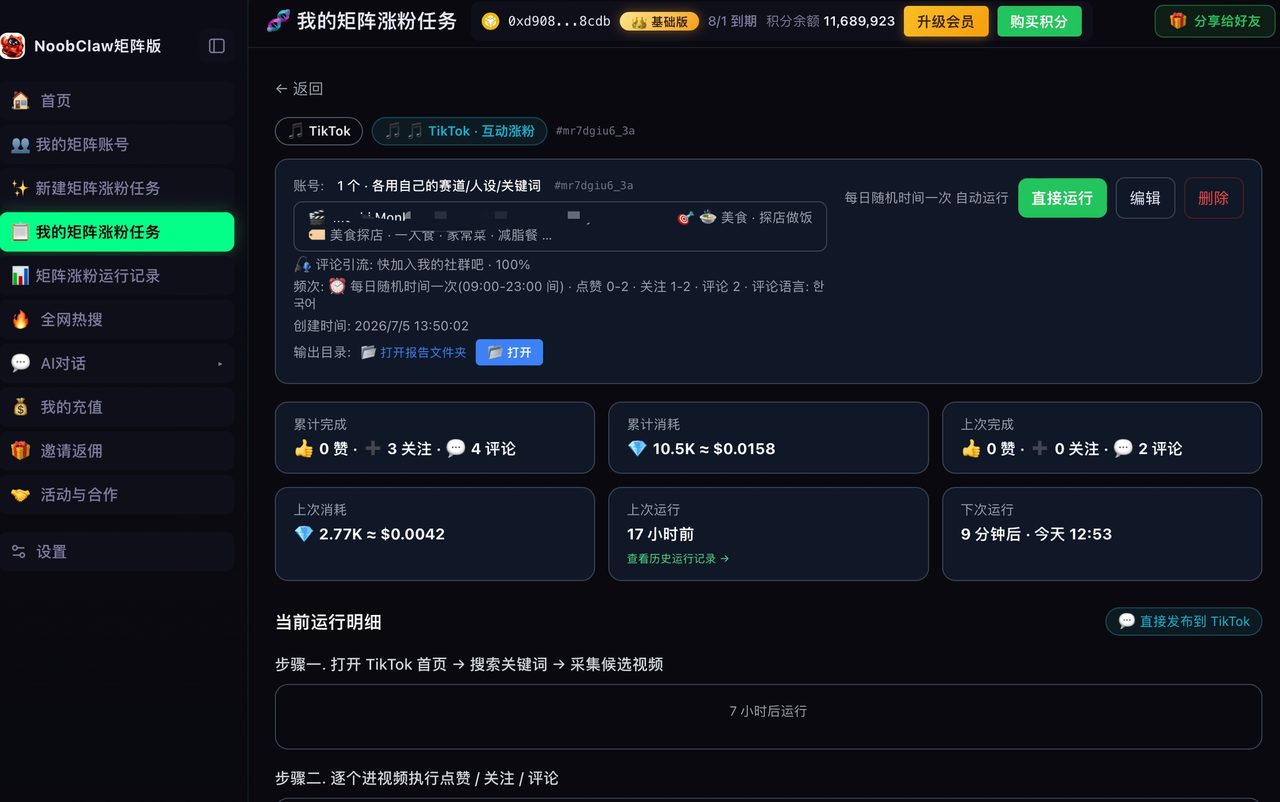
This is the design NoobClaw runs on — engagement and posting happen in a fingerprint-isolated local browser using your own logged-in session, quotas are randomised ranges rather than fixed counts, scheduled runs carry jitter, and each account generates its own content from its own niche and persona. What it will not do is manufacture engagement from accounts that aren't yours, because that's the thing that breaks the signal you actually need. The full picture, including where the honest limits are, is in the TikTok automation guide.
One more constraint that changes tool selection and that almost nobody accounts for: API posting quotas belong to the account, not to the tool. Switching apps doesn't get you a fresh allowance — see TikTok's daily post limit.
The twenty minutes you were actually trying to save
Step back from the tooling question and look at the original problem, because it usually turns out to be three problems wearing one coat.
- The repetitive part. Opening the app, scrolling to the right place, engaging with your niche, checking notifications. This is genuinely mechanical, and it is the part automation legitimately addresses.
- The judgement part. Deciding what to make, which comment deserves a real answer, whether a trend fits your account. This looks automatable and isn't — and every tool that pretends otherwise produces the generic output platforms now specifically discount. See why AI content sounds generic.
- The context-switching part. If you run several accounts, a large share of your time isn't spent doing anything — it's spent logging in, logging out and remembering which account you're in. This is the cost nobody budgets for, and it's the one that scales worst. It's covered in creator burnout across multiple accounts.
Sorting your twenty minutes into those three buckets tells you what to buy. If most of it is bucket one, a scheduler or a local automation run pays for itself. If most of it is bucket three, what you need is isolation and session management, not a bot. And if most of it is bucket two, no purchase will help, because the thing consuming your time is the thing that makes the account worth following.
That's the sentence worth leaving with. Automation is a multiplier on a process, and multipliers are indifferent to sign. Applied to a process that produces something people want, it compounds. Applied to one that doesn't, it just gets you to the answer faster.
FAQ
Will a free bot get my account banned?
It depends entirely on which of the four categories it belongs to. Engagement sellers carry the highest risk and the worst side effects. Credentialed cloud tools carry a distinct risk — account takeover — that has nothing to do with platform enforcement. Ask which category you're in before asking about odds.
Is there any free option that's actually safe?
The genuinely free option is the platform's own tooling: native scheduling, native analytics, native creator features. It's less capable than what you're imagining, but nothing is being monetised behind your back. Start there and only pay when you can name the specific thing native tooling can't do.
How do platforms tell automation from a real person?
Mostly by rhythm and by consequence. Fixed intervals, identical phrasing, action counts that repeat exactly, engagement with no relationship to what's on screen, and a follower graph that doesn't match the engagement graph. Notably, "a machine typed it" is not by itself the test — Meta's spam policy, for example, describes prohibited behaviour as occurring "either manually or automatically."