
Creator Burnout Is Not a Volume Problem. It Is a Context-Switching Problem
- Reported burnout rates range from 62% to 90% depending on the survey; one 2025 study found 52% currently experiencing burnout and 37% considering leaving. The spread tells you definitions differ - use
- The counterintuitive finding: multi-account burnout is mostly a workflow problem, not a volume problem. Creators who post less but context-switch constantly burn out faster than those posting more on
- Most people did not choose multiple accounts out of ambition - they hit a reach ceiling and realized a single feed is structurally fragile. That reframes the whole conversation.
- Practical fix: batch by task rather than by account, cut accounts you no longer open, and move the repeatable steps off your hands. Posting less is treating the symptom.
You are producing less than you were a year ago. You are also more tired than you were a year ago. Those two facts sitting together is what makes this particular exhaustion so demoralizing — it does not even come with the consolation of having worked harder.
The standard advice is to post less. If you are reading this, you probably already did, and it did not help. There is a reason for that.
The number, and why it is a range
Reported burnout rates among content creators span 62% to 90% depending on the survey, with the highest figures attached to full-time influencers and social media creators. A 2025 Billion Dollar Boy study found 52% currently experiencing burnout and 37% considering leaving the industry.
That spread is too wide to be a measurement of one thing. Different surveys define burnout differently and sample different populations. So use it as what it is — a range indicating this is widespread, not a statistic to quote as if it were precise.
What is more useful than the number is a specific claim from the same research area:
Burnout in multi-account operations is mostly a workflow problem, not a volume problem. Creators who post less but switch contexts more burn out faster than those who post more on a tight batch schedule.
Read that twice if you are currently trying to fix this by posting less.

Why switching costs more than producing
Every time you move between accounts, you reload a full context: which niche this is, which persona writes here, what the last three posts were, what the audience responds to, which platform's rules apply, which format this one uses.
None of that produces output. All of it consumes the same attention that producing requires. And unlike hours, attention does not add up across the day — the twelfth switch costs more than the second.
There is a concrete version of this cost. Third-party operations write-ups describe managing 50 accounts across 5 platforms as consuming 2-3 hours a day just finding, logging into and switching between accounts — before any content is made. That is the visible part. The invisible part is that those hours are drawn from the same budget your creative work needs, and they are drawn first.
This is also why "post less" fails as a remedy. Cutting from three posts to one on each of eight accounts removes production work and leaves every single switch in place. You reduced the part that was rewarding and kept the part that was draining.
Nobody planned to have eight accounts
Worth saying, because the advice around this often carries a note of judgment — as if operating many accounts is greed.
The typical path is the opposite. Most people start with one account, hit a reach ceiling, and conclude that betting an entire business on one feed is structurally fragile. Platform dependency is a real risk: algorithm changes, classification shifts, enforcement mistakes, and account issues that arrive without explanation and without appeal.
So multi-account operation is usually a hedge, not an ambition. The mistake was not diversifying. It was diversifying the accounts without diversifying the way the work gets done — running eight accounts with the workflow designed for one.
That framing changes what a good solution looks like. If multiple accounts were a vanity project, the fix would be discipline: want less, do less. If they are risk management, the fix has to preserve the hedge while removing the cost — which is an operations problem, not a willpower problem. This is also why guides on managing twenty accounts that focus purely on scheduling miss the point: scheduling compresses the publishing step, which was never the step eating your attention.
Four changes that address the actual variable
1. Batch by task, not by account. The instinct is to work account by account: open account one, do everything, move on. That maximizes switches. Instead, do one type of work across all accounts in a block — all topic selection, then all drafting, then all review, then all scheduling. Same output, a fraction of the context reloads. This is the single highest-leverage change on this list and it costs nothing.
2. Cut the accounts you no longer open. If you have not looked at an account's analytics in three weeks, you have already made a decision — you just have not executed it. Every live account charges rent in attention whether or not it returns anything. Stopping updates while keeping the account intact preserves whatever search traffic exists and costs nothing further.
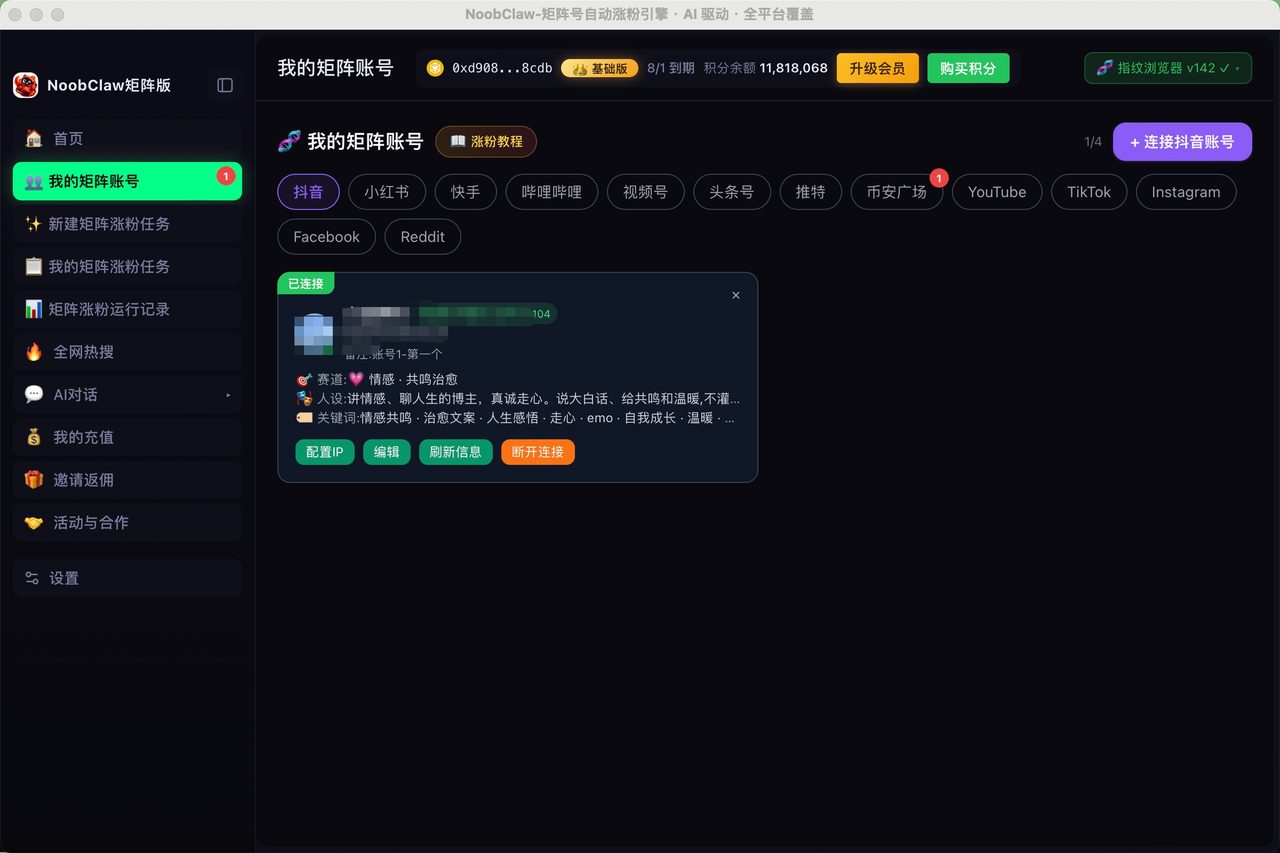
3. Move repeatable steps off your hands entirely. Some of this work genuinely requires you: the take, the judgment, what to leave out, what only you know. Most of it does not: subtitle generation, format adaptation, per-platform copy variants, publishing parameters, scheduling. This is where automation earns its place — a matrix engine like NoobClaw exists specifically to carry per-account production and posting so the switching cost stops scaling with account count. It does not make you post more. It makes each additional account cost less attention.
4. Fix your review process before raising output. Adding generation speed to a manual review process just relocates the pile, and an unreviewed queue produces guilt rather than results. If you have added AI generation but kept manual review, your queue is now the bottleneck, and a growing queue is its own source of dread. Survey data shows essentially everyone reviews AI output — 89.2% always edit it, 0% use it untouched — so review is not optional. It just needs to be triaged rather than uniform.
One honest limit: none of this touches the emotional side — the algorithm anxiety, the visibility pressure, the way results feel arbitrary. Tools do not fix that. What they can do is stop the mechanical part of the work from consuming the attention you need for the part that actually matters to you.
FAQ
Would going back to one account fix this?
It would reduce switching, and it would also restore the fragility that made you diversify. Before collapsing back to one, try batching by task for two weeks — most people find that the exhaustion drops sharply without changing the account count at all, which tells you the account count was not the cause. If it does not help, then consolidating is a reasonable next step, and cutting to two or three focused accounts usually beats going to one.
How many accounts can one person realistically run?
Industry experience is often cited as 30-50, but that figure carries an unstated condition: with tooling, and with content generated per account rather than hand-written for each. Those are experience-based estimates, not statistics. A more useful self-test than any number: if you have started copying content between accounts to keep up, you are already past your limit — and what you exceeded is not the account count, it is the number of distinct judgments you can supply.
Does automating content make burnout worse by increasing volume?
It can, if you automate generation and leave review manual — then you have simply relocated the pile. The version that helps is automating the repetitive steps and triaging review by risk, so throughput rises without your attention load rising with it. The failure mode to watch for is a growing queue of unreviewed drafts, which produces guilt rather than results.