Free TikTok Bots: Permissions, Code and Real Output
- A public-data reader, a content-drafting tool and a fake-engagement service perform different actions.
- TikTok’s inspected integrity policy prohibits fake engagement and specified manipulative automation.
- NoobClaw’s public local-video example does not prove six inbox integrations or safe automated replies.
The phrase free TikTok bot can describe several unrelated products. Before comparing prices, identify the action: reading public information, drafting text, managing an authorized publication step or manufacturing engagement. Then inspect the access requested and the output actually delivered. A repository’s popularity, an invite link or the absence of a password prompt does not settle those questions. This review offers a selection procedure, not a measured probability that an account will be compromised.
Plan the content separately from the permission and the final published result.
Classify the proposed action before comparing offers
TikTok’s current Integrity and Authenticity chapter permits multiple accounts for purposes such as creative expression, while prohibiting deception, fake-engagement services and specified spam automation. Its examples include bots writing fake comments, manipulative metrics and automation running many accounts or repetitive content. These are method-and-purpose conditions, not a guarantee that a local login or slower pacing makes an action allowed. We read the complete official payload through a public translation transport; direct access failed.
Make the proposed deliverable concrete. A hypothetical public-data reader might return a count; a drafting tool might return text for review; an engagement offer might claim to supply likes or followers. These are not interchangeable outputs. A useful count does not produce conversations, and a well-written draft does not establish permission to submit it automatically. Keep the action and its acceptance condition beside the product name.
If an offer requires you to invite people, watch ads or complete other tasks before access, record those conditions and what is delivered afterwards. Such friction alone is not a finding of fraud, and it does not prove that infrastructure is genuine. Decide what evidence you would require before investing further time. Do not treat a rising number in an offer’s own dashboard as proof of authentic engagement on your account.
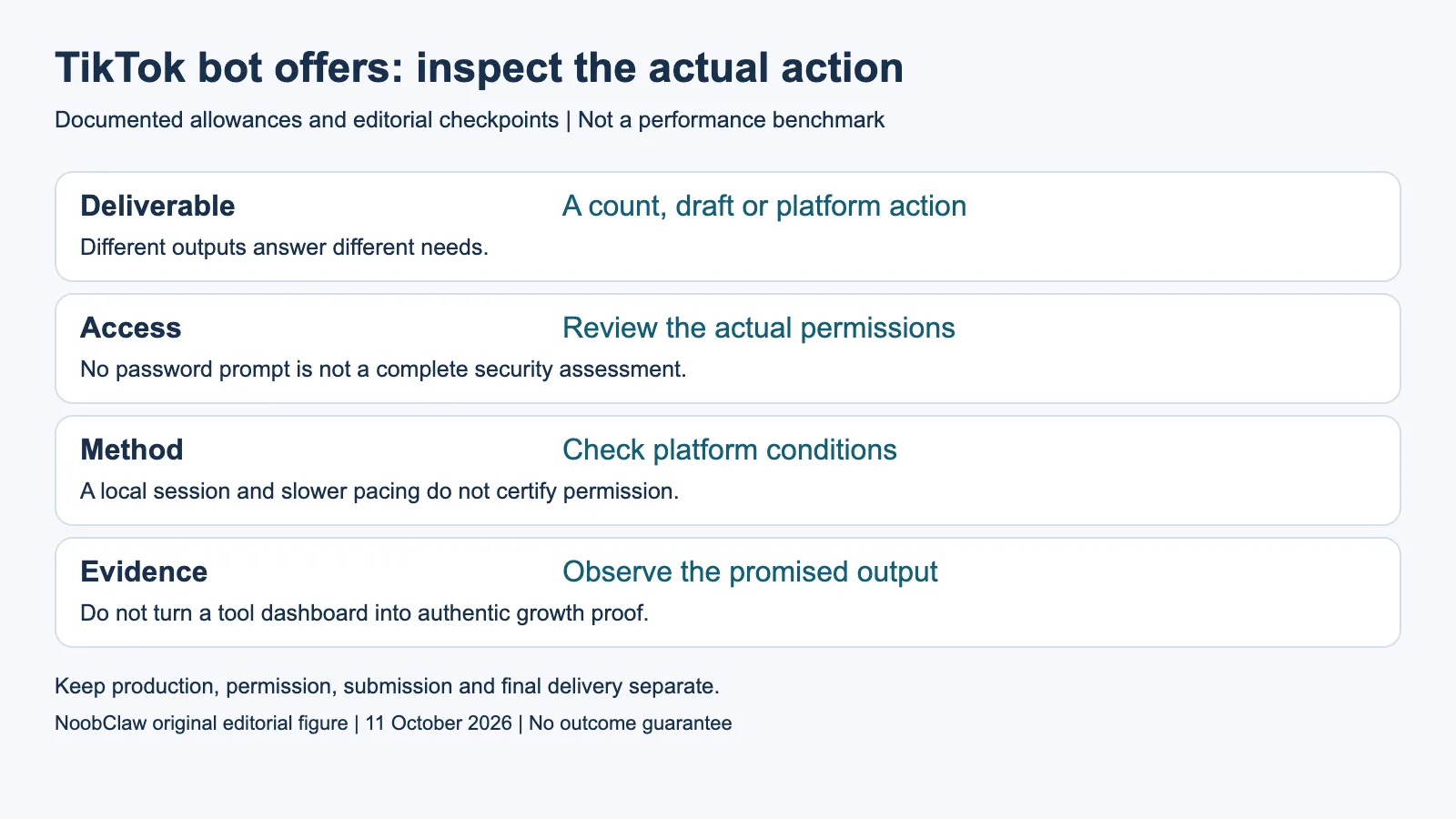
- Deliverable: A count, draft or platform action. Different outputs answer different needs.
- Access: Review the actual permissions. No password prompt is not a complete security assessment.
- Method: Check platform conditions. A local session and slower pacing do not certify permission.
- Evidence: Observe the promised output. Do not turn a tool dashboard into authentic growth proof.
Public source code is useful evidence with a limited scope
Read the original repository, its stated purpose, release information and installation instructions. Identify the release you would actually run. The code visible in one repository is not automatically the executable in a separate installer or a fork with a similar name. A star count is also not a review of current behavior, dependencies, platform permission or the handling of session material. This article does not test any downloaded program.
Include dependencies and requested access in the assessment. A tool can ask for browser, file or network access without requesting a password directly. A public-data workflow can still require review of collection conditions and of the data it stores or transfers. Conversely, a login requirement alone does not prove malicious behavior. Evaluate what the specific program does rather than assigning a universal safe or dangerous label to a whole category.
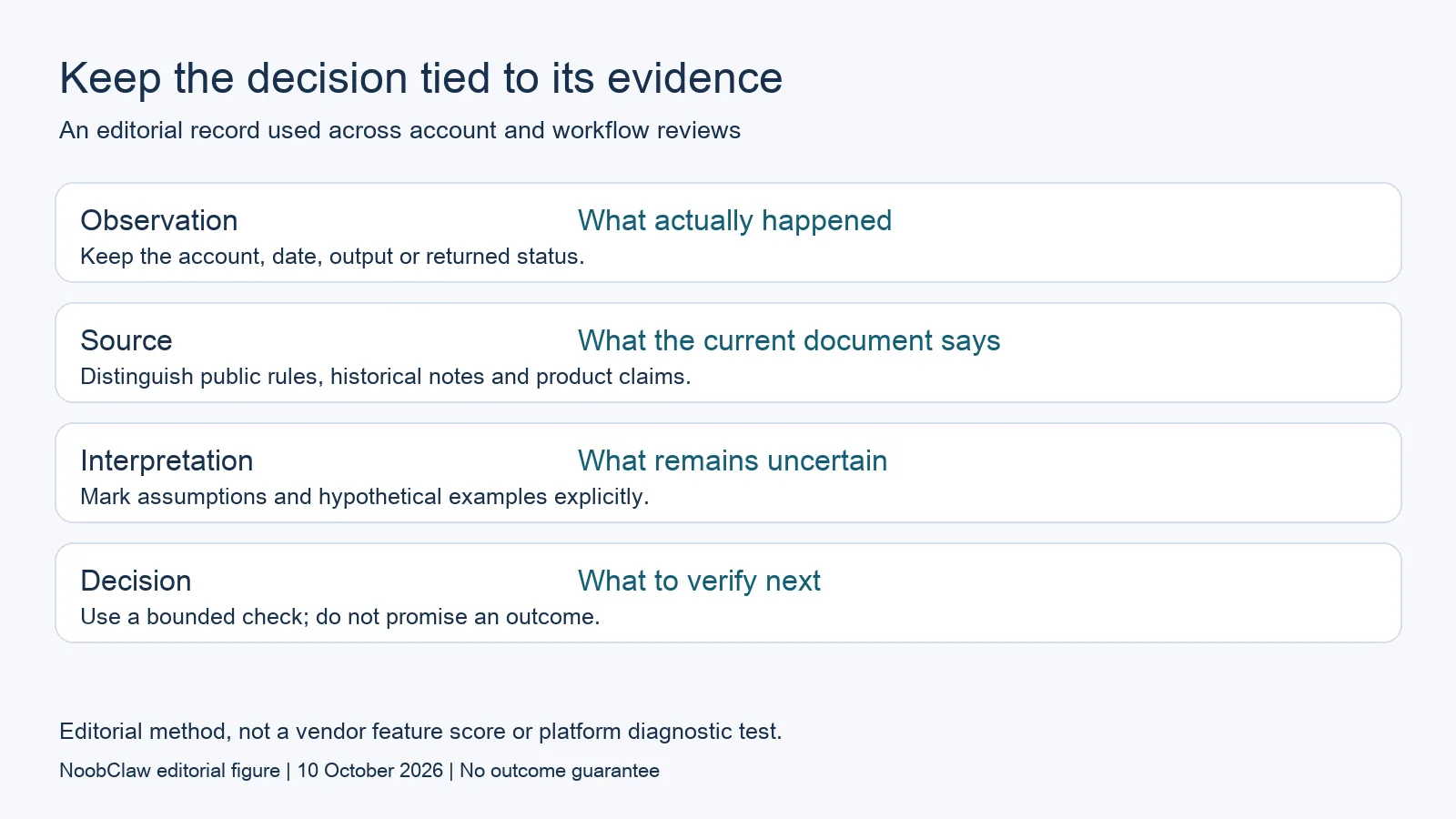
For a hypothetical decision record, keep the source location, version, permissions, expected output and observations from a bounded evaluation. Distinguish an observed result from a vendor statement and an unanswered question. If you have not inspected the executable or observed its network behavior, keep those items unknown. Do not replace that gap with a claim that credentials remain on the device or that there is a particular chance of account loss.
Separate drafting from an authorized platform action
The official Content Posting API guidance has its own client, creator and user-interface requirements. An interface that supplies a file to a workflow is not evidence that it satisfies those requirements or supports every intended use. This article does not certify a bot, private utility or browser routine as an approved publishing client. Review the intended audience, applicable integration conditions and actual publication mechanism before treating a generated asset as publishable.
A person reviewing proposed text can catch a poor answer, wrong language or irrelevant claim. That review is useful editorial work; it is not an automatic exemption for the mechanism that reads or submits the text. Ask whether the proposed step is a draft, a human action or an automated write. Keep account permission and the content’s suitability separate, even when both appear on the same convenient screen.
Use an illustrative acceptance condition such as a relevant draft that a person can inspect and decide how to use. Do not set acceptance as a promise of comments, followers or higher distribution. Those are different outcomes and require actual observations over a defined period. If a tool’s only demonstrated output is a file or text response, assess it on that output rather than extending the evidence to untested inbox actions or external publication.
Choose useful production work instead of manufactured signals
If your immediate problem is explaining a topic clearly, start with a content brief and an asset you can review. A useful brief identifies the intended audience, question, source material and desired format. Check names, claims, relevance and rights before preparing the final version. This is a proposed editorial workflow, not evidence that replying to a certain number of people or changing the pace will produce a particular growth rate.
NoobClaw’s public record documents one local script-to-video result. It does not demonstrate reading and replying in creator inboxes across six platforms, a complete credential-flow assessment or TikTok publication. Those capabilities would need their own evidence. Review the observed local result and its remaining footage, voice and rights limitations before deciding whether that production task is relevant to your work.
NoobClaw’s public creative record documents one 441-character English script exported locally as a 32.6-second video at 1080 × 1920 pixels and 30 frames per second. Footage relevance, listening quality and stock rights still require review. These measured input and file properties help evaluate asset preparation; they establish no platform publication, inbox access, security exemption or growth. Select the documented deliverable you need, then assess the distribution route separately.
For the related content and workflow decisions, read AI UGC Creator: Jobs, Deliverables and Disclosure and Free Social Media Posting API: Access, Limits and Costs. Each review has its own evidence and scope.
NoobClaw publishes this article. Its script-to-video guide and public creative execution record document a local video result, not external-platform publication. Check the current product offer against the supported action you need.
Frequently asked questions
Is a public-data reader automatically harmless?
No. Review the program, dependencies, access and collection conditions. Public inputs do not certify every implementation’s security, privacy or platform permission.
Does public code prove the installer is safe?
No. Identify the exact release and assess what you intend to run. The original source is useful evidence, but it does not certify every fork, binary or dependency.
Does NoobClaw’s local video example prove inbox automation?
No. The cited public record concerns a local creative result. Inbox integrations, credential handling and external-platform actions would need separate observations.
Sources
Sources inspected on October 11, 2026. Meta Graph API v19 was read in its retrieved German-language official body. Instagram Help and Meta Terms were read in their retrieved Chinese-language rendered bodies; the inspected account, app and regional scope is retained. TikTok policy versions were parsed from the complete official original-language payload through Google Translate public transport after original-site access failed; the cited access link is that transport, not a direct-origin HTTP200 claim. The current policy chapters do not certify a historical diff. Reused same-day primary copies retain their original receipts and are not new GETs. Workloads are illustrative; local creative output does not demonstrate publication, protection or paid conversion.