Hootsuite Unlimited Accounts: Limits and Trial Checklist
- Separate account capacity from user access and task requirements.
- The trial has organization-level posting limits and excludes bulk scheduling.
- Verify content output and destination results separately; AI features are not absent.
Hootsuite advertises unlimited social accounts on Professional and higher plans, while Standard lists ten. That describes account capacity; it does not establish unlimited user access, every workflow feature or unrestricted trial posting. The practical buying question is whether the chosen plan handles your actual accounts and tasks with the people who need access. This guide, checked against official material on October 11, 2026, gives you an inventory and a bounded trial exercise. It does not claim a thirty-account production experiment, universal account protection or a guaranteed reduction in operating cost.
Account capacity, permission, accepted content and confirmed delivery are separate checks.
Make an account inventory before interpreting unlimited
Start with the actual destinations you manage, not an arbitrary scale target. For each, record the brand, network, owner and required task. Distinguish an active publication requirement from an account kept only for reference. Also record who can authorize its connection and who owns recovery access. This is an editorial inventory, not a recommendation to create more accounts. It helps turn the word unlimited into a specific requirement that a vendor can confirm for the destinations you already need.
Use a hypothetical inventory of three brands on four networks to explain the counting question. Twelve brand-network entries in your own sheet do not automatically prove twelve supported connections. A network may distinguish account types, and the vendor must confirm the particular destinations and permissions. Ask how the selected plan counts those entries. Save the supported list and any exceptions. Then test a representative permitted connection rather than assuming that the headline capacity establishes compatibility with every profile type.
Keep access by people in a separate column. An account allowance and a user seat are different quantities, so thirty connected accounts would not itself prove that three colleagues can operate the workspace on one purchased seat. The current offer sells access per user. Confirm the actual access selection and quote for your team, including the workflow it needs. Do not treat a capacity label as a reason to share credentials or as evidence that every additional service is included.
For planned expansion, record why each added destination exists. A different audience may need a different editorial brief; a dormant campaign may need no new output at all. The inventory should make those choices visible instead of encouraging identical posts across accounts. It does not establish a platform penalty, a safe number of accounts or a claim that repeated material inevitably loses reach. Evaluate the usefulness and permitted method of each task on its own evidence.
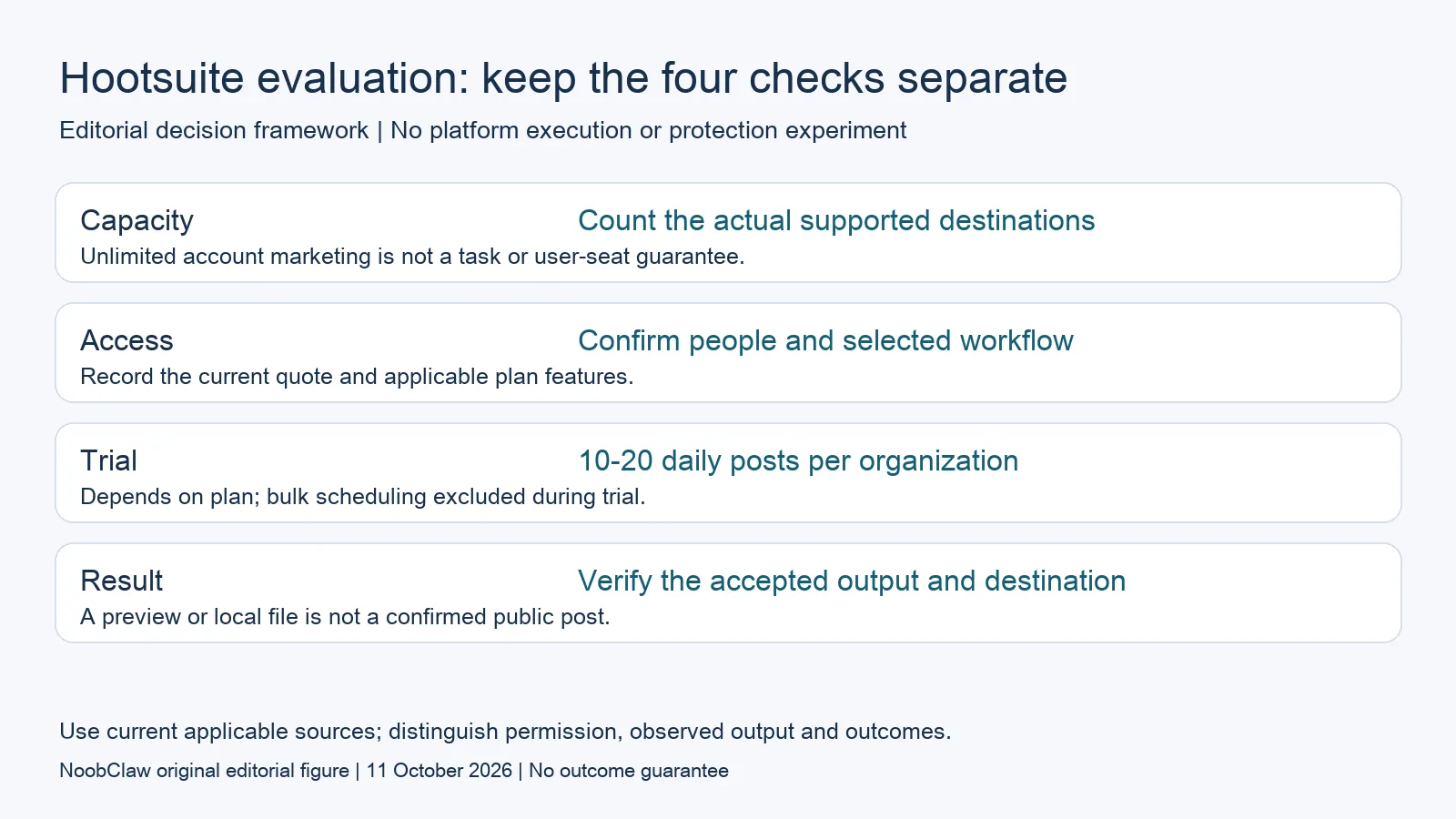
- Capacity: Count the actual supported destinations. Unlimited account marketing is not a task or user-seat guarantee.
- Access: Confirm people and selected workflow. Record the current quote and applicable plan features.
- Trial: 10-20 daily posts per organization. Depends on plan; bulk scheduling excluded during trial.
- Result: Verify the accepted output and destination. A preview or local file is not a confirmed public post.
Use the trial for a bounded handoff and destination check
The official page offers a fourteen-day trial without a credit card or automatic end-of-trial charge. Its footnote sets daily posting limits of ten to twenty posts per organization, depending on plan, and excludes bulk scheduling during trial. This is different from a per-account allowance. Ask which limit applies to your chosen trial and organize the evaluation within it. A trial limit cannot be interpreted as a test of the paid plan's full throughput.
Prepare a small test packet: one factual announcement, one image with a clear caption and one correction to a draft. Use a destination where you have permission to conduct the evaluation. Write acceptance criteria before operating the tool: correct account, correct approved copy, acceptable preview and an observable final result. If a step remains unavailable, record exactly which step. Avoid filling that gap with a claim that the product always fails or always succeeds at the task.
Observe the whole handoff, including what happens when a reviewer requests a change. Keep the prepared version and the accepted version distinct. Record who approved the final copy and who carried out any publication. When the output is public, verify the ordinary destination and preserve its time. A successful composer preview does not establish a delivered post. Likewise, a delivered post is not a measured audience response, an account-safety experiment or a sales event.
If you need bulk operation, request a demonstration under the appropriate paid terms rather than running outside the trial conditions. State the required formats, destinations and volume, but do not turn a capacity question into a platform-rule exemption. Each network's applicable conditions still matter. Preserve the vendor's answer and the tested scope, including failures. An evaluation that clearly marks untested work is more useful than an apparently complete comparison built from unobserved behavior.
Check creation capabilities without confusing them with delivery
Hootsuite's current Wisdom page describes content generation and drafting. It also says people control review, approval and publication; some integrations are marked coming soon. Read the relevant feature's status instead of assigning every marketing headline to every plan. It is inaccurate to call the product merely a scheduler that cannot make content. It is equally inaccurate to infer that any AI assistant produces every media format or autonomously completes every destination workflow.
For a creation test, use a brief with concrete source material and acceptance criteria. A hypothetical product announcement may need a correct specification, a suitable tone and a caption that the image can support. Ask the assistant for a draft, then inspect each claim against the provided source. Record the edits required and the accepted result. This measures a bounded drafting task; it does not establish long-term content quality or a generalized productivity figure for an entire organization.
For a publishing test, use an approved output and check the required destination independently. That distinction helps identify where another tool might fit. A local media generator can supply a file while a management suite organizes subsequent work. A buyer should decide whether replacing one stage, adding a stage or keeping the existing process solves the actual problem. The existence of empty calendar slots alone does not prove that no scheduling product can assist with creation.
The related reviews below cover a channel-based offer and another generation offer. Bring the same accepted task into those comparisons instead of asking which product wins every category. Confirm billing period, team requirements and remaining work. NoobClaw publishes this article and sells content tools; its documented local output is relevant to a creation brief, with the limitations below. It is not evidence of unlimited publishing, a team inbox, a successful Hootsuite migration or protection for multiple accounts.
For the related content and workflow decisions, read Buffer Alternative for AI Content: Compare the Actual Job and Blotato Pricing: Plans, Credits and Account Limits. Each review has its own evidence and scope.
What our actual output record can answer
The public NoobClaw record contains a 441-character supplied script and a 32.6-second locally rendered MP4 at 1080 by 1920 and 30 frames per second. Sampled subtitles were checked, but some stock visuals were only loosely relevant and full audio and visual review remained necessary. There is no destination upload or Hootsuite trial in that record. If your missing stage is narrated-video creation, you can inspect the artifact and ask for an example matching your own brief. If your missing stage is channel management or team access, ask for corresponding evidence rather than extrapolating from a video file. Save the editing and operating work still needed after generation alongside the output.
Inspect the public script-to-video execution record and the script-to-video operating guide. Check the current product offer against the task you need.
Frequently asked questions
Does unlimited accounts mean unlimited trial posts?
No. The trial footnote sets an organization-level daily posting allowance and excludes bulk scheduling. Confirm the limit for the selected plan.
Can Wisdom autonomously publish everything?
Its current FAQ says people remain in control of review, approval and publication. Check the precise feature and release status.
Have you tested thirty accounts through this workflow?
No. This article provides a dated source review and a proposed evaluation method, not a recorded thirty-account production experiment.
Sources
Official material reviewed on October 11, 2026. Document conditions apply to their stated service and scope; the editorial examples are explicitly hypothetical.