Antidetect Browser Claims: Evidence Before Account Decisions
- A restriction and its cause are different claims.
- Inspect the notice and task record before evaluating a proposed remedy.
- A vendor's environment claim is not an authorization or recovery result.
An account restriction does not, by itself, prove which device signal or software setting caused it. Begin with the account's actual notice and a record of what was attempted. An antidetect product cannot be accepted as a diagnosis or guaranteed remedy merely because it promises a different environment. This review explains how to assess such claims without an undocumented personal loss story, an account-survival statistic or a recovery promise. No browser-fingerprint or platform enforcement experiment was performed for this article.
An observed restriction is not proof of an advertised cause or remedy.
Preserve the observation before choosing an explanation
A useful incident record identifies the account, time, exact notice, affected function and the work attempted immediately around the observation. Preserve what is available before making broad changes. Do not insert an inferred device signal into the record as though the platform had disclosed it. A login problem, a content notice and a restriction on one function can involve different questions; their occurrence at a similar time is not enough to establish a shared cause.
For a hypothetical editorial team, one person might notice that a post is missing while another reports a failed login. The team should identify the two observations separately before deciding that either is related to its browser product. The publishing record can show which version was attempted and where. The access record can show the device and security review. Neither supplies a hidden moderation explanation. A proposed fix should state which observable problem it addresses and what would count as evidence that it worked.
Keep uncertainty in the conclusion. If the platform notice names a requirement, address that requirement through the stated route. If it does not identify the cause, do not invent one from an advertisement or a familiar account-loss anecdote. A vendor may be able to explain its own connection behavior while being unable to explain a platform decision. That boundary is useful: it prevents a purchase discussion from turning into an unsupported diagnosis.
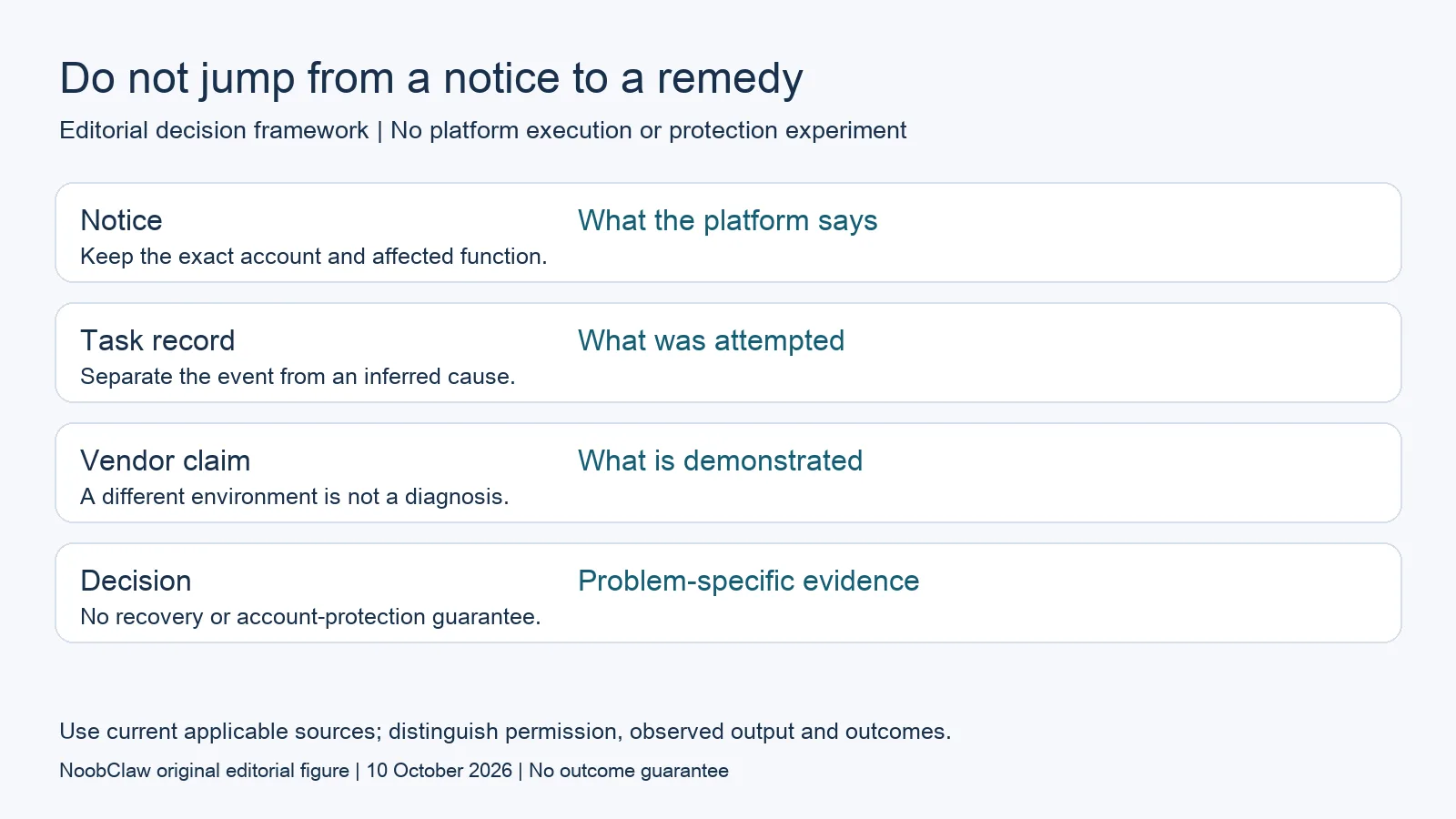
- Notice: What the platform says. Keep the exact account and affected function.
- Task record: What was attempted. Separate the event from an inferred cause.
- Vendor claim: What is demonstrated. A different environment is not a diagnosis.
- Decision: Problem-specific evidence. No recovery or account-protection guarantee.
Require a testable claim from the proposed product
Ask what the supplier means by its feature description and what evidence supports it. A working-context feature, a connection setting and an account-permission arrangement are different things. A bounded product evaluation can inspect whether the software performs its described task under the stated conditions. It cannot establish a universal result for a destination's unpublished systems. Reject an assertion of zero risk if the supplier cannot identify the sample, method and actual outcome behind it.
A hypothetical buyer can prepare an acceptance sheet with the product version, permitted task, expected output, administrative responsibility and stopping point. Record both successful and unsuccessful observations. If a configuration changes, mark it as a different observation rather than silently combining the results. The conclusion may be as narrow as ‘this demonstration displayed the selected working context correctly.’ A narrower true conclusion is more useful than calling the same demonstration proof that every account is protected.
Chrome's profile guidance concerns separate browser information and notes that someone with device access can switch profiles. It does not certify another vendor's detection claims. For an organization, access responsibilities must therefore be evaluated as their own requirement. A feature that helps an editor distinguish clients should not be described as a substitute for device access controls, a platform-approved method or permission to carry out every action through those accounts.
Review the action even when the environment appears orderly
A clear browser setup does not settle whether the intended content and action are appropriate for the destination. In a hypothetical agency workflow, the client may approve source material and an editor may approve a final draft, while the proposed automated publishing method remains unresolved. Keep those decisions separate. A task should not proceed solely because the operator can log in or because its interface looks familiar. The relevant requirement concerns the actual action and method.
X's official automation guidance gives an example of why method matters: it restricts non-API automation such as scripting its website. That rule is specific to X and should not be mechanically copied to another service. It shows why an environment label cannot answer every platform question. Read the current requirements for the actual destination, and avoid replacing them with a broad argument that timing makes software equivalent to a person. The platform decides the applicable conditions; a product demonstration does not rewrite them.
For content reused across destinations, examine rights and original contribution alongside any account question. The two-channel YouTube review separates these subjects, while the channel-capacity analysis distinguishes management quantity from editorial capacity. Those distinctions can help a team correct a real requirement without claiming that an environment change restores eligibility. A change should be accepted for the problem it demonstrably resolves, not for an outcome the review has never observed.
For the related content and workflow decisions, read Same Video on Two YouTube Channels: Upload vs Monetization and How Many YouTube Channels Can You Have? The 100 Limit. Each review has its own evidence and scope.
Our visible record is an output case, not a restriction remedy
NoobClaw publishes this analysis and sells content tools. Its public record demonstrates one supplied script generating a local video draft, with sampled subtitles and limitations in some stock footage choices. It provides no before-and-after account restriction case, no antidetect trial and no measured change in a platform outcome. The record should be used to assess the creation stage it actually contains. An editor can inspect the local output and decide what needs revision without claiming the software diagnosed another account. If a buyer is evaluating a separate account task, request its purpose, applicable permission and actual execution record. A local export cannot fill those gaps. The product guide explains the specific drafting controls for the documented case. This analysis supplies the evidence boundary for choosing additional work, rather than telling a reader to replace an identity or configuration in the hope of bypassing a restriction.
Inspect the public script-to-video execution record and the script-to-video operating guide. Check the current product offer against the task you need.
Frequently asked questions
Can an antidetect browser restore an account?
No restoration outcome is established here. Preserve the actual notice and use the relevant official route. A supplier's feature description does not identify why a platform took an action.
Does no warning prove the configuration works?
It proves only that no warning was observed in the stated record. It is not a measured ban rate or confirmation that the proposed action is authorized.
What evidence should a buyer request?
Ask for a specific feature claim, product version, permitted acceptance task and actual result. Keep account authorization and platform requirements separate from the product observation.
Sources
Official material reviewed on October 10, 2026. Document conditions apply to their stated service and scope; the editorial examples are explicitly hypothetical.