Instagram Growth Tools: Content, Publishing and Evidence
- Separate content creation, publishing and measurement before comparing Instagram tools.
- Meta documents an official publishing API for professional accounts with specific connection and permission requirements.
- A local browser session does not establish immunity from account restrictions or make an API inherently inferior.
- No five-tool, 90-day survival experiment or safe likes-and-follows quota is established in this review.
An Instagram growth tool should be evaluated by the specific work you need it to complete, not a promised follower increase. Content preparation, publishing and reporting require different outputs and access. Start with the task that currently blocks you, check the account and publishing conditions, and ask for evidence of that output. Random delays, browser profiles and a dashboard of activity do not establish audience growth or account protection.
Buy a capability you can inspect: an editable draft, a confirmed publication or a defined report. A promised growth number is not a substitute for any of those results.
Name the missing job before comparing tools
A creator with finished media and an inconsistent publishing routine needs a different tool from a creator who cannot turn an idea into a usable script. Write a short requirement containing the input you already have, the output you need, the person who approves it and the destination account. Then ask a vendor to demonstrate that job. This is more informative than selecting the product with the largest list of actions or the strongest claim that it looks human.
For content preparation, evaluate whether the output is editable and whether it preserves your intended meaning. Ask for a caption based on a clear product brief or a script based on material you own. Inspect names, dates and claims about the product. If a model invents a testimonial or a discount, the draft is not ready even if the writing sounds polished. A content assistant should make uncertainty visible enough for a reviewer to correct it.
For publishing, the useful result is the approved asset on the intended account through a supported method. For reporting, it is a metric with a definition, period and known data source. These capabilities may appear in the same product, but one does not prove the others. A demo that generates text should be recorded as text generation, rather than described as an end-to-end Instagram campaign.
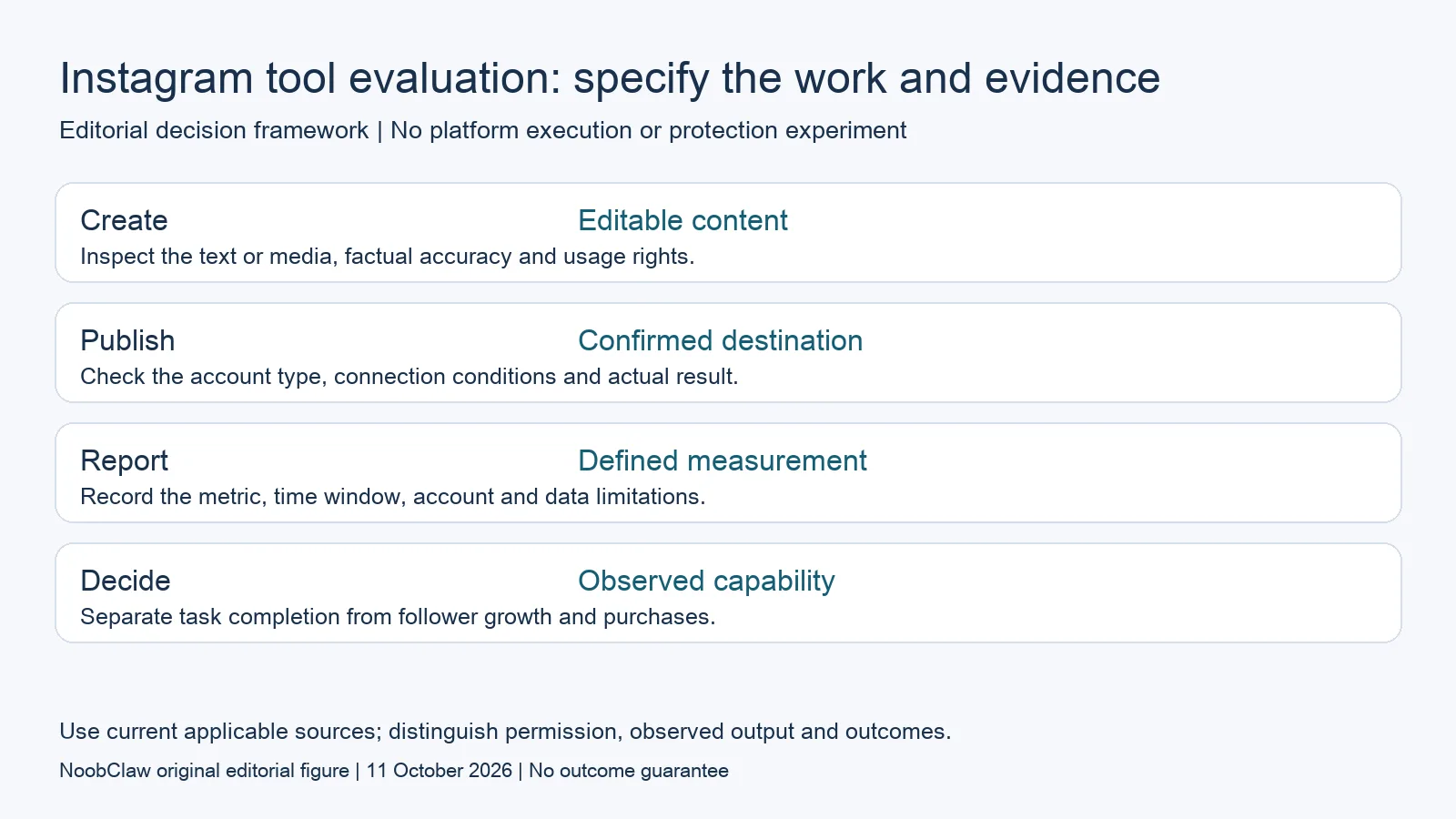
- Create: Editable content. Inspect the text or media, factual accuracy and usage rights.
- Publish: Confirmed destination. Check the account type, connection conditions and actual result.
- Report: Defined measurement. Record the metric, time window, account and data limitations.
- Decide: Observed capability. Separate task completion from follower growth and purchases.
Inspect account requirements and the publishing result
Meta's current content-publishing documentation describes publishing images, videos, Reels and carousels to professional Instagram accounts. It distinguishes Instagram Login from Facebook Login, with different tokens, permissions and hosts. Check which connection path a tool uses and whether your account meets its conditions. This directly contradicts a blanket claim that official API publishing is an inherently disfavored route and that a logged-in browser is the only useful alternative.
The same documentation distinguishes a media container from publication and provides status checks. A container ready for publication is not yet the same as a published item. Ask the vendor how it identifies the destination, retains the final media identity and confirms the returned result. If a demonstration ends with an asset being uploaded or queued, record that boundary. Do not turn it into a claim of completed public distribution.
Keep the approval decision specific. Write down who may connect the account, which account will receive the post and what happens after a request fails. Before retrying an uncertain attempt, inspect the existing destination state so that the first result is not hidden by a second publication. Browser access, an API token and an account connection are access mechanisms; none of them demonstrates that a particular campaign will gain followers or avoid every restriction.
Treat growth claims as claims that need a record
If a vendor advertises a follower result, ask what was measured, over which dates, for which account and alongside what other activity. Look for a preserved baseline and the exact definition of the result. A count of automated likes, a count of profile visits and a count of new followers are different observations. A result can be real while its attributed cause remains uncertain, especially when content, advertising and audience conditions changed together.
Meta's October 2020 announcement describes action against services that artificially inflated Instagram likes and followers. That is a dated official statement, not a current account-specific diagnosis or evidence that all tools share the same method. It is a reason to distinguish tools that help produce and publish your content from services selling artificial engagement. We do not have a recorded comparison showing that timing variance turns artificial activity into genuine audience interest.
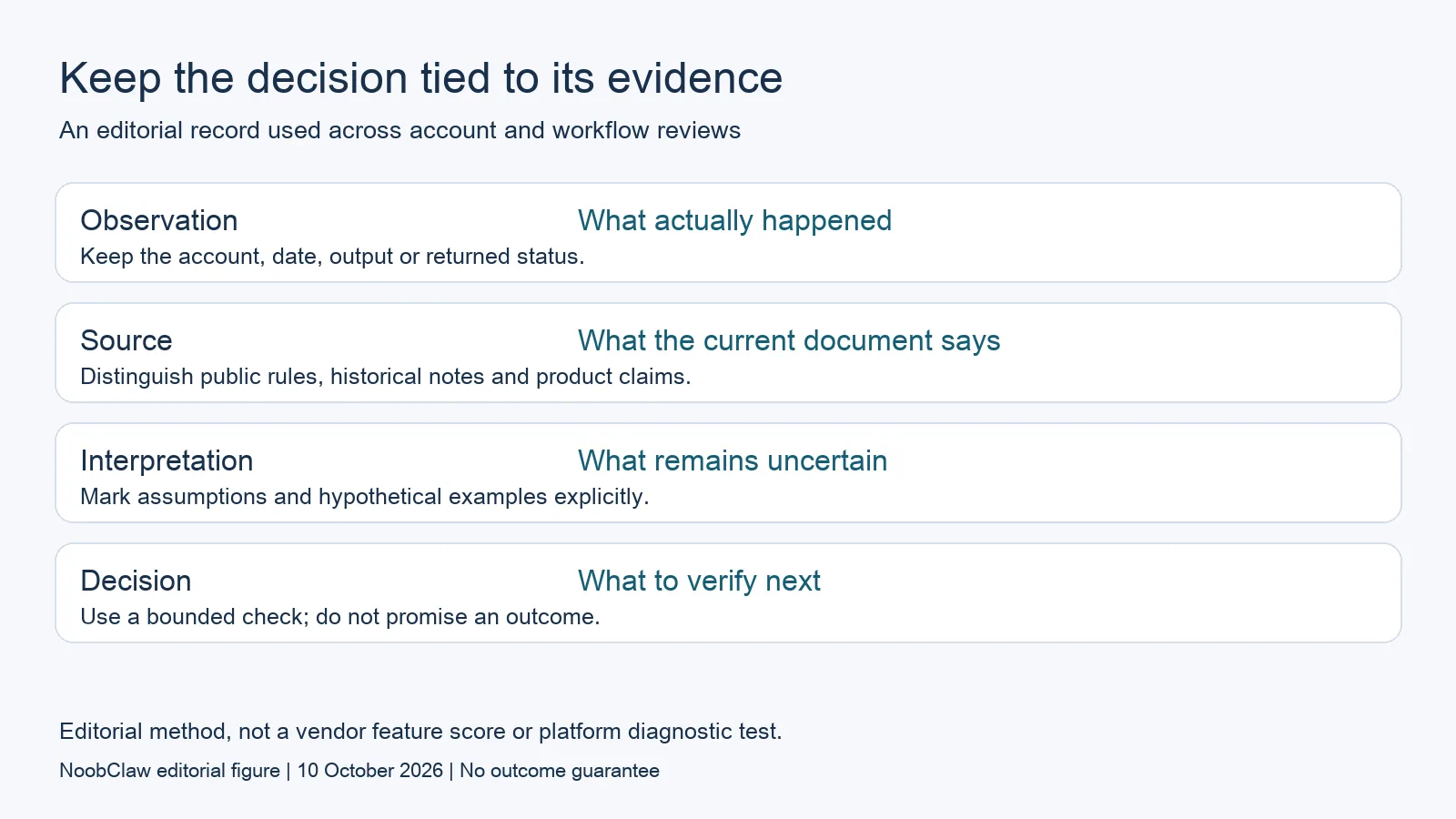
Use an evaluation record that keeps operational output and audience response separate. First establish that the intended draft or publication was completed accurately. Then review audience measurements using consistent definitions. Record any product inquiries or purchases independently, with the appropriate attribution evidence. A follower is not automatically a customer, and a completed software action is not automatically a follower.
Evaluate a content assistant with an actual acceptance brief
Consider a hypothetical creator preparing a short demonstration of a reusable bottle. The brief contains only confirmed materials, care instructions and the footage the creator owns. Ask for an opening, a spoken explanation and a caption without adding an invented durability test. Compare the returned claims with the brief. If the tool promises that the bottle survives a fall you never tested, reject that claim before evaluating the style of the writing.
Then inspect the media handoff. An editable script, a rendered video and an Instagram-ready publication are different outputs. Check whether the text is legible, the spoken explanation matches the demonstration and the media has the rights and format required for the actual destination. These are proposed acceptance checks, not a bottle campaign we ran or evidence of a specific retention improvement. The creator should be able to decide whether the tool reduced useful work rather than merely generated more material.
NoobClaw publishes this article and sells content software. Its public creative execution record documents a 441-character English script rendered into one 32.6-second local MP4 at 1080 by 1920 pixels and 30 frames per second, with voiceover and subtitles. These are observed input and output values for that local run; they do not demonstrate Instagram publication, followers or sales. Some observed stock material needed further relevance review. If your need is creation, inspect that bounded result. If your need is Instagram publication or reporting, require separate evidence for that action instead of inferring it from the local export.
For the related content and workflow decisions, read Human-Like Automation: Execution Is Not Account Approval and AI Tools for Content Creators: Choose the Missing Stage. Each review has its own evidence and scope.
A purchase record that keeps the claims separate
Use one row per requirement in your buying record. For an editable caption, retain the input brief and the text you accepted. For a media draft, retain the file and the corrections still needed. For publication, retain the supported method, destination and actual returned result. For a report, retain the metric definition and observation period. Mark anything the demonstration did not cover as unverified. This proposed record does not assume that one product must cover every row. It also avoids buying an artificial-engagement service to solve an editing problem. A small, bounded evaluation can establish whether a tool handles your input and output; it cannot establish a universal safe-action quota or predict how Instagram will distribute your next post.
NoobClaw publishes this article. Its script-to-video guide and public creative execution record document a local video result, not Instagram or YouTube publication. Check the current product offer against the supported action you need.
Frequently asked questions
Are API publishing tools inherently worse for Instagram growth?
The official platform documents API publishing for professional accounts. That establishes a supported capability with conditions, not a ranking advantage or disadvantage. Evaluate the method and actual result rather than assuming that browser execution is superior.
How many automated likes or follows are safe?
This review establishes no safe daily quota or protective delay pattern. A claimed survival story without preserved evidence does not supply such a limit.
Does NoobClaw's local video example prove Instagram growth?
No. It demonstrates the recorded local creative output only. Instagram publication, audience response and purchases require separate observations.
Sources
Official material reviewed on October 11, 2026. Document conditions apply to their stated service and scope; the editorial examples are explicitly hypothetical.