
Is My Niche Too Broad? The Test Is Whether a Stranger Can Predict Your Next Post
- Recommendation systems have to decide who to show you to. An account with no readable pattern is a harder guess, and harder guesses get made less often.
- The test: could a stranger who saw three of your recent posts predict the fourth? If not, neither can the system.
- Narrowing does not mean posting less. It means making the through-line visible — usually the audience and the angle, not the topic.
- Common false alarm: variety in format is fine. Variety in who the content is for is what breaks legibility.
You post consistently. The content is genuinely good. Your existing followers engage. And yet almost nobody new arrives — the same few hundred people see everything, and the reach beyond them never materialises.
The usual advice at this point is "niche down", delivered with no explanation of what that means or how to know if it applies to you. So here is the mechanism first, then a test you can actually run.
Why legibility matters more than breadth
Recommendation systems do one thing: predict which strangers will want to see this. To do that, they need a working model of what your account is about — built from your captions, your visuals, who already engages, what they engage with elsewhere, and what your last several posts had in common.
When that model is confident, distribution is cheap: show it to people like the last set who responded. When the model is uncertain, every attempt is a gamble, and gambles get taken less often.
You are not being punished for being interesting. You are being deprioritised for being unpredictable — and those feel identical from the inside.
This is the same underlying idea as content fingerprinting, which we broke down in what your content fingerprint tells the algorithm. This piece is the diagnostic half: how to tell whether yours is readable.

The test
Open your grid. Take the three most recent posts. Now imagine handing them to someone who has never heard of you, and asking:
"What is the fourth one going to be about?"
- They can answer with reasonable confidence → your niche is legible. Whatever is limiting your reach, it is not this.
- They can name a general area but not a direction → borderline. Fixable with framing, not with a change of subject.
- They shrug → the system is shrugging too.
Do it with an actual person if you can. Doing it in your own head is unreliable, because you know the connective tissue — you know why the recipe post and the productivity post and the gym post belong to the same worldview. That coherence lives in your head, and neither the stranger nor the classifier has access to it.
The distinction that saves most accounts
Here is where most niche advice goes wrong, and it costs people content they should have kept.
Variety in format is fine. Carousels, Reels, talking-head clips, screenshots, text-on-image — mix them freely. Formats are not what the model uses to guess your audience.
Variety in audience is what breaks you. If post one is for beginners, post two is for professionals, and post three is for people in a completely different industry, the system has three incompatible audience models and no basis for choosing.
So the question is not "am I posting about too many topics?" It is:
"Is every post I make aimed at the same person?"
You can post about recipes, productivity and the gym and still be perfectly legible — if all three are aimed at, say, shift workers with no time. The topic varies; the reader does not. That is a niche. "Things I am interested in" is not.
How to narrow without deleting half your content
Nobody wants to hear "post about one thing forever", and you do not have to. Four adjustments, in rising order of effort:
- Name the reader in the first line. "If you finish work at 11pm and still want to eat properly" does more for legibility than any hashtag. It tells both the human and the system exactly who this is for.
- Give it a repeating frame. Same opening structure, same kind of promise, same closing move. The topic can roam; the shape stays put and becomes the pattern.
- Run a ratio, not a rule. Roughly four posts in the core lane for every one outside it. That is enough to keep the model confident while leaving room to be a person.
- Split, do not compromise. If two genuinely different audiences both matter to you, two accounts will each outperform one blended account. This is the only situation where "just make another account" is real advice rather than a growth-hack cliché — and it is why multi-account setups exist for legitimate reasons, not just for volume.
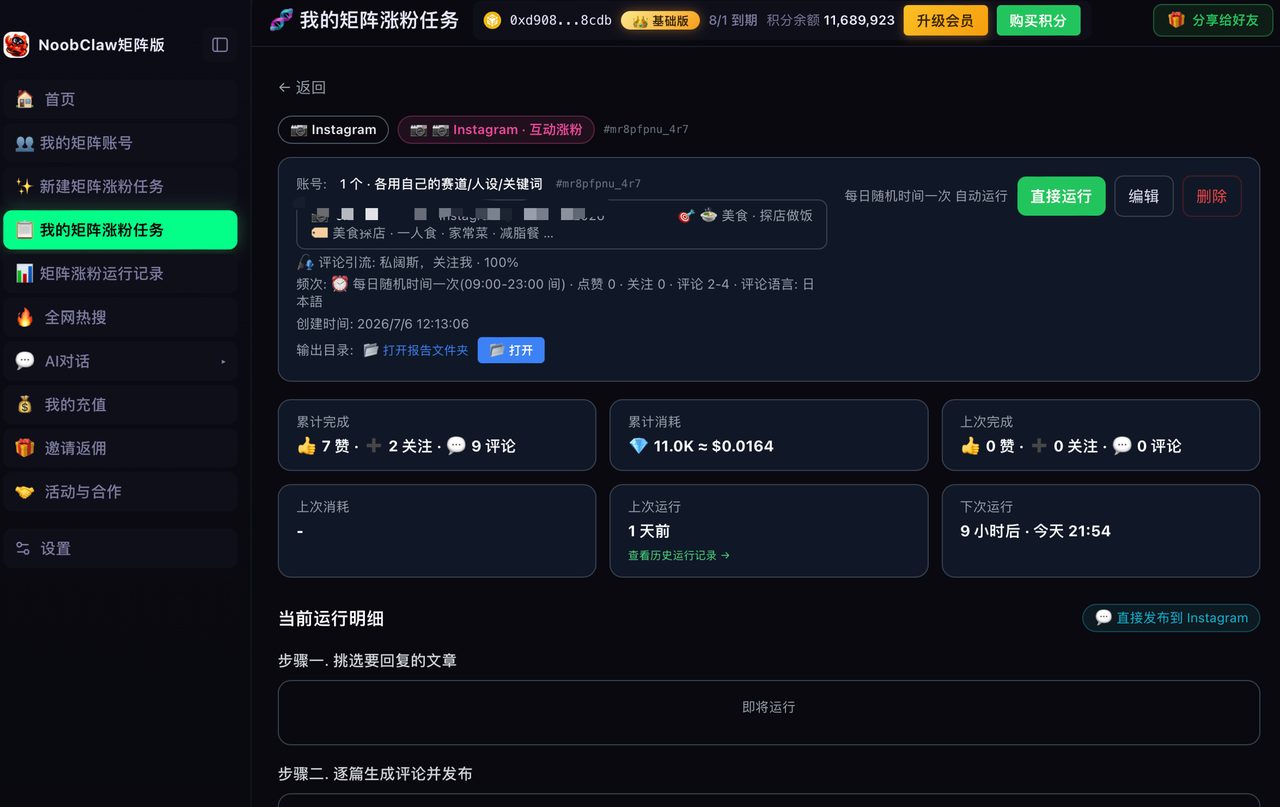
On that last point, if you do split: each account needs its own environment and its own genuinely distinct content, not the same posts redistributed. Two accounts posting the same material to the same people is worse than one. That is the whole reason tools like NoobClaw generate per-account content from each account's own niche and persona rather than broadcasting one draft — the point of splitting is divergence, and duplication destroys it.
When breadth is not your problem
Be honest about the alternatives before you restructure everything:
- A brand-new account has no pattern yet by definition. That is a data problem, not a niche problem — see how new accounts actually get established.
- A recommendation eligibility issue looks identical from the outside. Check your account status before assuming it is positioning; the difference between non-recommendable and shadowbanned covers how to tell.
- A hook problem. If people are being shown your content and not stopping, the system is doing its job and the content is not. Different fix entirely.
Narrowing a niche that was never the bottleneck costs you months. Rule out the cheaper explanations first.
FAQ
How long until narrowing shows results?
Expect it to take a meaningful number of posts, not a week. The system is updating a model built from your history, and history takes time to outweigh. A common mistake is reverting after ten days because nothing moved — that is roughly the point at which nothing could have moved yet.
Does deleting off-topic old posts help?
Generally not worth it. Recent activity carries far more weight than archived posts, and deleting removes engagement history that was doing you no harm. Change what you publish next rather than editing what you published last year.
My niche is narrow and I still get no reach. Now what?
Then legibility is not the constraint and you should stop optimising it. Look at retention within the first few seconds, at saves and shares rather than likes, and at whether the topic has enough searchable demand to be worth serving. The saves-versus-shares framework transfers directly.
A niche is not a cage. It is a promise specific enough that a stranger can decide whether to accept it — and that decision is the only one standing between you and everyone you have not met yet.