
How to Warm Up a New Instagram Account — And Why Every Day-by-Day Plan You've Read Is Made Up
- Instagram has never published a warm-up period, a day-by-day schedule, or new-account action limits. Every specific number you've read is a vendor's estimate.
- Third-party guides cluster around 7–14 days of light activity before serious posting, but they disagree with each other and most are published by companies selling proxies, antidetect browsers, or acc
- What is better supported: new accounts are treated as a stricter, separate risk tier than mature ones — the structure is more reliable than any number.
- The defensible approach is to warm up against a behavior profile rather than a calendar: vary your daily volume, vary your timing, and never repeat the same action count two days running.
Search this topic and you'll get a dozen articles with the same confident structure. Day 1: browse only. Day 3: like 10 posts. Day 7: your first post. Day 14: you're safe.
They contradict each other on almost every number. And they have something else in common that's worth noticing before you follow any of them: most are published by companies that sell proxies, antidetect browsers, or accounts.
The thing nobody says out loud
Instagram has never published a warm-up period. There is no official document that says a new account must wait N days, or may perform N follows on day 3. Not a help page, not a developer doc, not a blog post.
Which means every schedule you've read is one of two things: someone's operational experience generalized into a table, or marketing content from a company whose product is the thing the article recommends.
When a number appears with total confidence and no source, the useful question isn't "is it right" — it's "who benefits from me believing it."
You'll also find claims like "two accounts posting the same first Reel land at 200 views or 200,000, and the difference is the warm-up." That's an unfalsifiable sales line. Nobody ran that experiment with controls, and if they had, they'd publish the methodology rather than the punchline.
What is actually reasonably supported
Strip out the invented precision and a real, useful picture remains:
- New accounts are a stricter tier. Across many independent third-party sources, accounts in roughly their first 0–3 months hit limits earlier than mature ones. The sources disagree wildly on the numbers — by a factor of three or more — but they agree on the structure. The structure is the reliable part.
- Roughly 1–2 weeks of lighter activity is the common recommendation. Not because 14 is a magic number, but because every source lands in that neighborhood, which suggests it reflects real operational experience rather than a spec.
- Action blocks are real and observable. Whatever the exact thresholds, hitting them produces a visible result you can learn from — see what an action block actually means.
- Your account status is checkable. Instagram does surface an Account Status panel, which is a real signal rather than a guess — see how to check Instagram account status.
The number-by-number breakdown of new-account limits, including how badly the sources conflict, is in Instagram limits for new accounts.
Warm up against a profile, not a calendar
Here's the shift that makes this practical. A fixed schedule has a structural flaw: a rigid schedule is itself a pattern. Following exactly 10 accounts every day at 9pm for a week is not what a new human does. It's what a script does.
So the defensible version isn't a calendar. It's four rules:
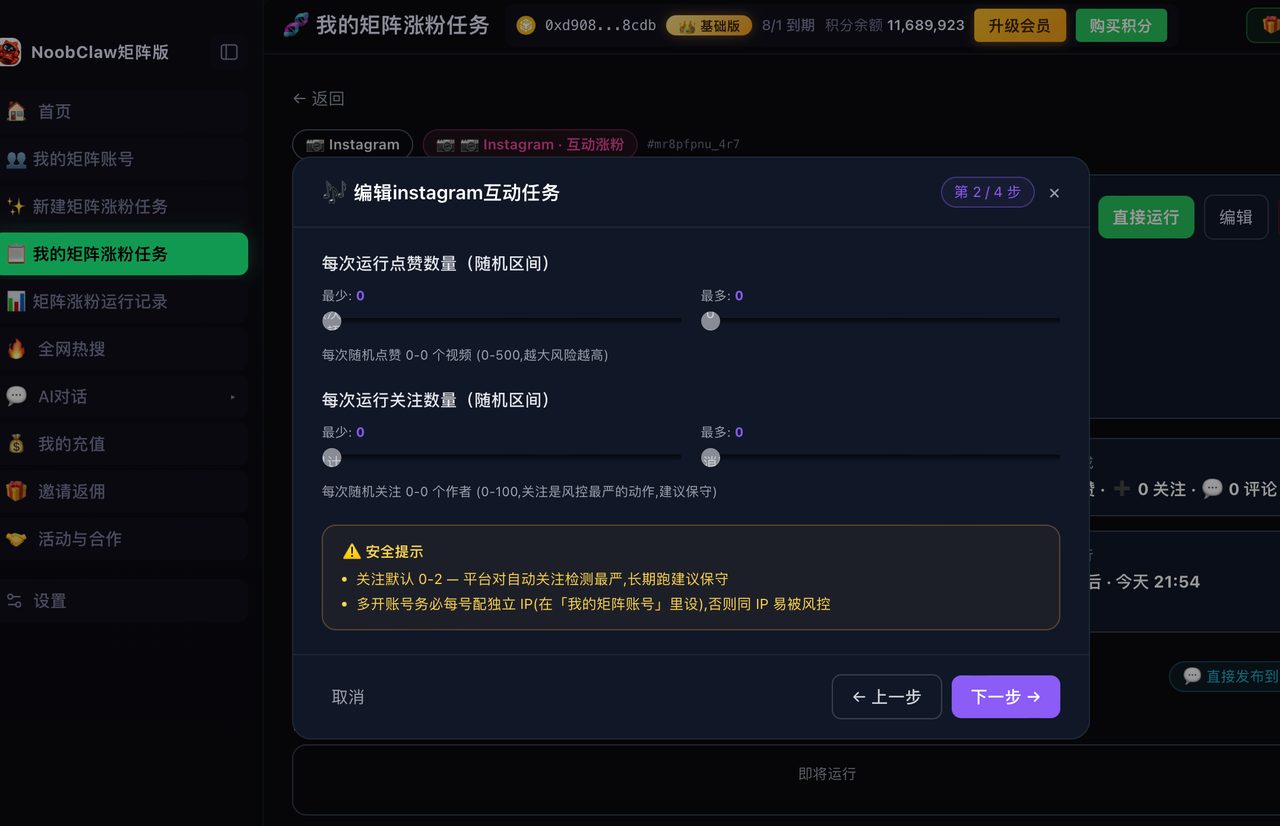
- Vary the volume. If you did 12 likes yesterday, don't do 12 today. Real usage is lumpy — some days heavy, some days nothing.
- Vary the timing. Same-minute daily activity is the single most mechanical signal you can emit. Spread actions across a wide window, and skip days.
- Consume before you produce. Scrolling, watching, and reading are the highest-volume things real accounts do and the lowest-risk things you can do. They're also the only part of warm-up nobody argues about.
- Post something before you engage heavily. An account with a few real posts and a filled-out profile reads differently from an empty account performing follows — regardless of what any schedule says.
This is also the honest framing for anyone running several accounts. Tools can enforce variance far more reliably than a person can — randomized action quotas, jittered timing, per-account browser profiles and IPs, so that ten accounts don't look like one script run ten times. That's what NoobClaw's randomized-interval design is for. But it's worth being blunt about the limit: no warm-up routine and no tool makes a batch of accounts safe if they then post near-identical content. Warm-up addresses behavior. It does nothing for content similarity, which is a separate and currently tightening problem.
How to read a warm-up guide critically
You will keep encountering these articles, so here is a filter that takes about thirty seconds each.
- Scroll to the bottom first. If the site sells proxies, antidetect browsers, or aged accounts, the recommendations will point at the product. That doesn't automatically make them wrong, but it explains why the numbers are so confident.
- Look for a source on the specific numbers. “Instagram allows 150 follows per day” should have a citation. It never does, because there is nothing to cite.
- Check whether different articles agree. Open three. If the follow limits differ by a factor of three — and they routinely do — none of them knows.
- Notice unfalsifiable claims. “The difference is the warm-up, not the content” cannot be tested and therefore cannot be wrong. That is a marketing sentence wearing a lab coat.
- Prefer structural claims over numeric ones. “New accounts are treated more strictly” is supported by many independent observers. “New accounts get exactly 100 follows on day 3” is supported by nothing.
What actually causes the outcomes people blame on warm-up
Here is the reframe that saves the most wasted effort. When a new account underperforms, warm-up is usually the least likely explanation among several better ones:
- The content isn't good yet. Uncomfortable, and by far the most common answer. Early posts on a new account are usually the worst posts that account will ever make — that is what a learning curve is.
- The niche isn't legible. Recommendation systems need to work out who to show you to. An account whose first ten posts cover five unrelated topics is genuinely hard to place, and the cost is distribution.
- The account looks incomplete. No bio, no profile photo, no posts, then aggressive following. That reads as low-effort regardless of pacing.
- The content duplicates something. If you run several accounts and they publish near-identical posts, similarity is the exposed variable — and no amount of warm-up addresses it. Platform detection of repeated content has tightened notably, and warm-up routines do nothing for it.
That last one is where multi-account operators lose the most time. They perfect the warm-up schedule, run it flawlessly across ten accounts, then feed all ten the same content — and conclude the warm-up failed. It didn't fail. It was solving a different problem.
FAQ
So how long should I actually wait before posting?
There is no verifiable answer, and anyone giving you one to the day is guessing. The defensible version: use the account like a person for one to two weeks — read, watch, follow a few things you genuinely care about — and post when the profile looks like it belongs to someone. That's not evasion; it's the most precise honest answer available.
Does warm-up prevent shadowbans?
No, and this conflation causes a lot of wasted effort. Warm-up addresses behavioral signals early in an account's life. Reduced distribution can also come from content that isn't recommendable, from repeated or unoriginal content, or from account-status issues — none of which warm-up touches. See non-recommendable vs shadowbanned for the distinction.
Is warming up on TikTok the same?
The principle transfers; the specifics don't. Platforms differ in how much early behavior matters relative to content signals — we ran through TikTok's version separately in TikTok account warming. Don't port a schedule from one platform to another; port the principle of variance.
One last thought worth carrying: the appeal of a day-by-day plan is that it converts anxiety into a checklist. That's a real comfort, and it's why these articles get written. But a checklist built on numbers nobody can source gives you the feeling of safety without the thing itself — and you deserve to know which one you're buying.