
Instagram Original Content Rules: Edits That Don't Count
- Instagram's Original Content Guidelines list six "minor and immaterial edits": borders, logos or watermarks or a credit line, thin reactions, purely descriptive text overlays, unrelated stickers or GI
- The page gives a one-line test: if someone could remove your contribution "and the content would virtually be the same, it probably needs more of you in it."
- The consequence is recommendations, not removal. An account that "primarily" posts unoriginal reels, photos or carousels may not be shown to new audiences; followers still see it.
- The way back is written down: eligibility returns when "most" of your recent posts are original in a rolling 30-day window, or you can remove the posts or appeal in Account Status.
If you searched "Instagram original content warning," you are probably looking at one of two things: an Account Status notice saying your content can't be recommended right now, or a sudden drop in reach to non-followers with no notice at all. Both lead back to the same page, Instagram's Original Content Guidelines, and that page is unusually concrete about which edits do not count.
(A different screen, the grey warning placed over a photo before you view it, is Instagram's sensitive content system. It has nothing to do with originality.)
Which edits does Instagram say don't count as original?
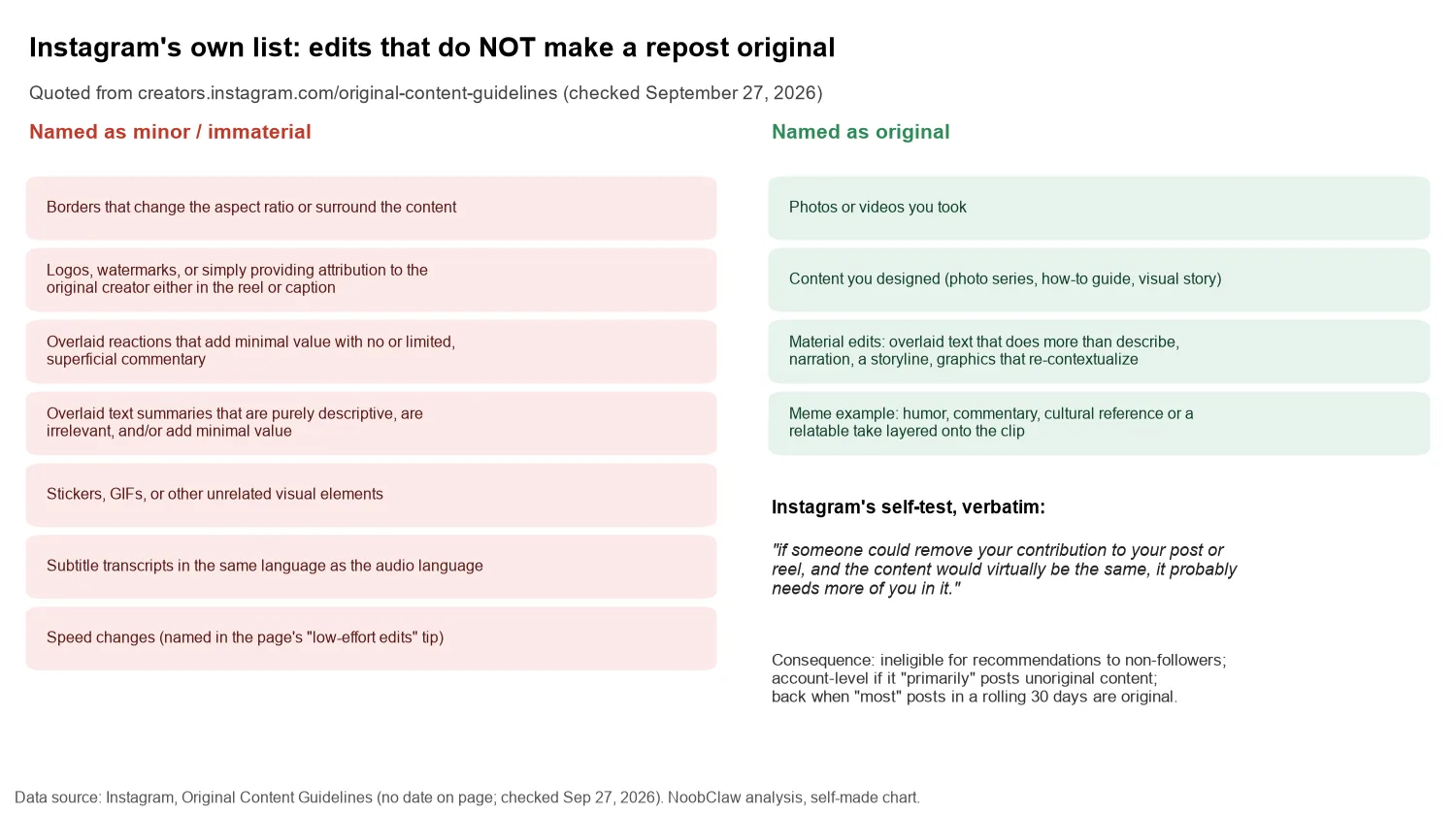
The guidelines list "examples of minor and immaterial edits," and say the list is "not limited to" these. On September 27, 2026 the list had six items. It sits in expandable cards that some text extractors miss, so we took it from the page's own HTML:
- "Borders that change the aspect ratio or surround the content"
- "Logos, watermarks, or simply providing attribution to the original creator either in the reel or caption"
- "Overlaid reactions that add minimal value with no or limited, superficial commentary"
- "Overlaid text summaries that are purely descriptive, are irrelevant, and/or add minimal value"
- "Stickers, GIFs, or other unrelated visual elements"
- "Subtitle transcripts in the same language as the audio language"
Elsewhere on the page, the advice for accounts that use other people's media names "speed changes" alongside borders, watermarks and "just crediting the original creator" as low-effort edits. The third-party summaries we checked on September 27 stop at borders, watermarks and credit. The last three items matter more for volume accounts, because reaction overlays, caption-style text and burned-in subtitles are exactly the "value-add" steps that templated workflows automate.
Item 6 is worded narrowly: subtitles in the same language as the audio. The page does not say whether translated subtitles count as material, so treat that as open rather than as a loophole. Our reading: by the page's own test, a translated subtitle track on an otherwise unchanged clip would still leave the content "virtually the same," so plan as if it does not count.
The page also gives a test you can run on any post: "if someone could remove your contribution to your post or reel, and the content would virtually be the same, it probably needs more of you in it." Its example is a screenshot of someone else's work: not original "even if you credit the original creator."
Crediting the creator is good manners. Instagram lists it next to watermarks as an edit that doesn't make the post yours.
What does count as original on Instagram?
The same page names three kinds of original work: "Photos or videos you took," "Content you designed" (a photo series, a how-to guide, a visual story), and "Content you materially edited," where "your addition meaningfully enhances the content you're using." For accounts that build on other people's media, it gives three practical directions: overlaid text "that does more than describe what's happening," narration, a storyline or graphics that "meaningfully re-contextualizes or offers more information than the original," and more than low-effort edits.
Meme accounts get their own example. When creators "add humor, social commentary, cultural references, or a relatable take by incorporating elements such as unique text, creative edits, and voiceover," Instagram says they are "producing something original." Notice what carries that sentence: a point of view the original did not have. Voiceover appears in the list, but only as a way of adding that point of view. A voiceover that narrates what is already on screen fails the remove-your-contribution test for the same reason a descriptive caption does.
For content you want to share without transforming, the guidelines recommend the built-in routes: "reposting to your followers or sharing the content to your stories," which keep credit and reach with the original creator. How those compare with re-uploading and Collab posts is laid out in posting the same Reel on multiple accounts.
What happens to an account flagged for unoriginal content?
The guidelines describe two levels. For a single post: "If we believe your content is unoriginal, it may be ineligible to appear in recommendations to people who don't already follow you." For the account: "If your account primarily posts unoriginal reels, photos, or carousels you didn't create or edit in a material way, your account may not be seen in recommendations to new audiences."
The account level is the one that hurts, and a separate Help Center page explains why: if your account is not eligible, "none of your content will be recommended regardless of whether or not all of your content goes against our Recommendations Guidelines." Your original posts go dark to strangers along with the reposts. Followers are unaffected; the guidelines say they "do not impact how we show people content from accounts they already follow." That is the familiar pattern of loyal likes and zero new reach, covered in your followers still see you, nobody new does.
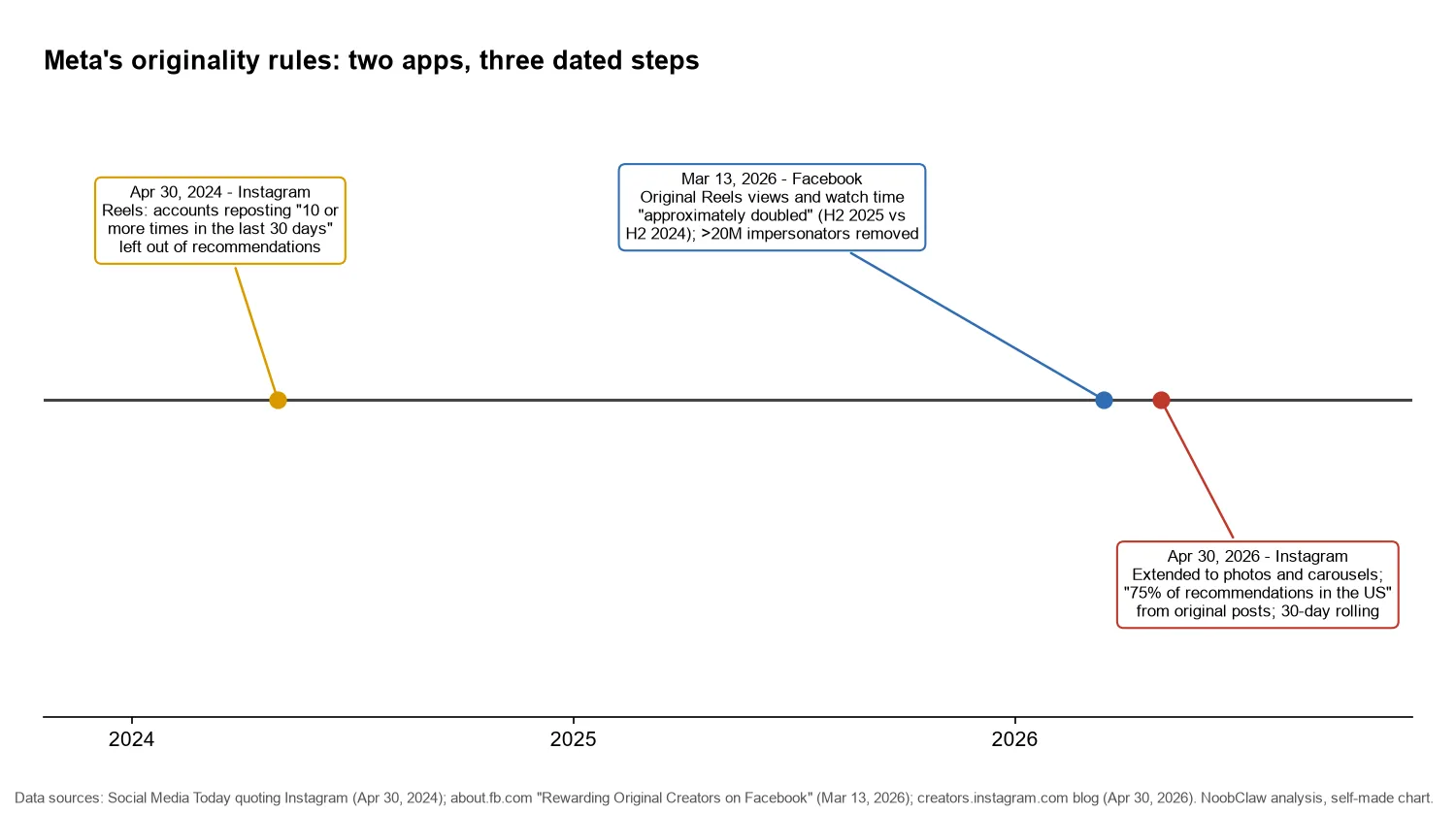
Two details change how you should read advice elsewhere. First, the rule is two-staged. In April 2024 Instagram said accounts that post others' content "repeatedly (10 or more times in the last 30 days)" would not be recommended, and that applied to Reels. The April 30, 2026 update extended protection to photos and carousels and said "75% of recommendations in the US" now come from original posts, but it uses "primarily" and "most," not the 10-post figure. Guides that quote "10 reposts in 30 days" as today's threshold, or reach drops of 60–80%, are quoting either the 2024 wording or nothing.
Second, Facebook runs a parallel rule, which matters if you post to both apps. Meta's March 13, 2026 Facebook update names "adding borders, inserting captions, and changing the reel's speed" as low-value changes, and says views and time spent watching original Reels "approximately doubled in the second half of 2025, compared with the same period in 2024." It also reports removing "more than 20 million accounts impersonating large content creators" in 2025. That is Meta grading its own policy, so read it as a stated direction rather than an audited result, but the direction is the same on both apps.
How do you get recommendations back?
The guidelines give the route in plain terms: "you can become eligible again when most of your recently posted reels, photos, and carousels are considered original in a 30-day period. This is calculated on a rolling basis." They also name two other routes: "remove unoriginal content or appeal the decision." All three run through Account Status, where the Help Center says you can see whether content is eligible for Explore, Search, Suggested Accounts, Reels and Feed Recommendations, view a sample of the post that triggered it, and edit, remove or disagree.
A workable order, based on those pages:
- Open Account Status first. If recommendations are not limited there, originality is probably not your problem, and the causes in reposting penalties on three platforms are a better place to look.
- If it is limited, look at the sample. It tells you which kind of post the system matched.
- Sort your last 30 days of posts against the six-item list and the remove-your-contribution test. Count honestly: a credit line or same-language subtitles is a "no."
- Decide per post: delete the clear copies, re-cut the near-misses so your commentary carries the piece, and appeal only where you believe the system got it wrong. Instagram itself says it "may not always get it right."
- Keep new posts clearly original for a full rolling month. Instagram publishes no restoration date and no percentage for "most."
For anyone running several accounts, the uncomfortable part is structural. A model built on finding good content and reposting it is, in Instagram's own words, not eligible for recommendations. The fix is producing more that is actually yours per account, which is a throughput problem. NoobClaw is one tool built around that: it generates each account's posts from that account's own niche, persona and keywords rather than pushing one asset everywhere. What no tool can do is turn a repost into original work; that is decided by whether you made the thing.
FAQ
Does adding a voiceover to someone else's clip make it original?
It can. Instagram names voiceover among the elements meme creators use to produce "something original," alongside unique text and creative edits. The test is whether your voiceover adds a perspective, joke or context the clip did not have. Narrating what is already on screen does not pass the remove-your-contribution test.
Does crediting the original creator make a repost OK?
Not for recommendations. "Simply providing attribution to the original creator either in the reel or caption" is on the list of minor edits. If you want to share without transforming the content, Instagram recommends reposting or sharing to your story. Separately, the guidelines remind you that permission to use someone's work is an intellectual-property question they do not answer.
How long does it take to get recommended again?
Instagram does not give a date. The condition is that most of your recent reels, photos and carousels are original within a rolling 30-day window. Removing the flagged content or appealing in Account Status are the other two routes; Instagram publishes no timing for any of the three.
Sources
- Everything you need to know about original content (Original Content Guidelines) — Instagram for Creators — undated, checked September 27, 2026 — https://creators.instagram.com/original-content-guidelines
- Rewarding original creators on Instagram — Instagram for Creators — April 30, 2026 — https://creators.instagram.com/blog/rewarding-original-creators-on-instagram
- Recommendations on Instagram (eligibility and Account Status) — Instagram Help Center — checked September 27, 2026 — https://help.instagram.com/653964212890722
- Why you're seeing a warning before you can view a photo or video — Instagram Help Center — checked September 27, 2026 — https://help.instagram.com/188848648282410
- Rewarding Original Creators on Facebook — Meta Newsroom — March 13, 2026 — https://about.fb.com/news/2026/03/rewarding-original-creators-on-facebook/
- Instagram updates its algorithm to prioritize original content (quoting Instagram) — Social Media Today — April 30, 2024 — https://www.socialmediatoday.com/news/instagram-algorithm-prioritize-original-emerging-creators/714777/