Shipinhao Marketing: Content, Comments and Platform Rules
- On WeChat Channels (Shipinhao) the official routes from a comment to a private conversation are a bound Official Account and WeChat Customer Service, which adds a "contact customer service" entry to t
- The comment thread itself has no public reply API that we could find. Tools that answer comments work inside the logged-in Channels web assistant, and clause 4.3 of the Operation Standards covers thir
- The Standards regulate how you invite contact (4.8.1 on excessive marketing, 5.20.2 on redirecting to personal contact details "through means not permitted by the platform") and how replies are produc
- In September 2026 China's regulator named a WeChat account that promoted AI "hosting" software which simulated real people running accounts and interacting in comments. Threshold-triggered replies dra
A viewer leaves a comment under your Channels video asking where to get the product. In most markets you would drop a link. On WeChat Channels a video cannot link out to an external website; what it can attach stays inside WeChat, typically a published article from a bound Official Account through the post form's "extended link" field (a WeChat developer-community thread shows the form rejecting an article that was never sent out). So where is that comment allowed to go next? WeChat answers part of it with two built-in features, and its Weixin Channels Operation Standards answer the rest.
Tencent's second-quarter 2026 results (August 12, 2026) put combined Weixin and WeChat monthly active accounts at 1,439 million as of June 30, 2026, and say Video Accounts' total time spent "grew more than 20% year-on-year in 2Q2026". We read every page cited here on September 28, 2026. There are no reply quotas or timing tricks below, because no official page publishes any.
What official routes does WeChat Channels give from a comment to a conversation?
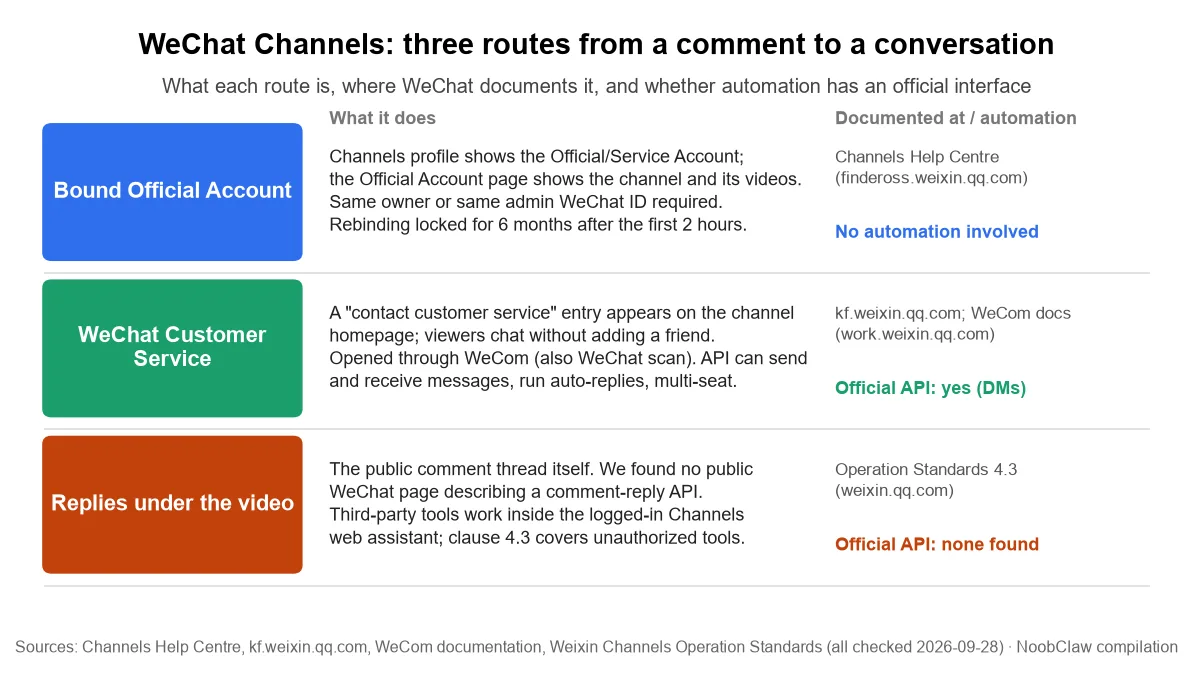
Route 1: a bound Official Account. The Channels help centre page on binding an Official Account gives the path (channel profile, top-right menu, "Account security and binding") and two alternative conditions: the accounts share a legal entity, or the Official Account admin's WeChat ID matches the channel admin's. After binding, the channel profile displays the Official Account and the Official Account page displays the channel and its videos. One detail teams miss: the binding can be changed within the first 2 hours, then is locked for 6 months.
Route 2: WeChat Customer Service on the channel homepage. The WeChat Customer Service site lists Channels among its entry points, says customers can chat "without adding a friend", and states that companies "can send and receive customer-service messages and manage customer-service accounts through the API, to implement multi-seat collaboration, auto-reply and other functions" (our translation). Sign-in is by WeCom (Enterprise WeChat) QR code, with WeChat scan also supported. The WeCom page on connecting customer service inside Channels adds: the company can only pick a channel it has already bound; after connection "a contact-customer-service entry appears on the company's Channels homepage, and users tap it to start a consultation"; and the entry can be reassigned or hidden later. The developer reference is the WeCom API documentation.
Route 3: the comment thread itself. Here the official trail stops. We searched the public WeChat and WeCom documentation for an interface that reads or answers comments under a video and did not find one. That does not prove none exists, but the two tools we looked at (one Chinese vendor's, and ours) both work by operating the Channels web assistant in a logged-in browser, which places them under clause 4.3 below. Private messages have an official, API-backed path built for companies; public comments have none.
On Channels the exit from a comment is a feature you switch on, not a reply you type: bind the Official Account, connect customer service, and let the viewer come to you.
What do the Operation Standards say about lead generation in comments?
The Standards never use the word "lead". They regulate how you invite contact and how the replies are produced. The English text is official, but in any discrepancy "the Simplified Chinese version shall prevail", clause 7.2 says the Standards are "subject to change", and the page carries no date.
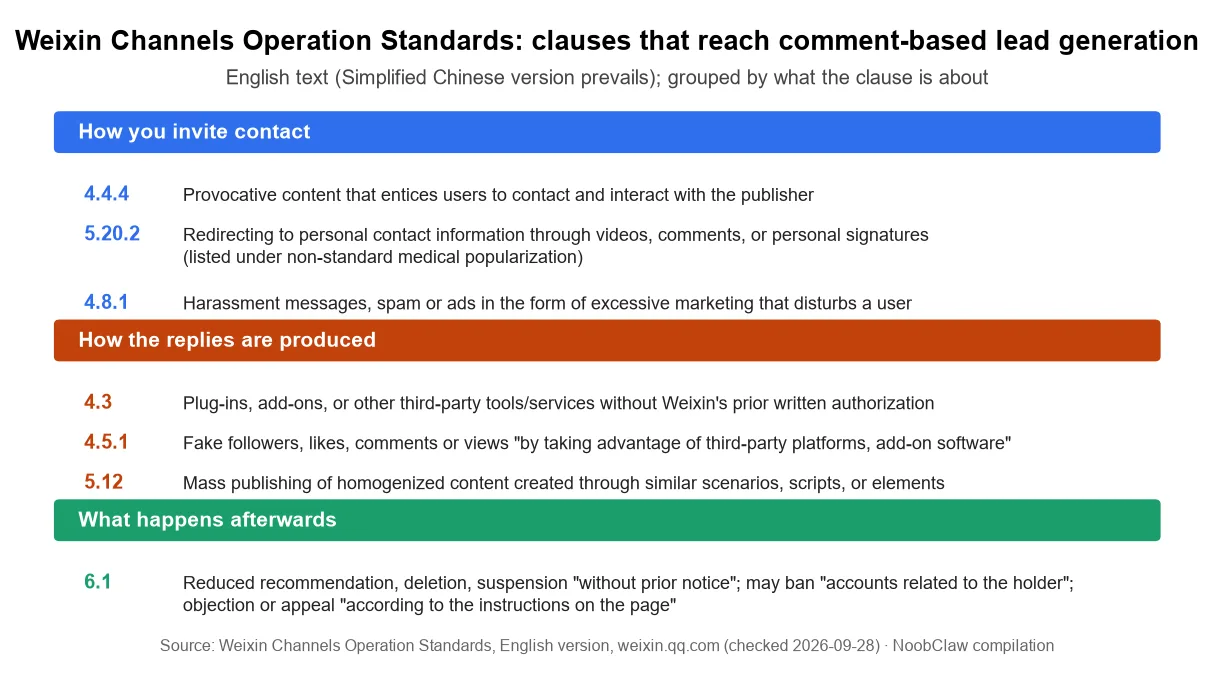
How you invite contact
- 4.8.1 covers "harassment messages, spam or ads in the form of excessive marketing or business promotion that disturbs and harasses a user". Answering a question is one thing; the same pitch pasted under every comment is what this clause describes.
- 5.20.2 names "redirecting to personal contact information through videos, comments, or personal signatures". It sits under 5.20, "non-standard medical science popularization", so its literal scope is medical. The prevailing Chinese text adds a qualifier the English drops: the redirection is a violation when done "through means not permitted by the platform" (通过未经平台许可的方式), which is one more reason to route contact through the two official features. Our judgment: treat that as the default in every niche.
- 4.4.4 in the English text reads "provocative content that entices users to contact and interact with the publisher"; the prevailing Chinese text is narrower and names "provocative dating-type content" (煽动性的交友内容). Read literally it is about lonely-hearts bait, not product questions, so we cite it only as the nearest clause on solicitation, not as a rule against inviting contact in general.
How the replies are produced
- 4.3 lists "using plug-ins, add-ons, or other third-party tools/services without Weixin's prior written authorization to access Weixin and its related systems". Every comment tool that drives the web assistant is covered, ours included.
- 4.5.1 bans fake "followers, likes, comments, or views" obtained "by taking advantage of third-party platforms, add-on software, or vulnerabilities", and 4.5.2 says making or sharing click-fraud tools "will be subject to harsh penalty". Manufacturing comments, not answering them, is what is named here.
- 5.12 covers "mass publishing of homogenized content created through similar scenarios, scripts, or elements". A phrase bank rotated across hundreds of replies is the closest thing in comment automation to this wording.
What happens afterwards
Clause 6.1 allows reduced recommendation, deletion, suspension or termination "without prior notice", and lets Tencent restrict or ban "accounts related to the holder"; a channel is tied to a WeChat account, so that reach includes the operator's WeChat identity. The same clause gives the way back: the user "may initiate an objection or appeal according to the instructions on the page".
Can you automate replies on WeChat Channels?
Private messages: yes, officially. The customer-service API quoted above is built for this: auto-replies, multiple agents, a written record. It requires a company entity on WeCom rather than a personal channel.
Comments: only through unofficial tools, and the method matters. One Chinese vendor's configuration guide, published June 15, 2025, states that its comment auto-reply is triggered by view-count and comment-count thresholds, that "the comment side currently has no keyword recognition", and that replies are "drawn at random from your configured phrase library, or use a fixed phrase, not custom replies generated for the specific comment" (our translation). That is one design. The other reads each comment and writes an answer to it. Our judgment is that the first carries more risk on Channels, because it reproduces the wording of 5.12 and of the regulator case below.
On September 2, 2026 the Cyberspace Administration of China published its second-phase report on the "Qinglang" campaign against AI misuse: cumulatively more than 5.61 million items removed, more than 49,000 accounts dealt with, and more than 2,400 websites and apps handled. Its sixth case concerns a WeChat account (name masked) that, with Weibo and Douyin accounts, promoted AI "hosting" software, "simulating real people to run accounts and interact in comments, generating large amounts of low-quality, homogeneous copy" (our translation). The campaign's April 30, 2026 notice lists the underlying behaviors: AI hosting that simulates real people to batch-register and operate accounts, batch-generated homogeneous copy, and social bots used to inflate metrics and steer comment sections.
Whether a given reply tool falls inside that description is decided by Tencent and the regulator, not by the vendor or by us. What an operator controls is narrower: whether each reply addresses the comment it answers, whether the same text repeats across accounts, whether contact details appear in comments, and whether a person reviews what went out and can stop it.
NoobClaw is one of the tools in the second category. Its "reply to fans" task covers Channels: it runs in a browser on your own machine with your own QR-code login, does not take your password, reads each follower comment on your recent videos and writes a reply in that account's persona, and skips comments you already answered. It is a third-party tool, not an authorized Weixin integration under clause 4.3, and Channels sessions expire and must be rescanned. The Chinese-language comparison of comment, DM and live-stream reply tools, 视频号评论自动回复软件怎么选, reaches the same split.
What should an overseas team settle before running Shipinhao marketing?
- Who holds the account. The help centre states the registration cap as "one person one account, one enterprise two accounts", and the Standards allow one channel per WeChat account (3.1). The official ways to add people rather than accounts are in what WeChat Channels' own rules allow.
- Where the conversation should land. For subscribers, bind the Official Account and accept the 6-month lock. For enquiries answered by staff, connect WeChat Customer Service, which needs a WeCom entity and a channel it has bound.
- What goes into a comment reply. An answer to the question. Not a phone number, not a WeChat ID, not the same pitch under every comment (5.20.2, 4.8.1, 5.12).
- What you will do when a comment disappears. Channels can restrict a comment's display (see 评论被限制展示是什么意思), a mechanism separate from any tool.
FAQ
Can I put a link or my WeChat ID in a Channels comment?
Comments carry no clickable links at all, and a video's attachments stay inside WeChat (an article from a bound Official Account, for example), never an outside URL. Clause 5.20.2 names "redirecting to personal contact information through videos, comments, or personal signatures" as a violation (in the medical section; the Chinese text adds "through means not permitted by the platform"). Our reading: keep contact details out of comments and use the two official entries.
Is there an API to reply to comments on WeChat Channels?
We found none on any public WeChat or WeCom page. The documented API is WeChat Customer Service, which handles private consultations started from the channel homepage. Comment tools operate the web assistant in a logged-in browser, which clause 4.3 covers.
Does automating replies risk my personal WeChat account?
Clause 6.1 lets Tencent restrict or ban "accounts related to the holder", and a channel is registered through a WeChat account. Tencent decides what is related, so treat any Channels tool as touching your WeChat identity and keep a person reviewing what is sent.
Sources
- Weixin Channels Operation Standards (English) — Tencent / Weixin — undated, checked September 28, 2026 — https://weixin.qq.com/cgi-bin/readtemplate?lang=en_US&t=weixin_agreement&s=video
- 微信视频号运营规范 (Simplified Chinese, prevailing version) — Tencent / Weixin — checked September 28, 2026 — https://weixin.qq.com/cgi-bin/readtemplate?lang=zh_CN&t=weixin_agreement&s=video
- 微信客服 (WeChat Customer Service) — Tencent — checked September 28, 2026 — https://kf.weixin.qq.com/
- 在视频号中接入 (Connecting customer service in Channels) — WeCom — checked September 28, 2026 — https://work.weixin.qq.com/nl/act/p/a7446b4905dc49cf
- 微信客服 API documentation — WeCom Developer — checked September 28, 2026 — https://developer.work.weixin.qq.com/document/path/94638
- 视频号如何绑定公众号? — WeChat Channels Help Centre — checked September 28, 2026 — https://findeross.weixin.qq.com/cgi-bin/mmfindernodelivecrmwebbroker-bin/helper-center/pages/GqqxqNGAOOT6FLby
- 一个企业主体可以申请多少个视频号? — WeChat Channels Help Centre — checked September 28, 2026 — https://findeross.weixin.qq.com/cgi-bin/mmfindernodelivecrmwebbroker-bin/helper-center/pages/a44LC9yBnijMNldV
- Tencent Announces 2026 Second Quarter Results — Tencent Holdings — August 12, 2026 — https://www.tencent.com/wp-content/uploads/2026/08/Tencent-Announces-2026-Second-Quarter-Results.pdf
- 中央网信办深入开展"清朗·整治AI应用乱象"专项行动第二阶段工作 — Cyberspace Administration of China — September 2, 2026 — https://www.cac.gov.cn/2026-09/02/c_1790099041364574.htm
- 中央网信办部署开展"清朗·整治AI应用乱象"专项行动 — Cyberspace Administration of China — April 30, 2026 — https://www.cac.gov.cn/2026-04/30/c_1779289298718765.htm
- 视频号评论自动回复配置指南 (vendor configuration guide) — 即刻视频号矩阵工具 — June 15, 2025 — https://sphkit.com/blog/comment-reply-automation-tutorial
- 视频号扩展链接提示"未群发内容无法添加" (community thread on the extended-link field) — WeChat Open Community — May 12, 2022, checked September 28, 2026 — https://developers.weixin.qq.com/community/minihome/doc/0004c034138028cac4ed49c0556000