X Growth Tools: Content, Scheduling and Evidence
- Define the missing content or workflow stage before buying.
- Compare current capabilities and billing periods, not unrecorded survival stories.
- Accepted drafts, confirmed publications and follower changes need different evidence.
Choose an X growth tool by the task you need completed: preparing a useful post, organizing an approved publishing workflow or understanding observed audience response. None of those deliverables establishes guaranteed follower growth. This article has no recorded five-tool experiment, four shadowbans or a surviving winner. It compares the available official product descriptions and gives a framework for reviewing the missing stage in your own work. Buffer offers content assistance and scheduling features; NoobClaw's documented example covers a local video draft. Check the particular destination connection before treating either production result as a completed X publication.
Buy the missing task, then measure the result it actually produces.
First decide whether your problem is content or workflow
A hypothetical founder who has something useful to explain but no accepted draft has a creation problem. A team with reviewed posts that cannot track approvals has an organization problem. An operator with published work but no reliable response records has a measurement problem. The phrase growth tool hides all three. Write down the blocked task and the artifact that would resolve it before comparing products. A feature list is easier to assess when the desired result is concrete.
For the creation task, prepare a short brief with the audience question, verified product fact and original example. Ask for a candidate that answers that question without inventing an experience or outcome. An editor should be able to identify the source behind the claim and the contribution supplied by the business. A generic rewrite of somebody else's popular post does not establish that your own explanation is accurate, useful or properly supported.
For the workflow task, list who approves the post, which destination is involved and what counts as a confirmed publication. Request a demonstration using that actual type of content and account setup. A calendar preview is useful for planning but does not prove a destination accepted the post. Keep unresolved attempts visible rather than counting them as delivered. Separate product support for a connection from the conditions applying to the action performed through it.
For response analysis, decide which observed question matters. A reply about a product limitation may help improve the next explanation, while a follower count describes a broader audience change. A link click does not establish that the reader became a buyer. Preserve the date, version and observation window before comparing results. This makes the next editorial decision more specific without claiming that one tool independently caused every difference.
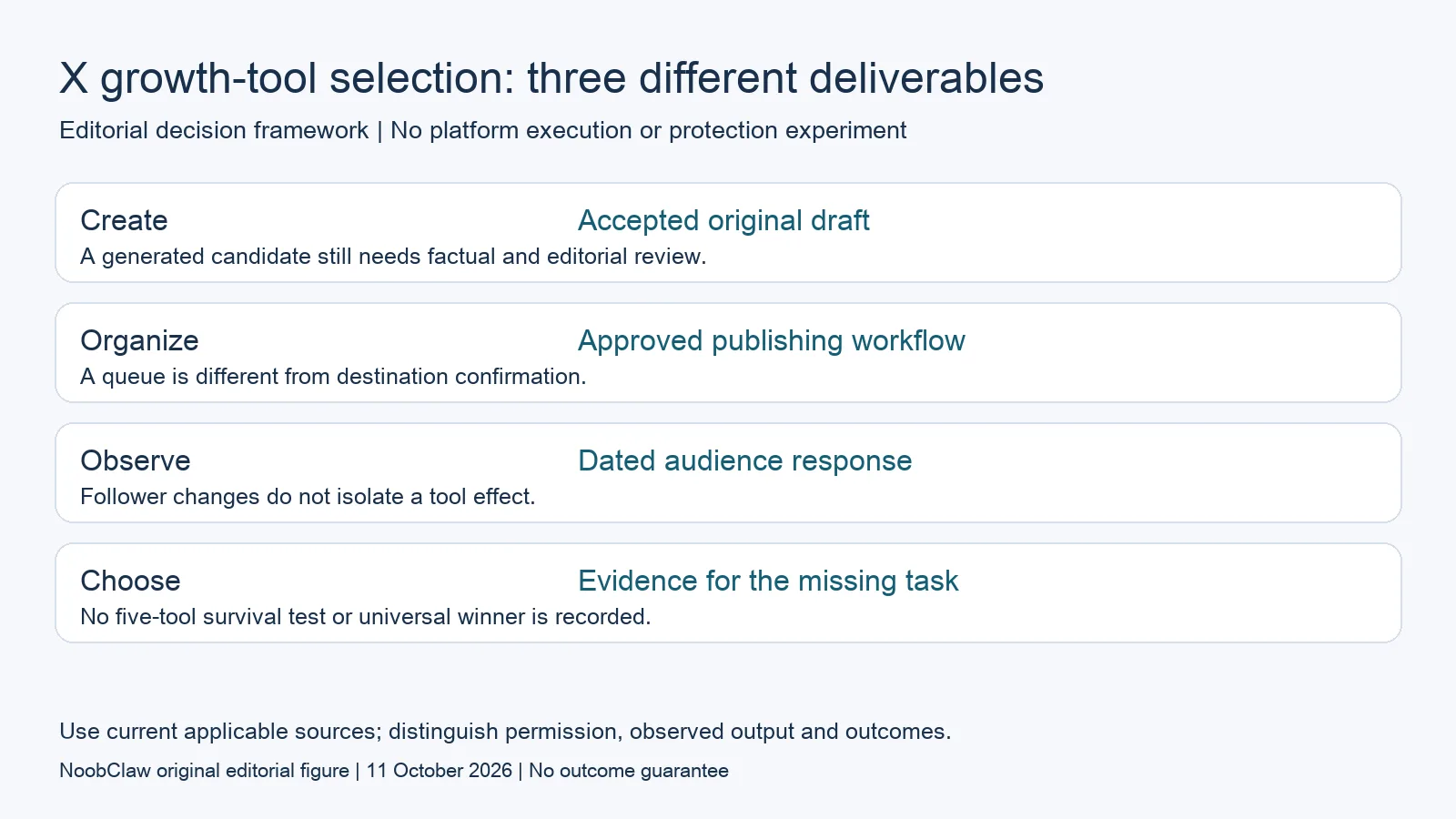
- Create: Accepted original draft. A generated candidate still needs factual and editorial review.
- Organize: Approved publishing workflow. A queue is different from destination confirmation.
- Observe: Dated audience response. Follower changes do not isolate a tool effect.
- Choose: Evidence for the missing task. No five-tool survival test or universal winner is recorded.
What the current product descriptions actually support
Buffer's official feature material includes its AI Assistant, planning, scheduling, analytics and community functions. Its channel list includes X. Free supports three connected channels and ten queued posts per channel. For the first ten channels, paid monthly rates are $6 for Essentials and $12 for Team; annual billing has different amounts. Check the current offer and the required feature before purchasing, rather than describing Buffer as a scheduler with no creation capability.
That description does not make every requested output equivalent. A tool that helps refine post text need not supply the same artifact as a local script-to-video task. A queue helps organize approved pieces but does not replace review of the claims in those pieces. A reporting feature can display observations while leaving interpretation to the reader. Ask the vendor to show the exact feature you require and preserve the result of that demonstration separately from the marketing description.
NoobClaw's public execution record below is concrete evidence for one local creation output, with stated limitations. It does not establish an X scheduling integration or a follower result. A buyer whose current need is that type of draft can inspect the artifact and operating guide. A buyer seeking a different production format or destination action needs corresponding evidence. Do not convert an advertised platform list into a claim that every feature works for every destination and account.
X's current automation rules prohibit non-API website automation and automated likes, and impose conditions on other actions. A tool described as human-like does not gain approval through that label. Read the method and proposed action together. This article makes no prediction that a particular operation will be punished or that another method protects the account. The related commercial reviews linked below discuss their own supported scope rather than providing a universal growth ranking.
Run a bounded buying test and keep its actual result
A hypothetical buying test can use one original product brief and a defined acceptance checklist. Ask the candidate tool to complete the specific stage it claims to handle. For a draft, inspect the answer, source accuracy and editorial quality. For a publishing workspace, inspect approval and actual destination confirmation. Do not add a follower target merely to make the test sound commercial. A short demonstration cannot establish a long-term audience effect.
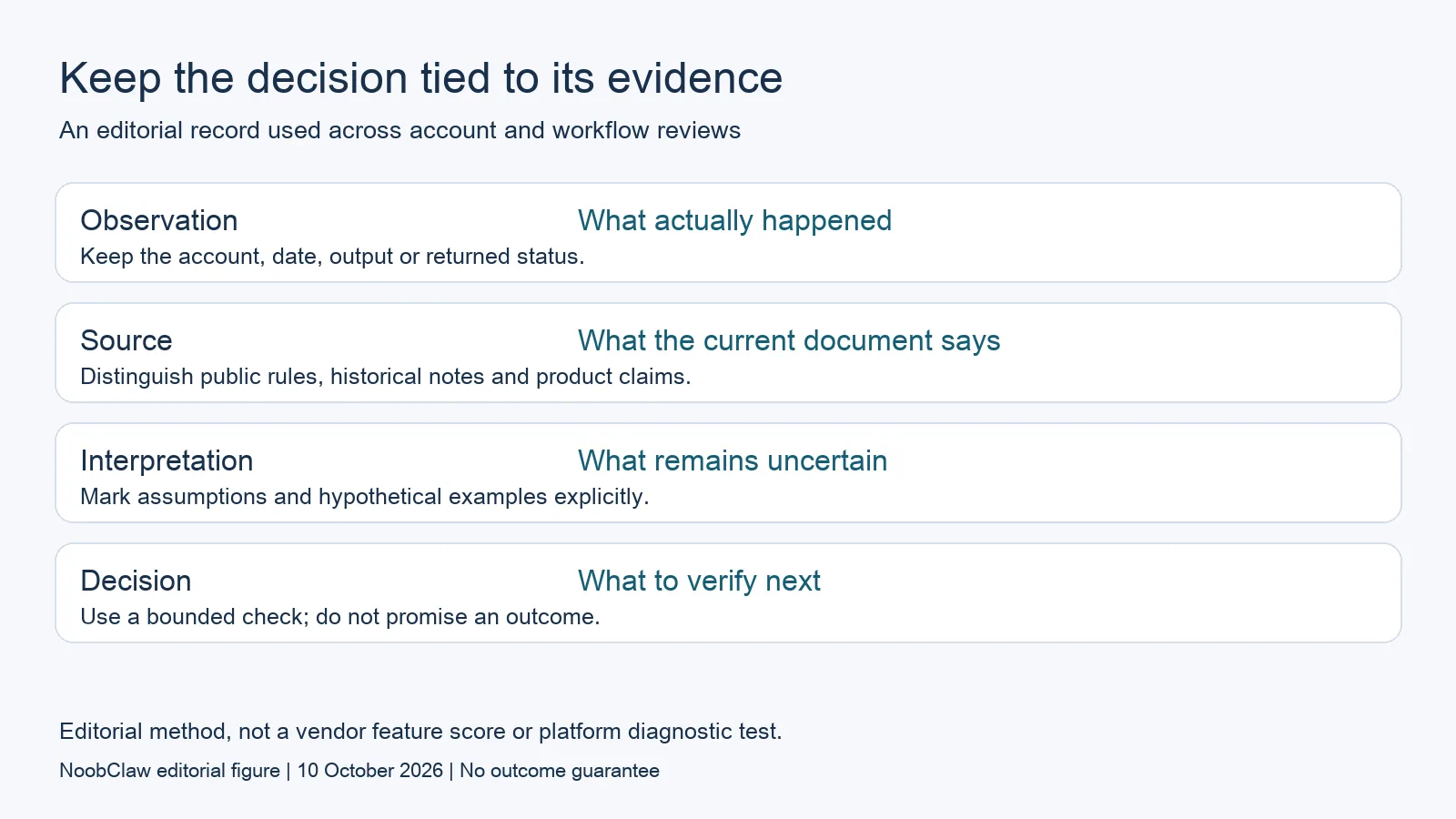
Record rejected work and the reason for rejection. If an output adds a feature the product does not have, that is a factual failure even when the writing is fluent. If an export has unreadable captions, it needs revision even when generation succeeded. If an action remains unresolved, retain that state. A record of accepted and rejected candidates is more useful to a purchaser than an unqualified claim that the tool worked flawlessly.
Compare cost for the accepted task and the actual billing unit. A per-channel subscription and a generation-credit allowance describe different limits. Include the editing and additional services still needed to finish the work. Do not divide a subscription price by a hypothetical number of videos and call the result a measured cost. A realistic estimate can be conditional, but its assumptions should remain visible to the buyer.
After permitted publication, review the observed response over a stated period with its sample size. Preserve changes in topic, audience, staffing and timing that may affect the comparison. A follower increase is not proof that the subscription caused growth, and a lack of warnings is not proof of account protection. Use the actual evidence to choose the next content improvement. The aim is a task that can be inspected and improved, not an invented story about a winning tool.
For the related content and workflow decisions, read NoobClaw vs Hypefury: Current Support, Prices and Fit and Buffer Alternative for AI Content: Compare the Actual Job. Each review has its own evidence and scope.
Inspect the documented creation result
NoobClaw is the publisher and a vendor. Its public creation record documents one supplied 441-character script becoming a 32.6-second local MP4 at 1080 by 1920 and 30 frames per second. The record includes sampled subtitle checks and limitations: some stock visuals did not closely fit the meaning, and full audio and visual review remained necessary. It records no X publication, follower comparison or paid result. An editor can inspect the artifact and decide whether that creation stage meets a particular brief. A buyer who needs scheduling or a live destination connection should request evidence for that separate operation. The operating guide describes the local task, not approval by another platform. No comparison in this article establishes an account-protection winner, automatic audience growth or a return on the subscription price.
Inspect the public script-to-video execution record and the script-to-video operating guide. Check the current product offer against the task you need.
Frequently asked questions
Which X growth tool guarantees more followers?
No guarantee is established by the evidence here. Define the production or workflow task and evaluate that deliverable before interpreting audience changes.
Does Buffer only schedule posts?
No. Its official materials include an AI Assistant and other content, community and reporting functions. Check the current plan and required destination feature.
Did NoobClaw win a five-tool account test?
No such test is recorded here. The cited example is a local video draft with documented properties and limitations.
Sources
Official material reviewed on October 11, 2026. Document conditions apply to their stated service and scope; the editorial examples are explicitly hypothetical.