TikTok Multi-Account Automation: Identity and Review
- Maintain an account register with ownership, intended content and approval responsibilities.
- Separate browser data can aid organization; it does not prove that accounts are unlinkable or protected.
- Verify the intended destination and the result of each supported publishing method.
- No 5-2-1 safety rule, randomized rest-day benefit or 12-account survival result is established here.
TikTok multi-account automation should begin with account ownership, approved content and destination checks. Separate profiles can help an operator keep browser data apart, but they do not establish permission for an action or immunity from restrictions. There is no preserved 12-account, 90-day survival experiment supporting the old safety story on this page. A useful operating record identifies who owns each account, which content belongs there and which stage of the work has actually been completed.
Keep account identity and content approval visible at the handoff. More accounts do not turn an unverified action into a supported workflow.
Build an account register before a batch workflow
Begin with accounts you are authorized to operate. For each one, record its public identity, purpose, owner, approved operators and content responsibilities. Keep credentials out of a shared editorial register. The register should answer which account a draft belongs to and who may approve it. If those answers are unclear, a batch-selection interface merely makes an unclear operation easier to repeat.
Define a content reason for each destination. For example, a business may have distinct accounts for products with genuinely different audiences or languages. That is a hypothetical operating situation, not evidence that multiplying accounts improves reach. The same approved factual brief can support different explanations, but the versions should be reviewed for their actual audience and destination rather than copied blindly into every available account.
Record the account identity at the handoff from editorial work to publication. An internal nickname is not enough if two destinations have similar names. Include a public handle or another unambiguous identifier that the operator can check. The goal of this register is avoiding an unintended destination and preserving responsibility. It does not claim to prevent TikTok from identifying relationships between accounts.
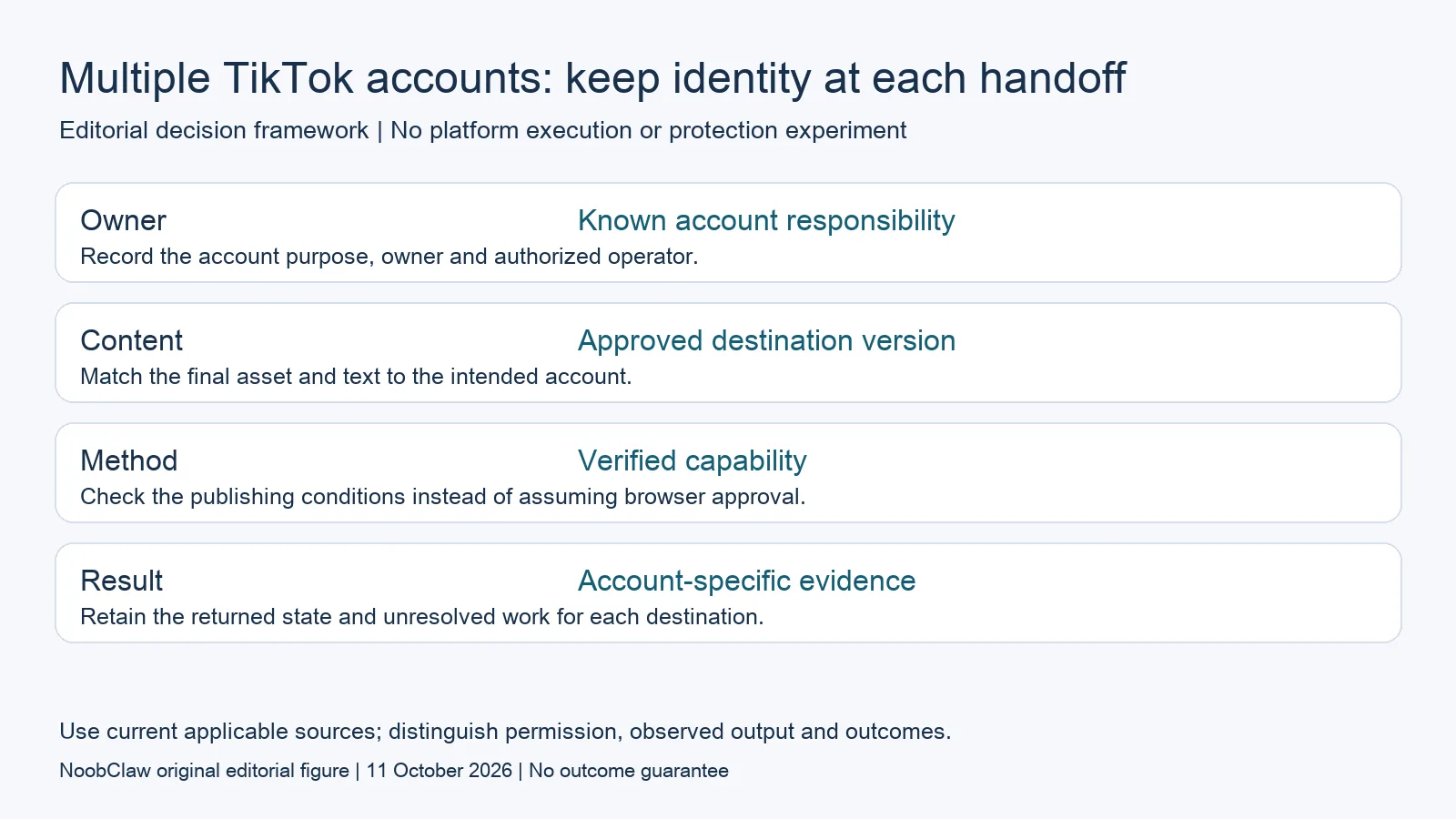
- Owner: Known account responsibility. Record the account purpose, owner and authorized operator.
- Content: Approved destination version. Match the final asset and text to the intended account.
- Method: Verified capability. Check the publishing conditions instead of assuming browser approval.
- Result: Account-specific evidence. Retain the returned state and unresolved work for each destination.
Use profiles for organization, not a protection claim
Google documents separate Chrome profiles for browser information such as bookmarks, history, passwords and settings. That is a documented organizational capability. It is not evidence that profile separation conceals every device signal, supplies a different person or guarantees that platform restrictions remain isolated. A profile label is also not the same as a confirmed destination account inside a site.
Before an account task, inspect the active destination rather than trusting the profile name alone. An operator can retain a simple non-sensitive record of the account identity and intended action. If the displayed account differs from the approved destination, stop the task and resolve the mismatch. This is a proposed operational check; it does not establish a browser automation method as authorized or certify a vendor's fingerprint implementation.
TikTok's March 2025 Security Checkup announcement includes recovery methods, two-step verification, device review, suspicious-activity information and passkeys. Review account security using the actual available controls. Random rest days, simulated locations and low interaction counts are not equivalent to those controls, and this article establishes no causal account-protection result for any of them.
Keep content approval separate for each destination
A draft approved for one account is not automatically approved for every other one. Retain the factual brief and the final asset, then identify which version belongs to each destination. Review language, product availability, dates and statements about the audience. An assistant can propose variants, but a variant that invents a regional offer or customer experience needs correction before it becomes an approved version.
In a hypothetical two-account product launch, one account explains a feature and another explains setup for a different audience. The shared brief contains only confirmed specifications. The reviewer checks both scripts, verifies that each caption names the correct offer and retains the approved files. That scenario is an editorial example, not a launch we ran, an account matrix experiment or a measured distribution advantage.
NoobClaw's public creative execution record documents one local script-to-video result with voiceover and subtitles. It does not demonstrate that two accounts received that file or that a batch-publishing workflow succeeded. Some sampled stock material needed further relevance checking. If you evaluate the creation capability, inspect the draft and output; if you evaluate multi-account publication, require a separate demonstration of that exact task.
Treat publication and measurement as account-specific
Write down the supported method used for each destination and inspect its conditions. An account connection, a queued draft and a publicly available post are separate states. Retain the approved version and the returned result so an uncertain attempt can be inspected before a retry. Do not mark an entire batch complete because one account produced a successful result or because the software displayed a general completion message.
Keep unresolved work attached to the affected destination. If one task remains queued while another is public, record those states separately. If a workflow did not demonstrate publication, leave that capability unverified. Do not interpret an unclear result as a hidden penalty or infer why several accounts changed together from their shared timing alone. Such explanations need account-specific evidence rather than a theory about private detection signals.
Compare audience measurements using their definitions and observation periods. An automated action, a profile visit, a view, a new follower and a paid order are different observations. A larger account count is not a growth result. When content, timing and account mix change together, an observed difference does not isolate the effect of profile separation or any other single feature. The operating record should first establish what was done and where.
For the related content and workflow decisions, read Human-Like Automation: Execution Is Not Account Approval and TikTok Automation: Content Creation and Publishing Limits. Each review has its own evidence and scope.
A destination-by-destination handoff record
Use a proposed handoff table containing the account identity, approved content version, approval owner, intended method, observed state and remaining work. For a creator who needs only video production, the record can stop at the accepted local file; it should not imply publication. For a publishing evaluation, retain the actual destination and the result for each account. Avoid storing passwords or session tokens in the editorial table. This operating method addresses responsibility and traceability rather than simulating different people. It supplies no universal account-count limit, hardware capacity promise, protective interaction quota or experiment showing that a multi-account system survives restrictions.
NoobClaw publishes this article. Its script-to-video guide and public creative execution record document a local video result, not TikTok publication. Check the current product offer against the supported action you need.
Frequently asked questions
Do separate Chrome profiles guarantee isolated TikTok accounts?
Chrome documents separation of browser information. That does not establish that TikTok cannot relate accounts or that restrictions cannot affect another account.
Is five likes, two follows and one comment a verified safe rule?
No. This review establishes no safe numerical engagement quota or benefit from randomized rest days.
Does a local video export prove a successful account batch?
No. Each publishing destination and returned state needs its own evidence. A local file establishes the creation stage only.
Sources
Official material reviewed on October 11, 2026. Document conditions apply to their stated service and scope; the editorial examples are explicitly hypothetical.