
Trial Reels vs TikTok 'Don't Show on Profile': Which to Use
- Instagram Trial Reels keep a video away from your followers, show metrics after about 24 hours and can auto-share it to followers if it performs well on its first 72 hours of views.
- In TikTok's help pages, "Don't show on TikTok profile" is the former name of "Show through ads only", a Spark Ads setting whose posts get no organic views at all.
- An organic, Trial Reels-style version was seen as an iOS test in September 2025. A year on, TikTok has published no announcement or help page for it.
- Judge any trial post on ratios such as watch-through, saves and shares, not total views. On TikTok, the filtering still has to happen before you publish.
The most expensive thing in a creator's week isn't the video that flopped. It's the four videos you didn't make because you were afraid they'd flop publicly.
Instagram ships a feature aimed squarely at that fear, and TikTok has been seen testing one. They're often described as the same thing. They aren't, and on TikTok the name itself is a trap.
The mechanical difference
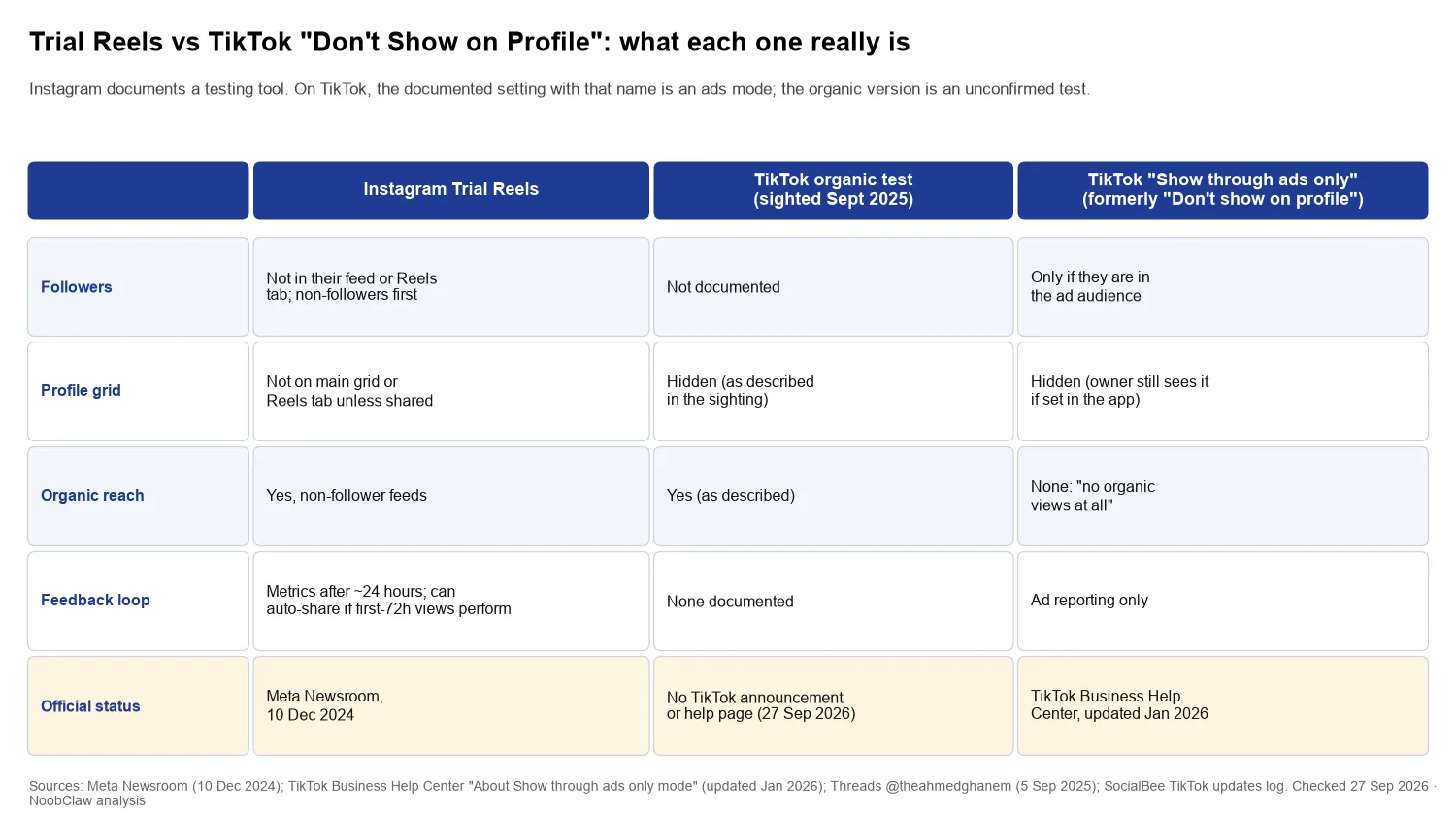
| Instagram Trial Reels | TikTok "Don't Show on Profile" (organic test) | |
|---|---|---|
| Who's excluded | Your followers won't get it in their feed or Reels tab (Meta says some may still meet it via DMs or audio/location pages) | Not documented; as described, the video is hidden from your profile grid rather than from feeds |
| Where it goes | Shown to non-followers first; followers won't see it in their feed or Reels tab | As described in the sighting, it can still reach people in their feed |
| Feedback loop | Data at about 24 hours; can auto-share to followers if it performs well on its first 72 hours of views | No documented promotion mechanic |
| Status | Documented product feature, announced by Meta on 10 December 2024 | Seen as an iOS test in September 2025; no TikTok announcement or help page as of 27 September 2026 |
The distinction that matters: Trial Reels is a distribution filter. TikTok's test is a display filter. One changes who sees it; the other changes where it's archived. They solve overlapping anxieties but not identical ones.
Instagram removed your followers from the room. TikTok's test removed the receipt from your wall. If your fear is judgment in the moment, they're different products.
Now the trap. If you look up "Don't show on TikTok profile" in TikTok's own documentation, you land on an ads setting, not the test. TikTok's Business Help Center (last updated January 2026) says the "Show through ads only" mode was "previously known as 'ads-only' mode and 'Don't show on TikTok profile' option". It works only for Spark Ads, it keeps the post off your profile, and "there will be no organic views at all". That is the opposite of a trial: strangers see the post only as an ad. The one documented organic case sits inside brand deals: TikTok's Creator Academy (18 August 2026) says TikTok One branded and sponsored posts "can be set to skip your profile page" while still showing on For You. We cover both in detail in what TikTok's "Don't show on profile" actually is.
Pick by which fear you actually have
Be specific with yourself here, because the options answer different questions:
- "I don't want my followers to see me try and fail." → Trial Reels. Followers don't get it in their feed or Reels tab.
- "I don't mind people seeing it once, I mind it living on my profile forever." → TikTok's organic test, if it ever reaches your account. Today the only documented way to keep an organic TikTok post off the grid is a TikTok One deliverable; see how to join TikTok One.
- "I want to know if this concept works before committing a series to it." → Trial Reels, because of the 24-hour data window and the automatic promotion path.
- "I want to run ad variants without cluttering my grid." → TikTok's Show through ads only, which is the setting that actually carries the "Don't show on TikTok profile" name. Accept that those posts get zero organic reach.
Each has its own deeper walkthrough: how Trial Reels actually work and TikTok's Don't Show on Profile, ads setting and test.
The caveat both features share
Neither platform promises a trial will reach more people. On TikTok the documented setting removes organic reach entirely ("there will be no organic views at all"). On Instagram a trial goes to non-followers first, and Meta frames sharing it with everyone afterwards as the way to "increase its reach". Some creators go the other way: Social Media Today notes that some have used Trial Reels as "a growth hack of sorts" to get content in front of a broader audience. If your goal is learning, not traffic, judge a trial post on ratios (watch-through, save rate, share rate), not total views. A video with strong ratios and small numbers may be a winner that hasn't been amplified yet.
There's also a gap worth flagging. Trial Reels deliberately start a video without the audience that already knows you. TikTok has documented nothing equivalent for organic posts: its documented grid-hiding setting removes organic reach entirely. On TikTok today the choice is between a normal public post and an ad, not between two cold-start paths. Which is why the filtering has to happen before you publish there.
How to actually run a test
- Change one variable. New hook, or new format, or new topic. Not all three. Otherwise the result tells you nothing about which change mattered.
- Decide your success metric before you post. Watch-through rate, save rate, or share rate: pick one and write it down. Deciding afterward guarantees you'll rationalize.
- Give it the full window. Trial Reels report at 24 hours; don't judge at hour three.
- Our rule of thumb: run at least three trials of the same idea before concluding. One post is one data point, and one flop can be noise.
- Then commit properly. The point of testing is to earn the confidence to post something ambitious to your full audience, not to hide permanently.
That last point is the one that matters. These features are useful because they lower the cost of trying. They stop being useful the moment they become a place to hide. On the early-window mechanics of a normal post, see TikTok's first hour.
What to test first
Meta's own examples of what to trial are "a new genre, storytelling format or topic". Those are also the changes you can't easily judge any other way. Keep caption and hashtag tweaks out of trials: one post is too small a sample to tell a small change from noise.
- Topic adjacency. One step away from your usual subject, not a total departure. It tells you whether your audience follows you or follows the topic.
- Length. Worth testing but interpret carefully. Length changes completion rate mechanically, so a longer video with lower completion isn't necessarily worse content.
Why platforms suddenly care about your fear of posting
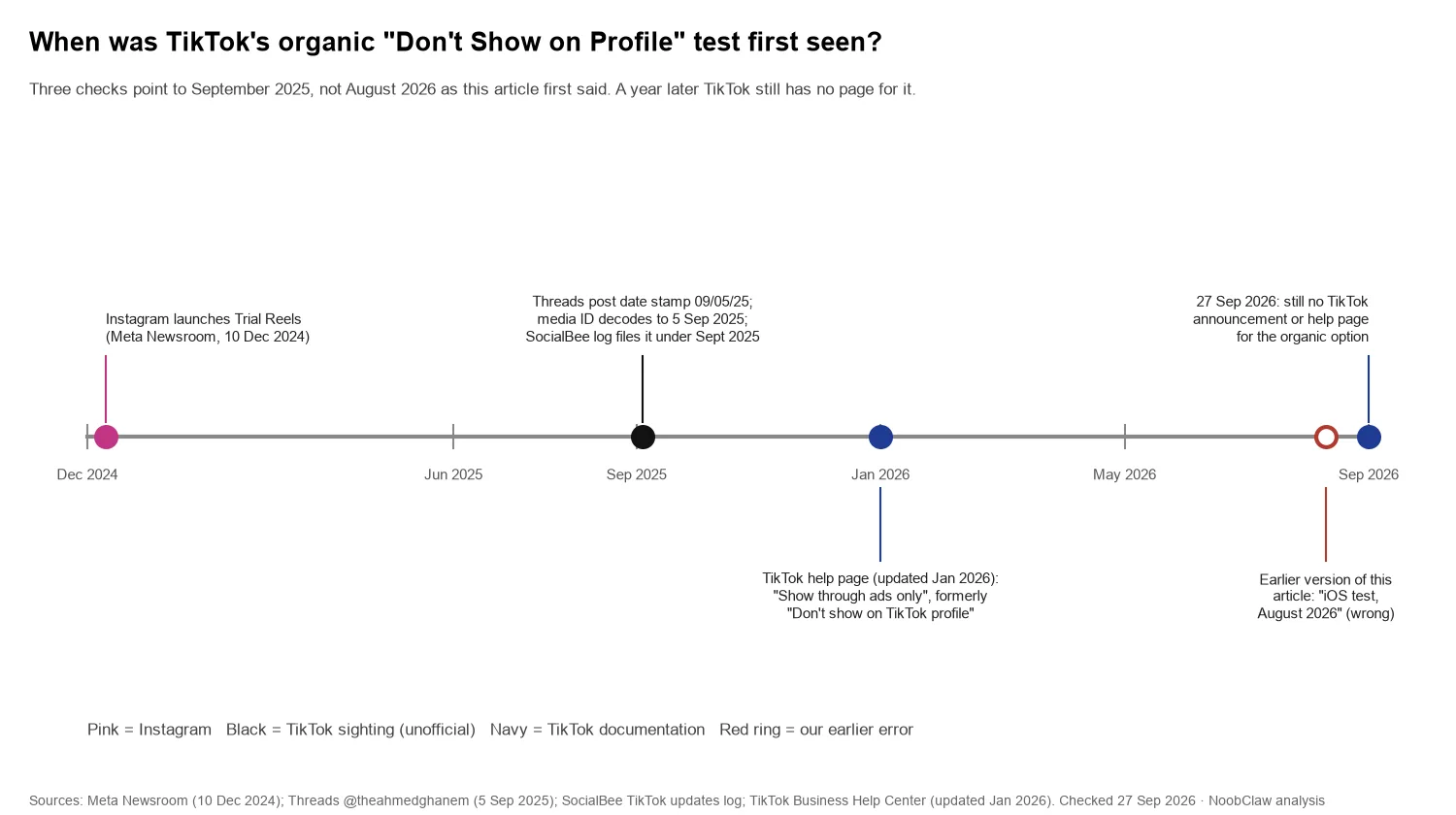
Instagram announced Trial Reels in December 2024. Nine months later, in September 2025, a TikTok test along the same lines was spotted: a Threads post by Ahmed Ghanem dated 5 September 2025 described a feature "similar to Instagram's Trial Reels", and SocialBee's TikTok updates log files it under September 2025 as an iOS test called "Don't Show on TikTok Profile". Our guess: both companies saw the same problem. Meta's announcement names it: "We often hear from creators that they feel nervous about posting too much or trying out content that's outside of their niche".
The conclusion here is straightforward: the supply of content is limited by nerve, not by ideas. Creators have more concepts than they publish, and the gap is self-censorship: the video that felt too weird, too niche, too much of a departure from what the audience expects. Every one of those is a post the platform didn't get.
Our reading: framed that way, these features aren't creator-welfare gestures; they're supply-side engineering. Which is useful to know, because it predicts what comes next: expect more tools that reduce the social cost of publishing: more reversibility, more audience segmentation, more ways to un-post. Instagram has kept building on Trial Reels; it added scheduling in April 2026. TikTok has not documented its organic version a year after the sighting, so treat the TikTok half of that prediction as a guess.
It also suggests the right way to use them. If the feature exists to increase how much you publish, then using it to publish more cautiously inverts the intent. The point is to get the weird idea out, not to get the safe idea out more safely.
FAQ
Can I use Trial Reels and then post the same video normally?
Trial Reels has a built-in path for this: it can auto-share to followers if it performs well on its first 72 hours of views, or you can share it manually. That's the intended flow (trial first, promote if it earns it) rather than reposting the file separately.
Is TikTok's version available to everyone?
No, and it may never be. The organic "Don't Show on TikTok Profile" option was seen as an iOS test in September 2025: the Threads post that first described it carries the date stamp 09/05/25, decoding its media ID gives the same day, and SocialBee's updates log files it under September 2025. As of 27 September 2026, we found no TikTok announcement or help page for it. If you find "Don't show on TikTok profile" under a post's Ad settings or in Ads Manager, that is the ads-only mode for Spark Ads, and it gives the post no organic views.
Do these features hurt my account if I use them a lot?
We found no platform statement that using either feature carries a penalty. The realistic risk is different and more mundane: if you only ever post to strangers, you stop giving your existing followers reasons to stay, and follower relationships decay from neglect rather than from any algorithmic penalty.
One takeaway to carry: the reason these features exist is that platforms figured out the bottleneck isn't ideas; it's the willingness to publish them. If a tool makes you braver, it's already done its job, even if the view count is small.
Sources
- Test Content With Non-Followers Using Trial Reels — Meta Newsroom — 10 Dec 2024 — https://about.fb.com/news/2024/12/trial-reels-try-content-non-followers-first-see-what-perfoms-best/
- About Show through ads only mode — TikTok Business Help Center — updated Jan 2026 — https://ads.tiktok.com/resources/help/article/how-to-turn-on-dont-show-on-tiktok-profile-option-in-tiktok-ads-manager
- How to set up TikTok One so brands want to work with you — TikTok Creator Academy — updated 18 Aug 2026 — https://www.tiktok.com/creator-academy/article/tiktok-one
- Post on TikTok testing a Trial Reels-like feature — Ahmed Ghanem on Threads — 5 Sep 2025 — https://www.threads.com/@theahmedghanem/post/DON4xXmDNdr
- TikTok updates, news, and features — SocialBee — accessed 27 Sep 2026 — https://socialbee.com/blog/tiktok-updates/
- Instagram allows creators to schedule Trial Reels — Social Media Today — 2 Apr 2026 — https://www.socialmediatoday.com/news/instagram-allows-creators-to-schedule-trial-reels/816549/
Correction (27 September 2026): an earlier version of this article said TikTok's "Don't Show on TikTok Profile" option was reported as an iOS test in August 2026. It was first seen in September 2025 (the source Threads post is dated 5 September 2025). The earlier version also did not say that, in TikTok's help pages, "Don't show on TikTok profile" is the former name of the Spark Ads setting "Show through ads only". Both points are corrected throughout, sources are now listed, and the illustrations have been replaced with our own charts.