
AI Comment Automation Without Getting Flagged: The Rate, the Variation, and the Line Worth Not Crossing
- The bare phrase has no unqualified variants — every real search names a platform first. The category exists only as a platform-specific problem, which is why generic advice about it is worthless.
- Replying to people who commented on your own post and manufacturing comments under strangers’ posts are different activities with different risk profiles, and the word "automation" hides the differenc
- X's developer policy, fetched today, forbids requesting a user's password or account credentials — so a tool that asks for your password is already outside the platform's own rules.
- A competing automation vendor tells its own paying customers to warm a new TikTok account for four weeks before connecting it to anything.
Look at how people actually type this. Not "ai comment automation" — that phrase, on its own, is close to dead. What people type is comment bot instagram, comment bot tiktok, comment bots youtube, auto comment bot instagram, tiktok auto comment bot github, youtube auto comment bot chrome extension. Every single variant names a platform before it names anything else.
That is not a trivia point. It means there is no such thing as comment automation in general — there are six separate problems wearing one name, each governed by a different rulebook, each with a different failure mode. Any article that answers the generic question is answering a question nobody has.
The word "automation" is hiding two unrelated activities
Split them before anything else, because almost every bad outcome in this space comes from treating them as one thing.
Activity A: replying to people who commented on your own post. A human chose to speak to you. You are answering. The comment is on content you made, under an account you own, to a person who initiated. The failure mode if you do this badly is that your reply is generic and someone is mildly unimpressed.
Activity B: producing comments under other people's posts, at volume. Nobody initiated. You are placing content in spaces you do not own, in front of audiences that did not ask, at a rate no person could sustain. The failure mode if you do this badly is that the account stops working.
Both are "AI comment automation". One is customer service with a draft assistant. The other is distribution you did not pay for. The platforms treat them as different things because they are different things.
Once you hold that distinction, most of the tooling questions answer themselves. You can be extremely aggressive about Activity A and it barely registers as a risk, because the volume ceiling is set by how many people actually comment on you. Activity B has no natural ceiling, which is exactly why it needs one imposed by hand.
What actually gets a comment removed
Let me be careful about sourcing here, because this is where articles in this genre invent things.
I fetched TikTok's Terms of Service today, 19 September 2026. Its prohibited-activities list includes "use automated scripts to collect information from or otherwise interact with the Services", and it asks that you "keep your account password confidential and that you do not disclose it to any third party". Note the breadth of the first clause — interact with, not just scrape. I also attempted two TikTok Community Guidelines pages today, on integrity and authenticity and on fake engagement, and both returned navigation shells containing no policy text. So I will not be characterising what those pages say.
From X's developer policy, fetched today, two lines are directly useful. The first: "You may not store X passwords, or request that people provide their X password, account credentials, or developer application information (including consumer key) to you directly." The second: "The use of the X API and developer products to create spam, or engage in any form of platform manipulation, is prohibited", alongside an instruction to "Never perform bulk, aggressive, or spammy actions, including bulk following."
That first quote is the single most useful sentence in this whole subject, and it points at the vendor rather than at you. Any tool that asks for your password is already operating outside the platform's own published rules — before you have posted a single comment. You do not need to reason about detection thresholds to reject those tools. The rule is written down, and the tool is on the wrong side of it.
Beyond quotable policy, what remains is creator-reported and I will label it as such. The patterns people consistently describe: comments that vanish silently rather than generating a notice; identical or near-identical text across accounts disappearing faster than varied text; brand-new accounts having a much worse time than established ones; and links inside comments performing worse than links anywhere else. None of that is published policy. It is a folk model, it is probably roughly right, and it is not evidence.
One genuinely hard third-party data point does exist, from an adversarial source. A commercial automation vendor's own help documentation tells its paying customers that "Connecting a brand new account to automation is the fastest way to get shadowbanned or flagged as a bot", and specifies a minimum warm-up of four weeks for TikTok, two to three weeks for Pinterest — and for Pinterest, to wait until the account has passed 100 monthly views before reconnecting — and one to two weeks for Instagram, Facebook, LinkedIn, YouTube, Threads, Bluesky and X. That is a vendor whose revenue depends on you connecting accounts, telling you to wait a month before connecting one. Treat it as a floor rather than a target.
Rate, variation, and the one control that is not a setting
Here is the operator's version, stated as configuration rather than vibes.
- Spacing, not volume. The number that matters is the gap between actions, not the daily total. Thirty to ninety seconds between comments is a human reading-and-typing interval; three seconds is not, and a perfectly regular thirty seconds is arguably worse than an irregular one, because regularity is itself a signature.
- Randomised quotas, not fixed ones. Any quota expressed as an exact number every day is a pattern. Express it as a range — a handful rather than exactly eight — and let it land differently each day.
- A jittered window, not a cron time. Running at 09:00:00 daily is a machine's habit. A window that fires somewhere between morning and late evening is a person's.
- Genuinely different text per account. This is the one most setups fail. If you run several accounts, each needs its own niche, its own persona and its own generated text — not one draft rotated through synonyms. Near-duplicate text across accounts is the most legible pattern in the whole space, because it is the only one that is trivially computable at platform scale.
- One fingerprint, one proxy, one profile per account — and then left alone. A browser identity that changes shape between sessions is itself a signal; stability matters more than sophistication.
- A human review step that you actually use. Not a checkbox. The reason to keep it is not compliance theatre, it is that generated replies fail in ways that are obvious to a person and invisible to a model — answering a complaint cheerfully, missing sarcasm, congratulating someone on bad news.
The control that is not a setting is the one at the top: stay in Activity A wherever you can. A system that only ever replies to people who already commented on your own content has a volume ceiling set by your own audience, produces text that is specific because it is responding to something specific, and never places anything in a space you do not own. That is a structurally quieter operation than any amount of careful rate-limiting applied to Activity B.
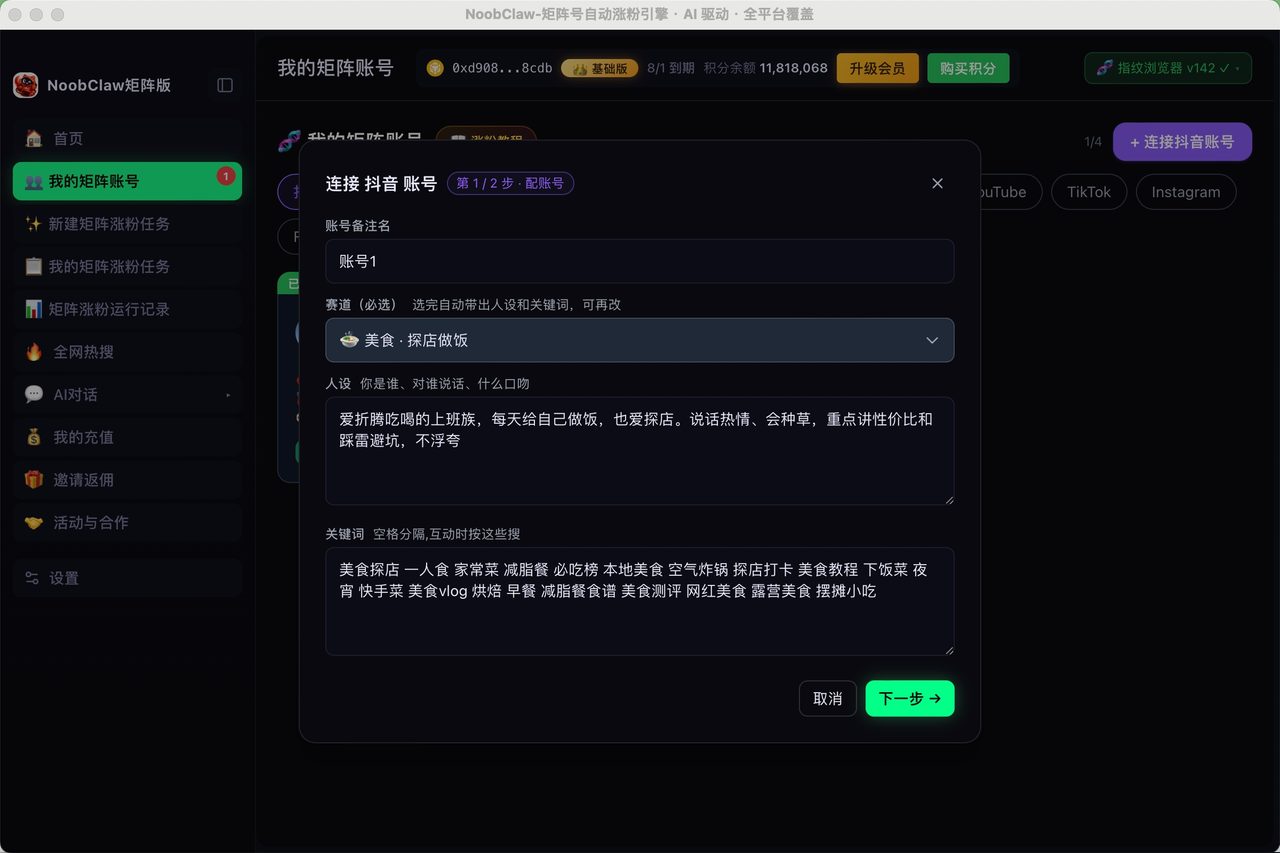
This is the shape our own tool takes, for what it is worth: NoobClaw reads the real comments sitting in your creator inbox across six platforms, drafts a reply in that account's voice, spaces them thirty to ninety seconds apart, and never comments on the work itself — you approve before anything is published, and you log in yourself, in a local browser, so no password is ever handed over. Where it does keyword or feed engagement, each account writes its own comment from its own persona rather than sharing a script. It is one approach among several and it does not make any rule stop applying.
Platform-by-platform, the rules diverge sharply enough that you should read them separately: we have written up why the direction of an Instagram message decides everything, what a LinkedIn automation warning means in the first 24 hours, the one sentence in Pinterest's guidelines that decides whether your tool is allowed, and the exact setup YouTube now calls spam. The generic advice above is the floor; those are the parts that actually bind.
FAQ
How many comments a day is safe?
There is no published number from any platform, and anyone quoting one is guessing. The more useful reframing is that the question has different answers for the two activities. For replying to people who commented on your own posts, the ceiling is set by how many people commented — you are not choosing a rate, you are answering your mail. For placing comments under other people's posts, the honest answer is that the safe number is low enough that automating it saves you little, which is itself a strong hint about whether to do it.
Will AI-written replies get detected?
Detection is the wrong frame, because "written by AI" is not what platforms act on — repetition, rate and reciprocity are. A reply that is specific to what the person said, posted at a human interval, from an account that person already engaged with, does not look like the thing enforcement is built to catch, regardless of what drafted it. Generic text posted at machine speed looks like that thing whether a model or an intern wrote it. Keep a human reviewing the drafts and the first case stays the first case.
Does a tool asking for my password mean it will get me banned?
It means something more concrete than that. X's developer policy, which I fetched today, states: "You may not store X passwords, or request that people provide their X password, account credentials, or developer application information (including consumer key) to you directly." A tool that asks you for that is breaking a written rule at the moment of the request, independent of anything it later does with the access. TikTok's Terms of Service, also fetched today, separately ask you to keep your password confidential and not disclose it to a third party. You do not need a risk model here; you need to close the tab. Our piece on the three kinds of TikTok comment bot walks through how that request usually gets framed.