
Dolphin Anty vs Multilogin: Profiles, API and Team Costs
- Dolphin lists Starter at $10/month for 20 profiles and 1500 RPM on paid tiers.
- Multilogin lists Pro 10/20/50 at $11/$19/$29 monthly, with separate annual totals.
- Count required users and exact API operations; browser capacity does not certify platform permission.
Dolphin Anty vs Multilogin depends on the profiles, people and API operations you actually need. Their October 11, 2026 pricing pages count different bundles, and Dolphin’s current API tutorial adds a qualification to its Free-plan table. Compare the documented allowance and the same billing term before choosing. A higher request limit does not establish faster completed work, permission to automate a destination platform or better account outcomes.
Compare a plan against the workload you can describe, not an unlimited number of accounts or an assumed publishing result.
Current monthly prices and the profile count they buy
Dolphin’s current pricing page lists Starter at $10 per month with 20 profiles selected, Base at $89 with 100 profiles, Team at $159 with 300 profiles, and Enterprise at $299 with 1,000 selected. Starter and Enterprise have larger selectable quantities. The Free plan lists up to five profiles. These are the displayed starting selections, not proof that every selectable configuration has the same price.
Multilogin lists Pro 10, Pro 20 and Pro 50 at $11, $19 and $29 billed monthly. Business 100 is $40 monthly, Business 300 $89 and Business 1,000 $185. Its current annual totals are separate: Pro 10 is $85 per year, Pro 20 $149 and Pro 50 $230. The headline annual equivalents should not be compared directly with Dolphin’s one-month invoices.
For a hypothetical solo requirement of 20 occupied profiles, Dolphin’s selected Starter costs $10 monthly and Multilogin Pro 20 costs $19 monthly before additional usage or taxes. That narrow comparison does not identify a universal winner. If a needed feature, operator or deployment route is missing, the cheaper starting invoice may not describe a usable configuration. Write those requirements alongside the count.
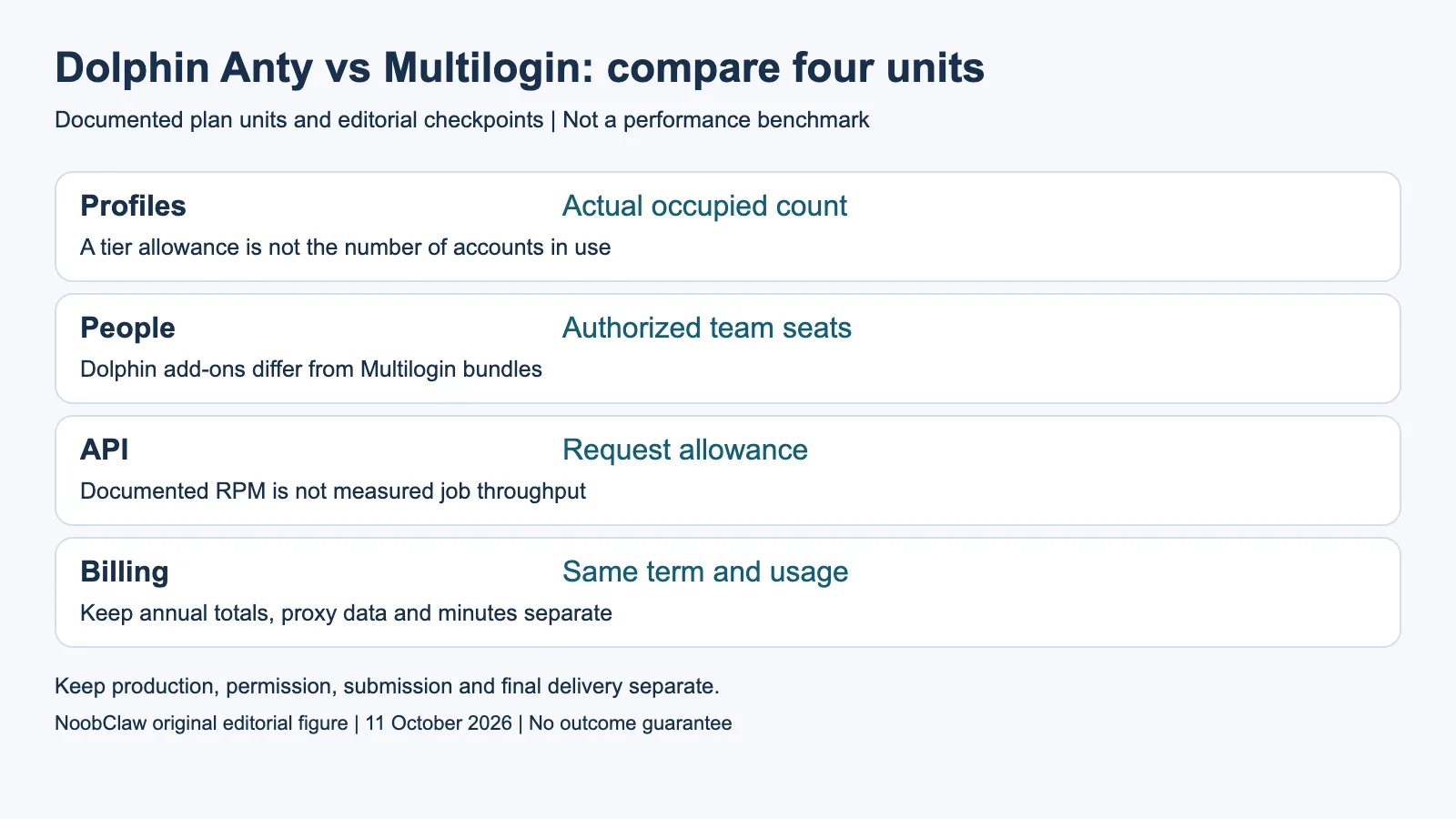
- Profiles: Actual occupied count. A tier allowance is not the number of accounts in use
- People: Authorized team seats. Dolphin add-ons differ from Multilogin bundles
- API: Request allowance. Documented RPM is not measured job throughput
- Billing: Same term and usage. Keep annual totals, proxy data and minutes separate
Request rates describe a gate, not completed publishing speed
Dolphin’s pricing comparison lists 1500 requests per minute on its paid tiers. Multilogin’s table maps Pro 10 to 50 RPM, Pro 20 to 75, Pro 50 to 100 and Business to 100; the Business card also mentions custom rate limits. A quoted custom allowance should be confirmed separately. These vendor limits concern their APIs rather than an entitlement to perform the same number of social posts.
The arithmetic ratio between 1500 and 100 is fifteen. That ratio does not establish that a full job finishes fifteen times faster. Jobs can need different numbers of requests, local resources and destination responses. For a hypothetical workload requiring three counted calls per operation, a 100-RPM allowance provides an arithmetic ceiling of about 33 such operations in that minute before other requests. This is a planning example, not a benchmark or a platform quota.
Dolphin’s current automation tutorial requires the app to be running and authorized, with local requests sent from the same machine. It describes starting a profile, connecting an automation tool and then stopping the profile. The configured API limit is only one requirement in that sequence. Confirm the exact endpoints, concurrency and error handling needed for your authorized task before buying a larger allowance.
Free-plan documentation needs an operation-specific check
Multilogin’s pricing FAQ expressly says its Free plan does not include API access. Its free five cloud profiles, 200 MB proxy bonus and 30 mobile minutes are separate allowances; the latter two are one-time. That is different from a trial that ends after a specified number of days. The paid Pro and Business plans include automation-friendly API access.
Dolphin’s pricing table marks the Free request-limit cell No access, while its current basic-automation documentation specifically discusses Free-plan cookie import/export being unavailable because cloud synchronization is absent. The tutorial also lists a 1500-RPM limit without resolving every Free entitlement. Those statements should not be stretched into a claim that no integration can be evaluated through any free, trial, demo or other vendor-supported route.
If Free-plan API evaluation matters, ask Dolphin to confirm the particular local or remote endpoint and operation on the current plan. Preserve that answer with the proposed configuration. This article does not resolve the mismatch by inventing a permission. A pricing cell, a tutorial prerequisite and the behavior of your own test are different evidence; check all three when the purchasing decision depends on them.
Team seats can change the useful comparison
Dolphin lists one included user on each plan. Free and Starter say additional users cannot be purchased. Base adds users at $10 each, Team at $20 and Enterprise at $25. Multilogin’s Pro 10 includes one seat, Pro 20 and Pro 50 two, and Business advertises unlimited seats. These are vendor plan allowances, not a legal determination about whether a two-person organization may exist.
For a hypothetical ten-person team needing 100 occupied profiles, Dolphin Base’s $89 monthly price plus nine $10 user add-ons equals $179. Multilogin Business 100 lists $40 monthly with unlimited seats. That arithmetic compares this stated inventory before taxes and extra usage. It does not show that the products have equivalent permissions, support or operational behavior, and it is not a measured saving from a migration.
Dolphin’s Base and Team cards say additional profiles cannot be purchased. Price the configuration just above a limit rather than dividing by capacity you will never occupy. A Custom plan is also offered, so the fixed ladder does not establish that the vendor cannot supply another quoted configuration. Check profile transfer, permission roles and the intended handoff before committing a team workflow.
Compare current billing and the actual task boundary
Dolphin’s current duration selector shows a 20-percent discount for six through eleven months and 40 percent for twelve months; its five-month option is not labeled with that discount. Multilogin’s current page shows ordinary annual totals and describes a 35-percent annual discount. Use the displayed total for the selected tier rather than forcing every rounded figure into an identical percentage. Earlier dated coupons are not current checkout quotes or evidence that two discounts can be stacked.
Include proxy traffic, mobile minutes, installation and the work needed to operate each configuration. Multilogin includes monthly usage bonuses on paid plans and sells additional resources; the one-time Free bonuses do not describe an automatic two-day expiration. Browser profiles organize sessions and configurations. Purchasing them does not approve an action under TikTok, Instagram or another destination’s rules, certify account safety or establish unlimited publication.
NoobClaw’s public creative record demonstrates one local video-production result, not either browser’s API benchmark, a platform-approved posting method or account protection. If your immediate need is a finished creative, evaluate that production step separately from profile administration. Choose Dolphin or Multilogin only after the required plan, exact operation, team access and total billing basis have been established.
For the related content and workflow decisions, read Multilogin Pricing: Monthly, Annual and Usage Costs and Multilogin vs AdsPower: Profiles, API Limits and Costs. Each review has its own evidence and scope.
NoobClaw publishes this article. Its script-to-video guide and public creative execution record document a local video result, not external-platform publication. Check the current product offer against the supported action you need.
Frequently asked questions
Is Dolphin always cheaper?
The $10 versus $19 comparison applies to the selected monthly 20-profile solo configurations. Other counts, required users, features and usage can change the result.
Does 1500 RPM mean fifteen times as many published posts?
No. It is an API request allowance. Calls per job, local operation and the destination’s permissions and limits remain separate. No throughput benchmark is claimed.
Can the Free plan be used to test every API action?
Multilogin says Free has no API access. Dolphin’s pricing and tutorial statements need an operation-specific clarification; this article does not certify an untested Free endpoint.
Sources
Official material read on October 11, 2026. Prices identify their billing term; vendor allowances are not measured publishing results. Hypothetical inventory and cost examples are labeled; the public local-production record has its own limitations.