Facebook Page Automation: Publishing and Content Review
- Define whether the missing work is content creation, Page publishing or reporting.
- Meta’s current Pages API posts guide documents permissions, Page tasks and publishing operations.
- A local NoobClaw video export does not demonstrate Facebook publication or follower growth.
- No fixed interaction cap or browser profile establishes detection immunity.
Facebook Page automation can mean preparing content, publishing an approved post or reporting its observed result. Choose the task before choosing a product. Meta documents a Pages API for Page posts; an access token is not evidence that a tool is inherently inferior to browser operation. This review does not establish the old page’s 22% follower-growth story, six-account survival trial or any universal safe number of likes and friend requests.
A content draft, a scheduled Page post and audience growth are separate results. Buy the capability you need and ask for evidence of that capability.
Choose a Page-content task rather than a growth promise
Start with the Page’s audience and the information the post needs to convey. A product demonstration needs confirmed feature steps and appropriate footage. A service announcement needs accurate availability and a clear explanation. A generic instruction to like other posts does not define either output. Write the brief in terms of content readers can understand and the completed work your team needs.
Then separate the responsibilities. A creation tool returns a caption, script or media draft. A publisher releases approved content to the intended Page. A reporting tool presents actual measurements. One product may cover several responsibilities, but its demonstration should identify each one. Do not assume that a text-generation example establishes publishing support or that a visible post establishes a successful audience campaign.
Consider a hypothetical gardening business explaining a watering method. It supplies confirmed instructions and owned footage. An assistant prepares a script; a reviewer checks the instructions and replaces a mismatched visual. The approved version then goes to a separately verified publishing method. This is a proposed content process, not the old article’s claimed gardening campaign or evidence of a measured follower increase.
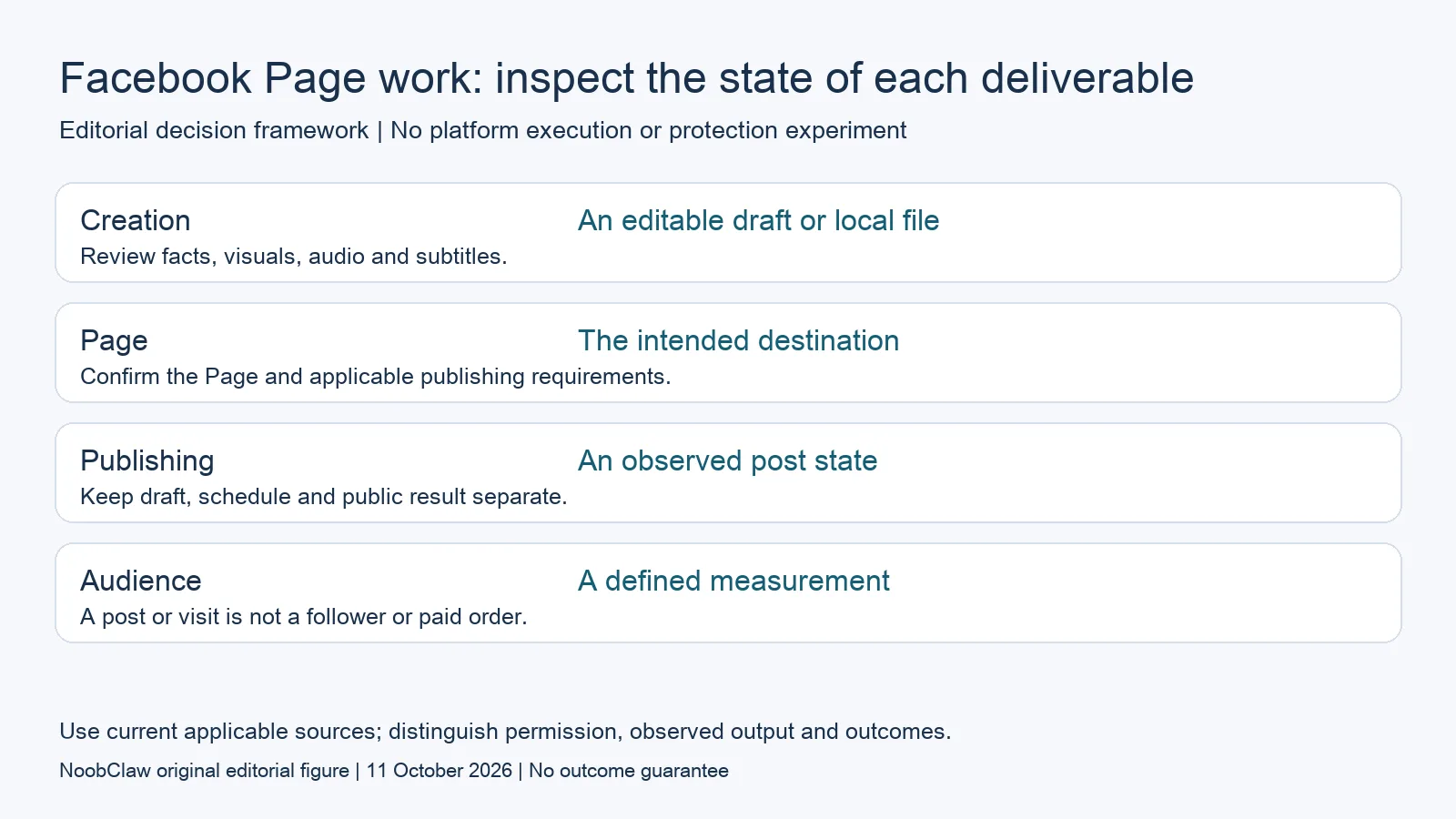
- Creation: An editable draft or local file. Review facts, visuals, audio and subtitles.
- Page: The intended destination. Confirm the Page and applicable publishing requirements.
- Publishing: An observed post state. Keep draft, schedule and public result separate.
- Audience: A defined measurement. A post or visit is not a follower or paid order.
Read the Pages API at its documented scope
Meta’s current Pages API posts guide documents creating, publishing, updating and deleting posts on a Page. It describes Facebook Login, required permissions, a Page access token and the user’s applicable Page tasks. The guide includes immediate and scheduled publishing and returning a post identity. These are documented capabilities and conditions; this review did not implement or test a Facebook app.
An access token’s existence should therefore prompt an access and scope review, not an unsupported claim that API use makes accounts look like bots. Ask the vendor which Page action it supports and which requirements apply to its app and intended user. Do not infer that a personal profile, Page and another Page’s content are interchangeable destinations. A product demonstration should make the actual target visible.
Inspect the outcome according to the purchased stage. An editable caption is ready for review, not automatically public. A returned post identity should be checked against the intended destination and state. Scheduled content needs its actual planned values preserved. If an outcome is uncertain, inspect the existing result before repeating the request. These are proposed acceptance checks, not proof that NoobClaw has a verified Pages API publishing integration.
Reject unsupported protection and audience claims
No preserved evidence supports this page’s old 22% growth in 60 days, six-account protection story or comparison showing browser execution safer than APIs. The claimed daily like, comment and friend-request ceilings also have no verified basis here. A delay setting, rest day or profile boundary cannot be presented as a guarantee of detection immunity. Evaluate a supported content task instead of buying an undocumented protection mechanism.
Meta’s October 20, 2020 announcement describes enforcement against services providing fake likes and followers. It is a dated historical source, not a current diagnosis of any particular Page. It does not establish a rule that slow artificial engagement is acceptable or that friend activity predicts a Page’s distribution. This review does not claim knowledge of a private ranking or account-detection model.
For a Page result that needs investigation, preserve the actual notice and measured observations. Do not turn a fall in reach into a claimed causal account penalty. The content, audience, period and publishing state may all matter to an analysis, and this article provides no controlled experiment separating them. A provider should distinguish observed results from explanations it has not verified, and should not promise recovery after an invented cooldown.
Evaluate NoobClaw for the creation work actually observed
NoobClaw publishes this review and sells content software. Its public creative record documents one 441-character English script producing a 32.6-second local MP4 at 1080 by 1920 pixels and 30 frames per second, with voiceover and subtitles. These are observed values from that local creation run. The record does not show a Facebook upload, a published Page post, follower growth or a customer campaign.
Some sampled stock footage needed further relevance review. Inspect the local output against your brief, including the spoken explanation, text and visuals. A completed file does not establish full audiovisual approval or rights for every asset. For a business requiring its own demonstration footage or a different format, ask for a demonstration matching that requirement rather than extrapolating from the short vertical example.
If content creation is the missing task, this bounded result can inform a purchase decision. If approved media already exists and the missing task is publishing coordination, investigate the publisher’s actual Facebook support and requirements. If the missing information is audience performance, require the relevant measurements. A local export, scheduled post, public post, follower and paid order remain different outcomes even when a dashboard displays them together.
For the related content and workflow decisions, read Human-Like Automation: Execution Is Not Account Approval and AI Content Generation for Social Media: Drafts to Video. Each review has its own evidence and scope.
A proposed acceptance record for a business Page
Retain the factual brief, source media, edited script, approved output, reviewer and intended Page. For a publishing claim, add the documented method, applicable requirements, returned identity and actual destination state. For an audience claim, add the metric definition, data source and observation period. This is a proposed review record, not a Page campaign we ran. It lets a buyer identify whether a product reduced creation work or merely displayed activity. It also makes an unresolved publishing result visible without calling it growth. If a video needs another revision, keep that task open; a render should not erase the reviewer’s concerns. Compare software costs only after identifying the same accepted output, billing period and work remaining for the team.
NoobClaw publishes this article. Its script-to-video guide and public creative execution record document a local video result, not external-platform publication. Check the current product offer against the supported action you need.
Frequently asked questions
Are Facebook API access tokens inherently a growth risk?
Meta documents Page access tokens and permissions as part of its Pages API. This review establishes no controlled comparison showing browser operation safer than API use.
Does the local NoobClaw output demonstrate Page publishing?
No. It demonstrates the stated local creation run with review limits. Facebook app authorization, upload, public release and audience outcomes require separate evidence.
Is there a safe daily interaction formula?
No verified universal formula is established here. Fixed likes, comments, friend requests or rest days cannot be used as a protection or growth guarantee.
Sources
Official material reviewed on October 11, 2026. Document conditions apply to their stated service and scope; the editorial examples are explicitly hypothetical.