
Facebook Detected Automated Behavior on Your Account? The Warning Is About Access, Not Posting Speed
- As users have quoted it, the warning asks you to "ensure that no other users or tools have access to your account". It is about access, not how often you post.
- Tools reach an account in three ways: an authorization Meta issues, a login with your password or session from elsewhere, or software in your own browser. None is risk-free.
- Meta's Terms (effective January 1, 2025): do not share your password or let others use your account. A disabled user needs Meta's permission to make a new account.
- First hour: check where you are logged in, remove apps and integrations you do not use, change the password, turn on two-factor authentication, and do not open replacement accounts.
On September 21, 2026, a Metricool customer added an edit to a one-star review: "FACEBOOK almost shut down my accounts with 15+ pages due to unauthorized automation." Sixteen months earlier, a Buffer customer had written, "Since using Buffer we have lost 3 account pages on Facebook," and then the part that hurts most: "We are unable to appeal and we are unable to create any new accounts."
Two companies, two users, the same platform, the same blame. When Facebook detects automated behavior on your account, the natural reaction is to slow down your posting. But the warning is not really about speed. It is about who, and what, can get into the account.
(Both reviews are on Trustpilot: trustpilot.com/review/metricool.com, checked 2026-09-23, and trustpilot.com/review/buffer.com, review dated May 21, 2025. They are each one user's account of what happened. Meta has never said publicly that using either tool gets accounts disabled.)
What the warning actually says
We could not find the full warning text on a public Meta help page as of September 23, 2026. The most complete copy we found is quoted by a user in a GitHub issue titled "Message from Facebook: 'We suspect automated behaviour on your account.'" (github.com/mautrix/meta/issues/44, opened March 22, 2024):
"To prevent your account from being temporarily restricted or permanently disabled, ensure that no other users or tools have access to your account and that you're following our Terms of Use."
The same message goes on to suggest changing your password "to prevent unauthorised access to your account by third parties".
Read the verbs. The warning does not tell you to post less. It tells you to make sure nobody and nothing else has access. The fix it suggests is a password change, which only makes sense if the concern is something logging in as you. That user was running a bridge that logs in to Facebook Messenger from a server, which is an access pattern, not a posting pattern.
That matches how Meta's Terms of Service are written. In the version effective January 1, 2025, section 3.1 asks each person to create only one account for their own use, not to share their password, and not to let anyone else use their account. Section 3.2 says you may not access or collect data from Meta's products using automated means without prior permission, whether or not you are logged in. The same section says you may not ask for, collect or use other people's login credentials. Section 3.1 also says that if your account was disabled for breaking the rules, you agree you need Meta's permission before creating a new one. That is the Buffer reviewer's "unable to create any new accounts", written into the contract.

Three ways a tool can reach your account, and how each looks to Meta
"I use a scheduling tool" covers very different arrangements. From Meta's side they are not the same thing, and the difference explains a lot of these warnings.
| How the tool gets in | What Meta sees | Where you can see it | Main risk |
|---|---|---|---|
| Official authorization (you click "connect" and approve permissions) | An app Meta reviewed, acting through a token Meta issued | Your apps, websites and business integrations settings | Page-level actions still count against you if they break the rules; tokens can be revoked or expire |
| Login with your password or a copied session, from the tool's servers | Your account logging in from another location, device and network | "Where you're logged in" in Accounts Center | This is the shared-credentials case the Terms address directly |
| Software driving your own browser, on your own device | Your usual login and device, with automated actions inside the session | Nothing separate. It looks like you, because it is your session | Still automation. Pacing, repetition and content quality decide how it looks |
The first kind is what the large scheduling tools use for Pages, which is why "I only used Buffer" and "Facebook flagged unauthorized automation" can both be true. The authorization itself is legitimate. The warning may have been set off by something else touching the account at the same time.
The second kind is where the warning's wording lands most directly. Any service that asks for your Facebook password, or for a cookie export, is asking to become one of the "other users or tools" the message talks about. Other platforms say the same thing. X's developer policy puts it bluntly: developers may not store X passwords or ask people to hand over their credentials. Meta's Terms say much the same about collecting other people's login details.
The third kind is the one people assume is invisible. It is not. It keeps your login in one place, so there is no second location for the warning to point at, but automated clicking and typing inside a real session is still automated behaviour. How it is judged depends on how human the pacing is and whether the output is something a person would actually post. We compared the trade-offs in more depth in API or browser automation, and the extension-based version of the third kind in what Facebook auto-poster extensions really do.
Where the "15+ pages" detail points
The Metricool review has a second detail that is easy to skip. The reviewer writes that they "tested 15 different iPhones, 15 different Facebook accounts, and 2 Metricool accounts" while trying to fix a "Wrong Token" error on the iOS app. We do not know how those accounts were set up, and it would be unfair to guess. But it shows the part of Meta's Terms that multi-page operators tend to forget: the Terms ask each person for one personal account. Pages are the unit meant for scale. Personal accounts are not.
If you manage many Pages, the question to ask before any tool question is whether each Page is administered by a real person's single account, with access handed out as Page tasks and not by sharing logins. We covered how that works in Facebook access vs task access and how many Facebook accounts one person can have.
The first hour after the warning
You cannot see Meta's side of the decision, but you can make your side of the access question clean. In this order:
- Open "Where you're logged in" in Accounts Center under password and security. Log out every session you cannot name, including servers, old phones and anything in a country you are not in.
- Review connected apps, websites and business integrations. Remove every one you are not actively using. For the ones you keep, check that the permissions still match what the tool does.
- Change the password and turn on two-factor authentication. The warning itself suggests the first step. The second stops a leaked password from bringing the same problem straight back.
- Stop any tool that holds your password or a copied cookie. If it needs your credentials to work, it is the "other tools have access" case, however good the tool is otherwise.
- Pause bulk actions for a while: mass friend requests, group posting, identical comments. Pace is not what the warning names, but it is what a reviewer sees if your account gets a closer look.
- Do not create replacement accounts. If the account is later disabled, the Terms say a new account needs Meta's permission. Opening one early can turn a restriction into the permanent outcome the Buffer reviewer described.
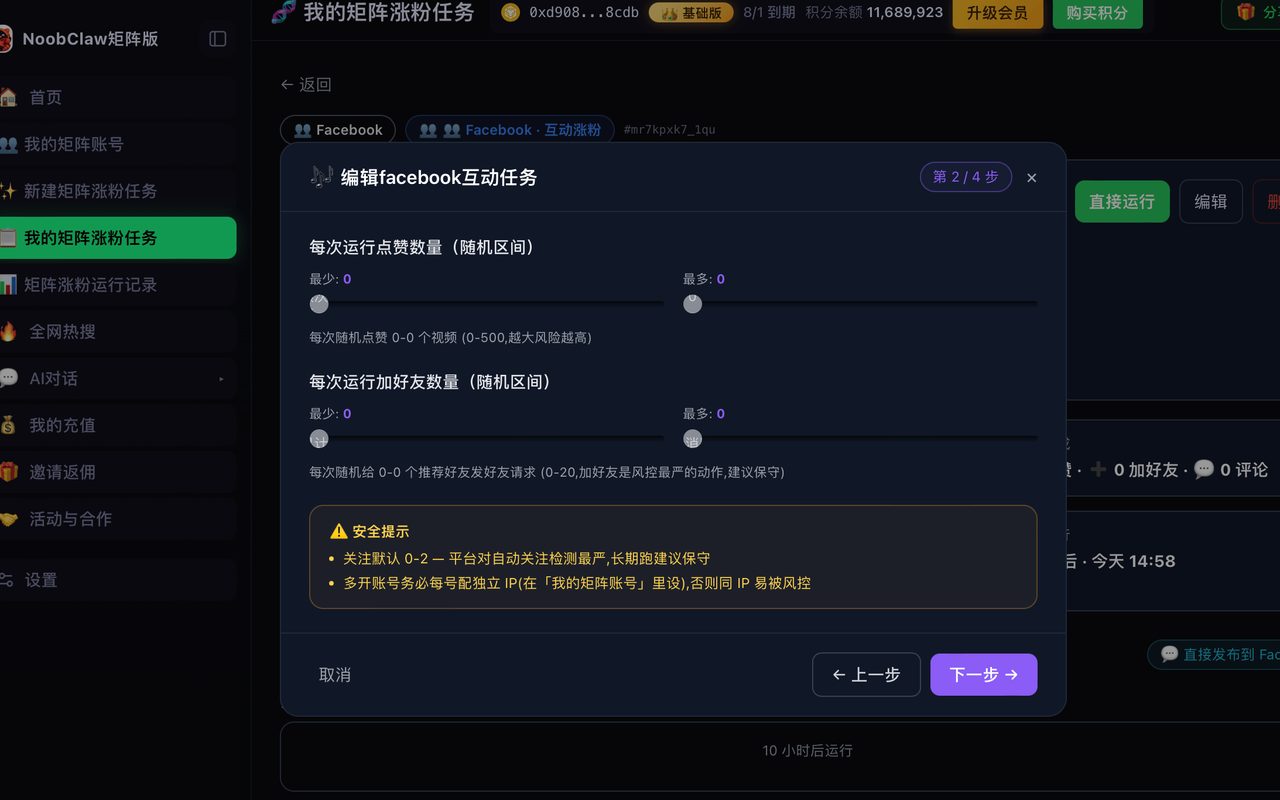
Where a tool like NoobClaw fits: it belongs to the third kind. It runs in a local browser where you log in to your own accounts, it never asks for or stores passwords, and each account's content is generated separately. That removes the second-location problem. It does not remove risk, and it is not an arrangement Meta has approved. It is still automation inside your session, so keep a human reviewing what goes out and keep the pace human. For the wider difference between scheduling and automating, see automation vs scheduling.
FAQ
Does "we detected automated behavior" mean Facebook will disable my account?
Not by itself. The message, as users have quoted it, is a warning meant to prevent the account "from being temporarily restricted or permanently disabled". It asks you to remove other users' and tools' access and to follow the Terms. Whether anything else happens depends on what Meta finds next, which it does not publish.
Is using an official scheduler like Buffer or Metricool against Facebook's rules?
No public Meta rule says so. Schedulers that connect through Meta's own authorization flow are working through a channel Meta provides. Individual users do blame these tools after getting a warning, but that is their view, not a finding by Meta. Often something else, such as a shared login or an unknown session, is touching the account at the same time.
Can I appeal the automated behavior warning?
A warning is not an enforcement decision, so there is usually nothing to appeal yet. If the account is later restricted or disabled, Meta's Terms say it will tell you how to request a review, apart from some listed exceptions. The Buffer reviewer's experience of being "unable to appeal" is one of the outcomes that falls outside that.