
How Long to Warm Up a TikTok Account? Nobody Official Has Ever Said
- TikTok has never published a warm-up period. Every day-count you've read is vendor folklore, which is why the autocomplete for this query surfaces 'reddit'.
- What is structurally credible: new accounts sit in a stricter tier because they have no history to weigh a suspicious signal against.
- Calendar-based warm-up fails because it produces the one thing that actually looks synthetic — a perfectly regular schedule.
- Warm up by behavioural variance, not by days: irregular session lengths, real dwell time, actions that a person would plausibly take.
Type "how long to warm up a tiktok account" and Google finishes it four ways: before posting, how many days, reddit, how to properly.
That third one is the tell. When a query's autocomplete surfaces "reddit," it almost always means the official answer doesn't exist and people have gone to forums because there is nowhere else to go.
The uncomfortable starting point: there is no published number
TikTok has not published a warm-up period, a probation window, or a minimum age before posting. Neither has Instagram. So where do the schedules come from?
Trace any "7-day warm-up plan" back through its sources and you land in the same three places: proxy vendors, antidetect browser vendors, and account sellers. These are not neutral parties — a warm-up schedule is a product feature for them, because every day of warm-up is a day of subscription, and "your account died because you warmed up wrong" is an unfalsifiable explanation for a refund request.
That doesn't make the schedules malicious. It makes them unverified. And an unverified number that everyone repeats is the most dangerous kind, because it feels like consensus.

What is actually credible about new accounts
Strip out the folklore and one structural claim survives, because it follows from how any trust system has to work:
A new account has no history, so every ambiguous signal it produces carries more weight. An established account that suddenly posts eight times in an hour has thousands of prior data points arguing it's a real person having a busy day. A three-day-old account doing the same thing has nothing on its side of the scale.
This explains several things that otherwise look like superstition:
- Why new accounts get restricted for behaviour that older accounts do freely — it's not a rule about age, it's a rule about evidence.
- Why the same action pattern produces different outcomes on different accounts.
- Why "warming up" appears to work even though no warm-up rule exists: you are not satisfying a timer, you are accumulating history.
Meta has documented a version of this from the other direction — its spam policy notes that limits can apply at lower frequencies when repetition or inauthenticity signals are also present, which is to say frequency is judged in context, not against a fixed number. We covered that in Meta's high-frequency posting rule, and the new-account version in what Instagram limits on new accounts.
Why calendar warm-up backfires
Here's the irony at the centre of this whole practice. The typical warm-up plan says: day 1, watch 20 videos and like 5; day 2, watch 30 and like 8; day 3, follow 3 accounts…
Executed literally, that produces a session pattern no human has ever generated. Real people watch four videos and get distracted, then watch ninety on a Sunday evening. They like nothing for two days and then like eleven things in a row. They open the app at 7:14am and 11:52pm and not at all on Thursday.
A tidy schedule is the artefact. If you build your warm-up around consistency, you are optimising for the exact property that separates scripts from people.
Warm up by behaviour, not by days
Replace the calendar with four properties. None of them require you to count anything:
- Variance over volume. Session lengths, intervals and action counts should differ meaningfully day to day. Ranges, not targets.
- Dwell before action. A like that lands 0.4 seconds after a video opens says something. A like at the 80% mark says something else.
- Coherence. The accounts you follow, the content you watch and the content you eventually post should describe a recognisable person with an interest. Random engagement across unrelated niches is its own signal — and it also teaches the recommender the wrong things about you.
- Asymmetry. Real accounts consume far more than they produce, especially early. An account whose first week is 90% posting is unusual before it is anything else.
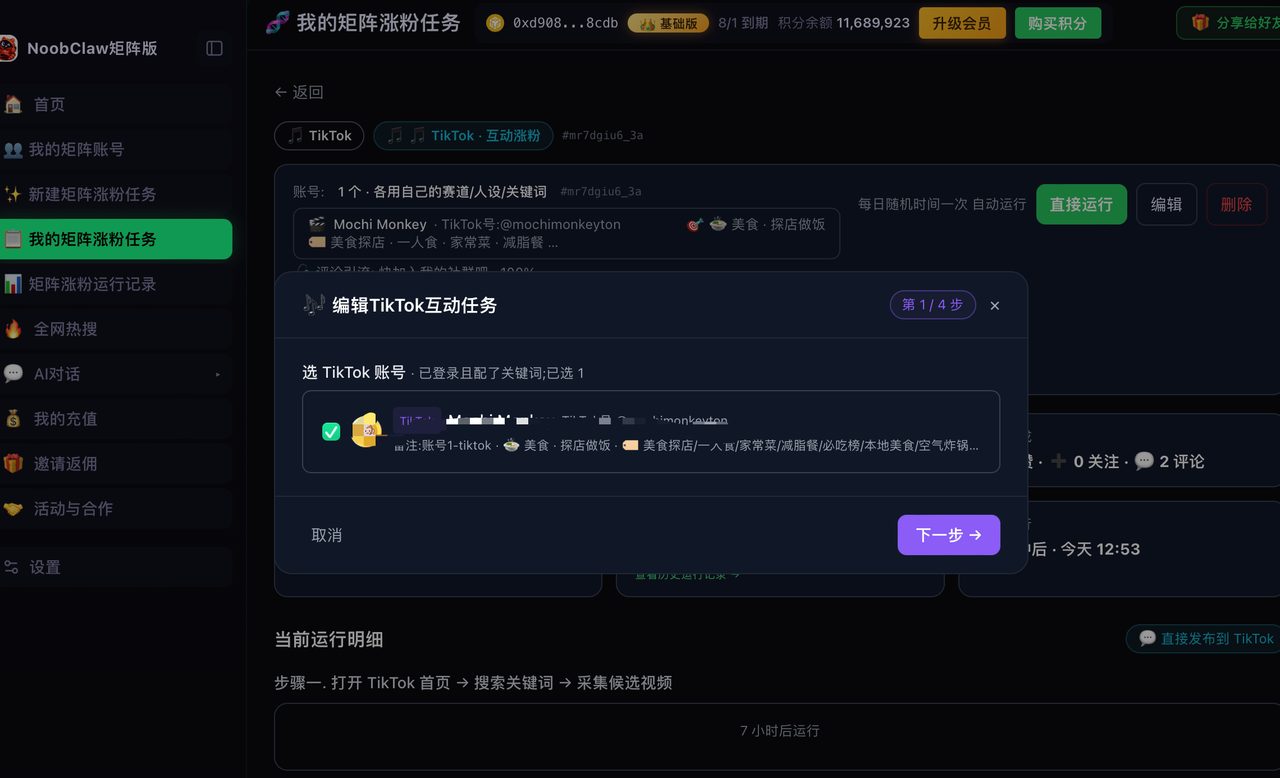
This is also the honest case for and against tooling. Anything that automates warm-up with fixed quotas reproduces the exact problem above. What is defensible is automation built on randomised ranges — a run that likes somewhere between three and eight things, at intervals that vary, at a time drawn from a window rather than a clock — operating in your own browser session on your own account. That's the design principle behind NoobClaw's engagement runs, and it's worth stating the limit plainly: this makes rhythm plausible; it does not make a thin account interesting. The wider trade-offs are in the TikTok automation guide and API versus browser automation.
What to do instead of waiting
If you're holding a new account hostage to a countdown, here is a more useful sequence: complete the profile so it describes someone specific; consume in your niche until the recommendation feed clearly reflects it; post when you have something worth posting, not when the schedule says day four; and keep the first weeks' volume modest not because a rule says so, but because you don't yet know which of your ideas works. The Instagram version of this argument, including why the schedules there are equally unfounded, is in how to warm up a new Instagram account.
Where the warm-up myth came from, and why it survives
It's worth understanding why an unfounded practice became universal advice, because the same mechanism will produce the next one.
First, it's unfalsifiable. If you warm up for seven days and the account is fine, the warm-up worked. If it isn't fine, you warmed up wrong. No outcome can disconfirm it, which is the defining property of folklore rather than method.
Second, it's emotionally useful. Starting a new account is uncertain, and a schedule converts uncertainty into a to-do list. That feels like progress even when it's displacement activity — and the displaced activity is usually the hard one: figuring out what the account is actually for.
Third, survivorship. The people writing warm-up guides are the ones whose accounts survived. The identical practice on accounts that died produced no blog posts.
Fourth — and this is the load-bearing one — it contains a real observation wrapped in a wrong explanation. New accounts genuinely are treated more strictly. Waiting genuinely does correlate with better outcomes. But the causal story isn't a hidden timer; it's that history is the thing being accumulated, and history is made of behaviour, not of elapsed days. An account that sits untouched for fourteen days has aged without accumulating anything.
That distinction is the whole practical payoff here. Stop asking how long to wait, and start asking what evidence this account has produced about who owns it. The first question has no answer; the second has one you can work on today.
FAQ
Can I post on day one?
There's no published rule against it. The reason to wait is not compliance, it's information: on day one you have no idea how the recommender reads your account, and your first posts are the most expensive ones to get wrong because they shape what it learns about you.
Does watching videos actually help a new account?
It does one thing that is definitely real: it teaches the recommendation system what your account is about, which affects who your content is shown to later. Whether it also builds "trust" in a risk sense is not something any platform has confirmed — treat that part as plausible but unproven.
Do I need a separate device or network for each account?
Network and device separation address one layer of association, and it's a layer that matters at scale. But it is not the layer most accounts die on. Content sameness and behavioural regularity are usually the stronger signals, and no amount of network hygiene compensates for them.