
Meta Spam Policy on High-Frequency Posting, Quoted Verbatim
- The rule, verbatim: Meta does not allow "posting, sharing, engaging with content or creating accounts, Groups, Pages, Events or other assets, either manually or automatically, at very high frequencies
- The next line is the one that matters for most operators: Meta "may place restrictions on accounts that are acting at lower frequencies when other indicators of Spam (e.g., posting repetitive content)
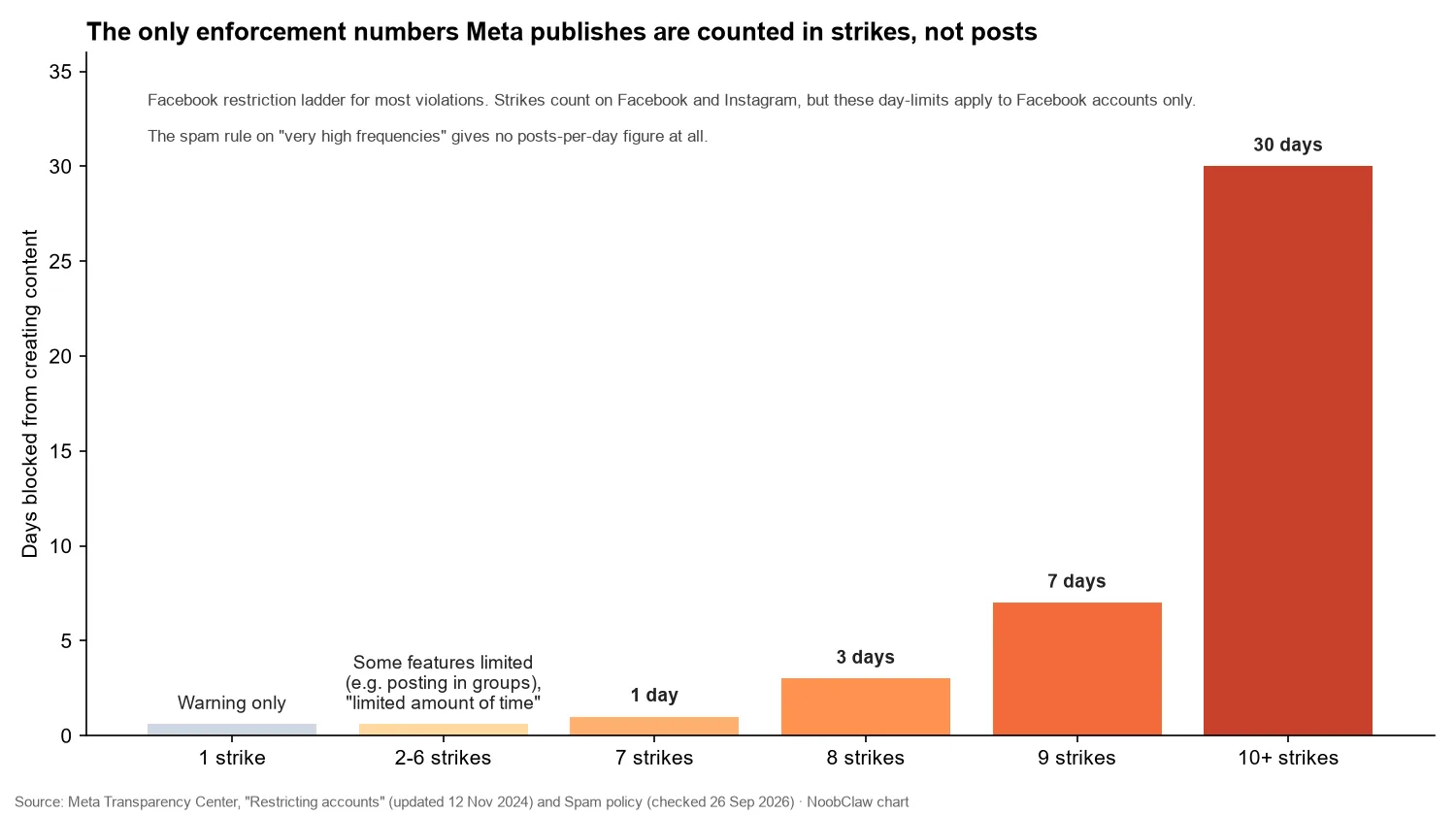
- Meta publishes no posts-per-day limit. The numbers it does publish count other things: strikes (7 to 10+ strikes bring 1- to 30-day posting blocks on Facebook), a 7,500 follow cap on Instagram, and AP
- Automation sits in a different policy: Account Integrity lists scripting outside "authorized routes" as a case where Meta may ask for more information about an account. The clauses in that policy that
Meta's rule on high-frequency posting is one sentence long, and it answers the usual question before you finish asking it. The Spam section of Meta's Community Standards, which covers Facebook and Instagram, says Meta does not allow:
"Posting, sharing, engaging with content or creating accounts, Groups, Pages, Events or other assets, either manually or automatically, at very high frequencies."
We re-read the page on 26 September 2026. Its change log shows the last revision on 26 June 2024, and nowhere on it does "very high" become a number. There is no posts-per-day figure, no hourly cap, nothing to sit under. What the page does contain is a second sentence that changes how the first one should be read.
What Meta's spam policy says about posting frequency, in full
Directly under the frequency line, as a sub-point of the same rule, Meta adds:
"We may place restrictions on accounts that are acting at lower frequencies when other indicators of Spam (e.g., posting repetitive content) or signals of inauthenticity are present."
Read together, the two sentences name three things Meta looks at: frequency (how fast and how much), repetition (how similar the output is to itself) and signals of inauthenticity (anything that makes an account look like a process rather than a person). The second sentence means the first is not a threshold you can stay below. An account posting three times a day can still be restricted if those three posts are the same post.
Two other details on the same page are easy to miss. "Manually or automatically" removes authorship from the test entirely: an AI-written caption posted at a human pace is not what this rule describes, while a human pasting the same caption into twenty Pages in ten minutes is. And the rule covers engaging and creating accounts, not only posting, so a burst of follows or comments falls under the same words. The rest of the list bans buying or selling accounts, Pages and engagement, and gating content behind likes or shares.
Is there a safe number of posts per day on Facebook or Instagram?
No official one exists, and the low-frequency clause means any number you find elsewhere cannot be a safe harbour by construction. It helps to look at the numbers Meta does publish, because none of them counts posts:
- Strikes. Meta's restricting accounts page (updated 12 November 2024) lists the ladder for most violations: one strike is a warning, two to six limit some features such as posting in groups, and seven, eight, nine and ten-plus strikes bring 1, 3, 7 and 30 days without creating content. Meta notes that strikes are counted on both Facebook and Instagram, but "these restrictions only apply to Facebook accounts."
- Follows. Instagram's help page on following says that "to help reduce spam, Instagram doesn't allow anyone to follow more than 7,500 people." That is a total, not a daily rate.
- API quotas. Instagram's Content Publishing API caps accounts at 100 API-published posts in a moving 24 hours in one paragraph and 50 in another, on the same developer page; Facebook's Pages API budget is 4,800 calls times the number of engaged users per 24 hours. Both limit API traffic, not what you post in the app.
Facebook also shows a separate "temporarily blocked" message about using a feature too fast, and it does not map neatly onto posting volume. In July 2024 VnExpress reported that many users in Vietnam got that warning while only reading or chatting on Facebook or Messenger. A consultant quoted by the paper called it a likely Facebook system error, and with no spike on Downdetector, VnExpress concluded the problem probably affected only accounts in Vietnam; Facebook Vietnam did not respond. The message can therefore appear when nobody is doing anything fast. These blocks do not appear on the strike ladder above, and Meta publishes neither their trigger nor their length.
What the low-frequency clause means for accounts that post the same thing
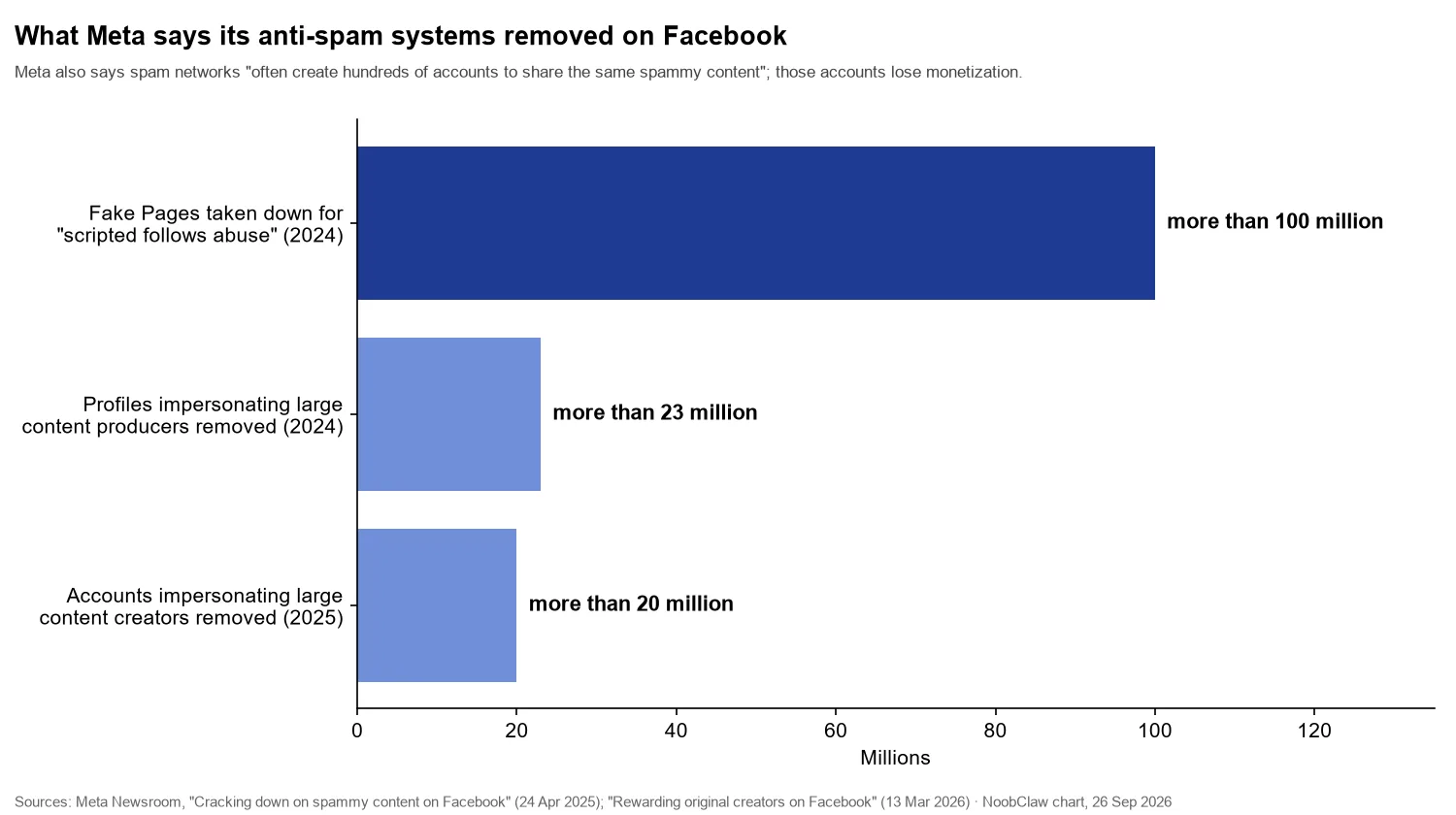
Meta has not published an enforcement case tied to the low-frequency clause itself, but it has described how it treats repeated content on Facebook in a separate announcement, under its feed and monetization rules rather than the Community Standards. In "Cracking down on spammy content on Facebook" (24 April 2025) it said accounts posting long, distracting captions with an inordinate number of hashtags, or captions unrelated to the content, "will only have their content shown to their followers and will not be eligible for monetization." It also said that "spam networks often create hundreds of accounts to share the same spammy content," and that those accounts lose monetization and may see lower reach. The same post reports that in 2024 Meta "took down more than 100 Million fake Pages engaging in scripted follows abuse on Facebook." Those are distribution and monetization penalties, not the account restrictions the spam rule refers to, but they show that duplication across accounts is something Meta says it looks for.
One more detail from Meta explains why spam behaves differently from other rules. When Meta said in January 2025 that it would wait for user reports before acting on less severe violations, it estimated that one to two out of every ten of its daily content removals may have been mistakes, and added that this "does not account for actions we take to tackle large-scale adversarial spam attacks." Our reading: spam stays with the automated systems, so a pattern of repeated content is judged by detection, not by whether anyone complained.
In practice, the fix for each of the three named variables is different:
- Frequency: spread actions over the day instead of batching them at one hour. A burst is what "very high frequencies" literally describes.
- Repetition: five accounts posting the same caption with different images is still repetition. Content that differs per account is the only fix, and no posting schedule substitutes for it.
- Inauthenticity signals: empty profiles, no history, no interaction in either direction. The fix is time.
Our reading is that repetition, not frequency, is the variable the low-frequency clause is written for, and slowing down does nothing about it. This is also where tooling choices matter: a scheduler that pushes one caption to every account multiplies repetition, while a workflow that writes each account's posts separately (NoobClaw builds each account's content from its own niche and persona) addresses the repetition variable directly; it does nothing for frequency or for the inauthenticity signals, which only time and real activity fix.
Where automation fits: the Account Integrity clause
Automation is not in the spam rule at all. It sits in Account Integrity, and the current wording is narrower than most summaries suggest. Meta lists "creating or using an account or other entity through automated means, such as scripting (unless the scripting activity occurs through authorized routes and does not otherwise violate our policies)" among the scenarios in which it "may request additional information about an account to ascertain ownership and/or permissible activity." Meta does not define which routes count as authorized; its official APIs are the obvious ones.
The clauses in the same policy that let Meta restrict or disable accounts are about linkage. Meta may restrict or disable accounts, Pages and business assets that are "owned by the same person or entity as an account that has been disabled," created to evade a previous removal, or closely linked to a network that violates its policies. For anyone running several Pages from one personal profile, that is the exposure written into the policy: one account's problem can travel to the others. The warning Facebook shows when it suspects automation points the same way. A user of a Messenger bridging tool posted it on GitHub in March 2024: "ensure that no other users or tools have access to your account." Our reading: that notice is about who or what has access to the account, not posting speed; we unpack that notice in Facebook suspects automated behavior.
FAQ
Does Meta penalize AI-generated captions or images under the spam rule?
Not for being AI. The rule covers activity performed "either manually or automatically" and says nothing about who wrote the text. AI content has its own labeling rules, a separate topic covered in how AI content is reported and labelled on Instagram. Under the spam rule, repetitive AI posts are a problem because they repeat, not because a model wrote them.
How many posts per day can I make on Facebook or Instagram?
Meta does not say. Third-party numbers are guesses, and the low-frequency clause lets Meta restrict accounts below any of them when content repeats. The one hard Instagram action number Meta publishes is the 7,500 follow cap; for why the rest of the online limits do not hold up, see Instagram action blocked limits.
Does posting through the official API make high-frequency posting acceptable?
It changes the automation question, not the spam one. The Account Integrity exception requires that scripting through authorized routes "does not otherwise violate our policies," and the API adds its own quotas (100 or 50 posts per 24 hours on Instagram, depending on which line of the documentation you read). Repetitive, high-frequency posting is still spam when it arrives through an API.
Sources
- Spam — Meta Transparency Center (Community Standards) — last changed 26 Jun 2024, accessed 26 Sep 2026 — https://transparency.meta.com/policies/community-standards/spam/
- Account Integrity — Meta Transparency Center (Community Standards) — accessed 26 Sep 2026 — https://transparency.meta.com/policies/community-standards/account-integrity/
- Restricting accounts — Meta Transparency Center — updated 12 Nov 2024 — https://transparency.meta.com/enforcement/taking-action/restricting-accounts/
- Following limit — Instagram Help Center — accessed 26 Sep 2026 — https://help.instagram.com/408167069251249
- Content Publishing — Meta for Developers (Instagram Platform) — accessed 26 Sep 2026 — https://developers.facebook.com/docs/instagram-platform/content-publishing/
- Cracking Down on Spammy Content on Facebook — Meta Newsroom — 24 Apr 2025 — https://about.fb.com/news/2025/04/cracking-down-spammy-content-facebook/
- Rewarding Original Creators on Facebook — Meta Newsroom — 13 Mar 2026 — https://about.fb.com/news/2026/03/rewarding-original-creators-on-facebook/
- More Speech and Fewer Mistakes — Meta Newsroom — 7 Jan 2025 — https://about.fb.com/news/2025/01/meta-more-speech-fewer-mistakes/
- Người dùng hoang mang vì Facebook báo lỗi 'chặn tạm thời' — VnExpress — 10 Jul 2024 — https://vnexpress.net/nguoi-dung-hoang-mang-vi-facebook-bao-loi-chan-tam-thoi-4768391.html
- "We suspect automated behaviour on your account" (issue #44) — mautrix/meta on GitHub — 22 Mar 2024 — https://github.com/mautrix/meta/issues/44