Instagram Growth Strategy: Accounts and Content
- Assign a distinct audience and editorial purpose to each account.
- Use current account guidance; historical policy numbers are not a present-day safe quota.
- Review content output, audience response and business outcomes as separate observations.
An Instagram growth strategy for several accounts starts with a clear job for each account: who it serves, what it contributes and what response you want to learn from. Adding accounts or repeating a posting routine does not, by itself, establish that more people will follow. Organize the content and review process before increasing the number of accounts you operate.
If you are producing for a brand account, a founder account and a specialist channel, the immediate problem is coordination. The same source material may be useful to all of them, but an identical post can leave each audience with the wrong context. Our recommendation is to keep the underlying facts consistent while changing the explanation, evidence and next step for the actual audience.
A second account needs a second editorial purpose, not just a second copy of the post.
What should each Instagram account contribute?
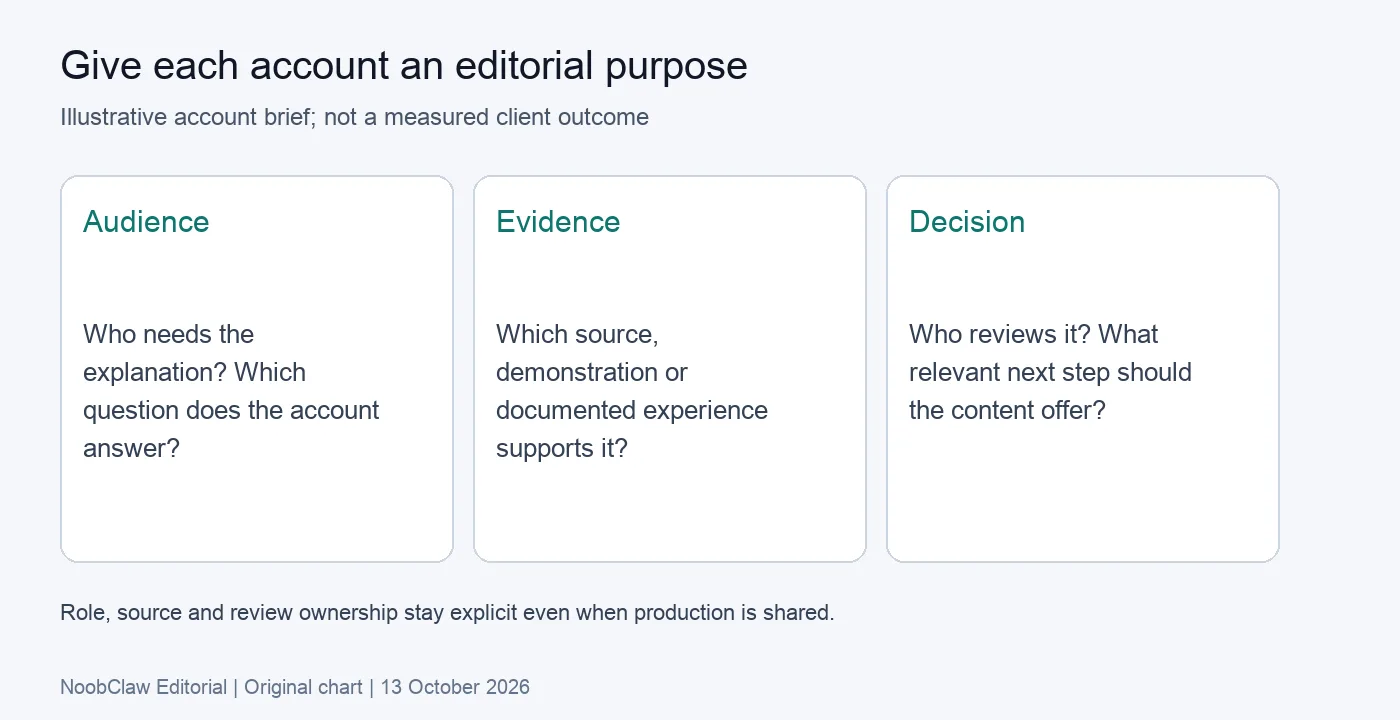
Write a short account brief before filling a calendar. Name the intended audience, the question the account helps answer, the evidence it can contribute and the person responsible for reviewing it. A founder account might explain decisions, while a product account might demonstrate use. These are illustrative roles, not a claim that this arrangement has produced a particular growth rate.
The practical test is whether a reader gains something distinct from following both accounts. If the answer is only that each profile repeats the same message, consolidate the editorial work rather than treating duplication as a growth tactic. If the accounts have different audiences, preserve the differences in the brief instead of asking a writing tool to manufacture variation after the fact.
Choose a next step that the content can support. A demonstration may lead to a setup question; an explanation may invite a substantive discussion. Asking every account to push the same follow request gives you little information about why anyone responded. Keep the response attached to the content's job so that later review can distinguish curiosity, usefulness and an actual decision.
What does Instagram's own creator guidance cover?
Meta's October 2024 Best Practices announcement is a concrete example of account-oriented guidance. It introduced an educational area in the professional dashboard covering five categories: creation, engagement, reach, monetization and guidelines, with general advice and personalized tips.
That structure is useful because it separates questions operators often combine. A problem with how a post explains its subject is different from a question about recommendation eligibility. A business outcome is different from an engagement count. Use the current guidance available to the account you manage rather than assuming that one generic posting rule addresses every category.
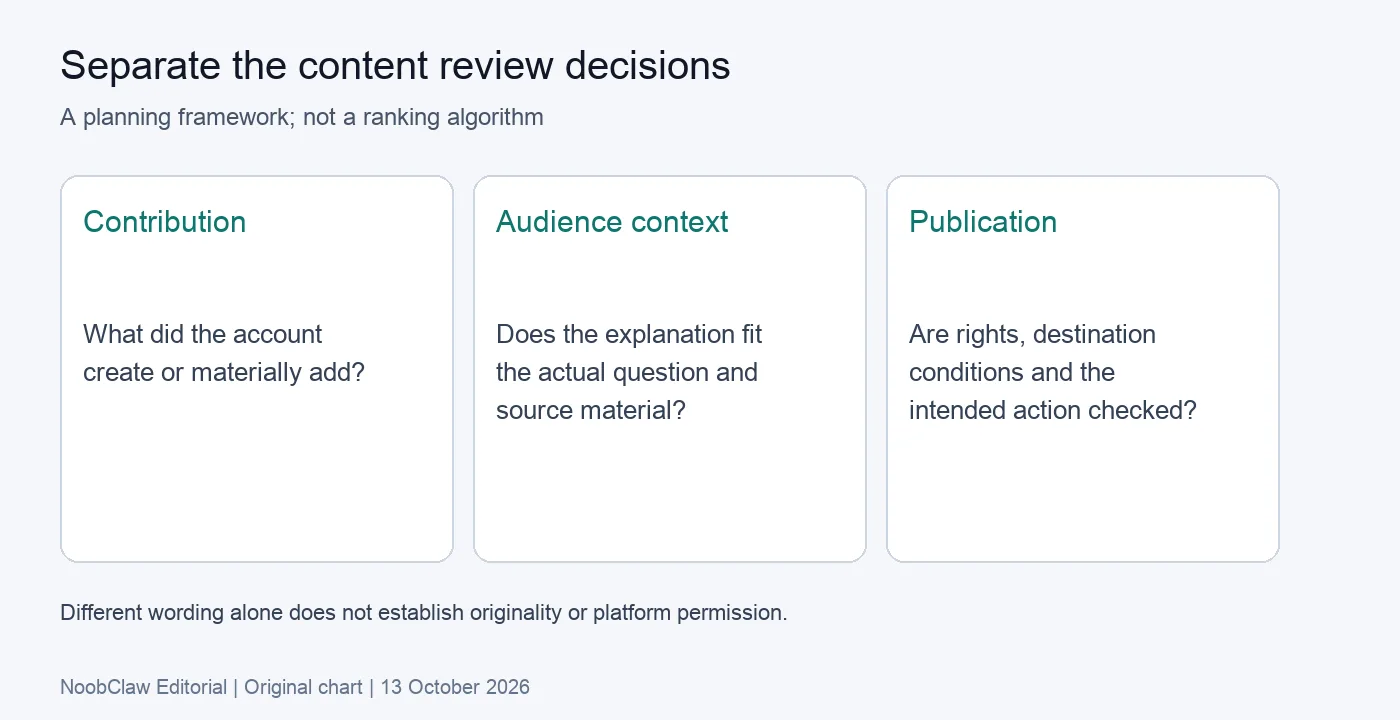
For a team, translate those questions into ownership. Someone should review the content's explanation; someone should inspect the account's current notices and available guidance; someone should evaluate whether the response supports the intended next step. In a small operation these may be the same person, but the decisions should remain separate.
The announcement is an educational-product case, not a tested growth formula for your accounts. It does not establish a universal number of daily follows, likes or comments that makes automation approved. If a tool or checklist supplies such a number, ask which current source and specific action it applies to before building your routine around it.
Why does the originality case matter to a multi-account plan?
In its April 2024 original-content announcement, Meta described replacing matching reposts with originals in recommendation areas. The announcement also described an aggregator condition involving 10 or more repeated unoriginal posts over 30 days, with stated exceptions and review options. These figures belong to that dated announcement; they are not a current universal ban threshold or a recovery promise.
One detail in that official Portuguese text changes the interpretation: the described consequence is “nas áreas em que recomendamos conteúdo” — in the areas where content is recommended. The live page retained this wording when checked on 13 October 2026. It describes a recommendation-surface condition in the dated announcement, not a statement that every such account is deleted. This is why an account-status question and a weak content response need different evidence.
The editorial lesson is broader than the historical number. A content plan should be able to explain what each account created or materially contributed. A different caption alone is a weak explanation if the asset and argument remain the same. Keep the source material, permission to use it and the account-specific contribution together in the working brief.
For example, suppose your team owns a product demonstration. A support-oriented account could use it to explain a setup decision, while a creator account could discuss the recording process. This is a planning illustration, not an observed campaign. The worthwhile difference is the question answered and the evidence offered, rather than an attempt to disguise the same post.
There are legitimate reasons to coordinate accounts, including different languages, products or organizations. This article does not conclude that any particular coordination method is approved merely because the wording differs. Review the finished content and the actual publication method separately under the current guidance that applies to the account.
How can you review growth without mixing incompatible signals?
Choose comparable observations before interpreting a change. Define the account, content format, observation period and desired response. A view, a follow, a comment and a sale answer different questions. Keep the denominator and available reporting consistent when comparing periods; do not relabel an interaction as a customer acquisition.
Meta's June 2023 ranking-transparency announcement introduced 22 system cards across Facebook and Instagram, describing different systems and surfaces. That is not evidence that Instagram has 22 identical algorithms or that a single metric governs every surface. It supports checking which experience and reporting context you are discussing.
Our practical judgment is to make a narrow content decision from the evidence you actually have. If a post attracts questions about setup, consider whether the next piece should answer them. If it attracts broad reactions but little relevant follow-up, revisit the audience or next step. These are editorial hypotheses to test, not conclusions about a hidden ranking mechanism.
A worked decision example: suppose an owned product account answers “How do I set this up?”, while an owned creator account explains “How was this demonstration made?” This is an illustrative planning exercise, not a measured client campaign. Start with the same source facts and permissioned footage, then specify different accepted outputs: the product account must visibly show the setup step; the creator account must explain a documented production choice.
Before publishing, define the response you will review for each brief. For the product account, identify substantive questions about the demonstrated step. For the creator account, identify questions about the explained production choice. Use the account's available reporting to keep views and new follows separate, with the same observation period and format context. The illustration supplies no invented view, follower or conversion totals.
If the product post receives questions about a step the video never showed, our proposed next action is to record that missing step and review the explanation. If views increase but new follows do not, do not call that an account restriction or a successful acquisition result. Check whether the post gives its intended audience a reason to return, then test a narrower brief. If an account notice reports a separate issue, examine that notice before interpreting the content experiment. The decision path follows the observed question, the available reporting and the stated account role; it does not rely on a universal interaction quota.
Account-level notices should also be examined on their own terms. A content experiment is not a remedy for an unresolved account restriction, and a quiet post is not proof of a restriction. Record what the platform actually reports, what changed in the content and what remains unknown. This helps a later review avoid attributing every movement to the most recent edit.
What can a content tool usefully help you do?
A tool can help organize a brief, draft wording or prepare an asset for review. Its usefulness depends on the missing step. If the evidence and footage already exist, you may need an edit rather than a new video-generation workflow. If the explanation is unfinished, draft the argument before choosing a format or a publishing schedule.
For NoobClaw, the content-generation analysis separates post text, spoken scripts and assembled video drafts. The multi-account planning article keeps account roles and review decisions explicit. These are relevant preparation steps; neither establishes Instagram permission, recommendation eligibility or follower growth.
Keep a review record with the source, chosen wording, visual asset and intended account. Check whether generated text implies personal experience you cannot substantiate, whether the asset supports the explanation and whether the next step makes sense to that audience. A fluent draft is a proposal for an editor, not evidence that the account holder performed the stated experience.
Before repeating production, review the work it creates as well as the assets it generates. More drafts can mean more review rather than more usable posts. Choose the workflow whose outputs you can inspect, using the current Guides and plans and credits for the relevant product conditions.
FAQ
Should every account publish the same asset?
Decide by the editorial role and the rights to use the material. Shared facts can support distinct explanations, but duplication alone does not establish a growth strategy. Keep the original source and each account's contribution visible in the brief, and assess the publication method separately.
Does the 2024 announcement give a current safe repost count?
No. The numbers in the historical case describe a specific recommendation policy announced at that time. They do not establish a current universal limit, permission for other actions or an account-recovery timetable. Use current in-app information and applicable platform guidance for your decision.
Can AI content tools guarantee more Instagram followers?
This article provides no such evidence. Draft quality, audience relevance, rights, publication conditions and the actual response all need separate review. Evaluate whether a workflow produced a usable asset first, then report audience and business outcomes under their own definitions.
Sources
- Introducing Best Practices — Meta, October 2024; checked 13 October 2026.
- Helping creators find new audiences — Meta, April 2024, Portuguese original; historical policy example, checked 13 October 2026.
- How AI Influences What You See — Meta, June 2023; checked 13 October 2026.
Correction, 13 October 2026: this English page replaces a Chinese-language body. Invented first-person growth anecdotes and unsupported daily interaction quotas have been removed. Historical policy numbers are identified by their announcement date.