Social Media Matrix Strategy: Accounts, Roles and Content
- Assign account ownership, audience questions and review decisions before production.
- One caption request and one local video export are bounded cases, not multi-account publishing proof.
- Track draft, review and publication states separately from audience and business results.
For practical planning, a social media matrix strategy means giving each owned account a distinct audience, editorial role and review path while coordinating the work shared between them. The point is to make account decisions explicit. The number of accounts is not evidence of audience growth, and a batch of generated drafts is not a batch of confirmed publications.
If one account explains a product, another discusses a specialist topic and a third serves a different language, the shared production process still needs separate briefs. Keep the source facts stable, but decide which explanation and next step belongs to each audience. Our recommendation is to start with ownership and content purpose, then choose tools for the production steps you can actually review.
Coordinate the work between accounts while keeping each account's purpose and publication decision clear.
What belongs in an account-role plan?
Record the account owner, audience question, editorial role, usable source material, review responsibility and publication destination. These fields make a content plan inspectable. If the account has no distinct audience or purpose, adding it can create more coordination work without establishing additional value for readers.
Consider an illustrative plan with three accounts: a product channel explains setup, a creator channel explains the making process, and a specialist channel discusses a use case. This is a planning example, not a report of three accounts operated in a NoobClaw test. Each brief should identify what its audience needs to understand and what evidence the account can contribute.
Keep facts separate from tone. The same documented product behavior can be explained in several ways, but an account persona cannot create a missing test or customer result. A more conversational voice does not authorize a sentence claiming that the speaker tried something when they did not.
Decide who can approve the next step before production starts. A draft owner, an account owner and a reviewer may be the same person in a small operation, but the responsibilities should still be explicit. This prevents a prepared asset from being mistaken for permission to publish it everywhere.
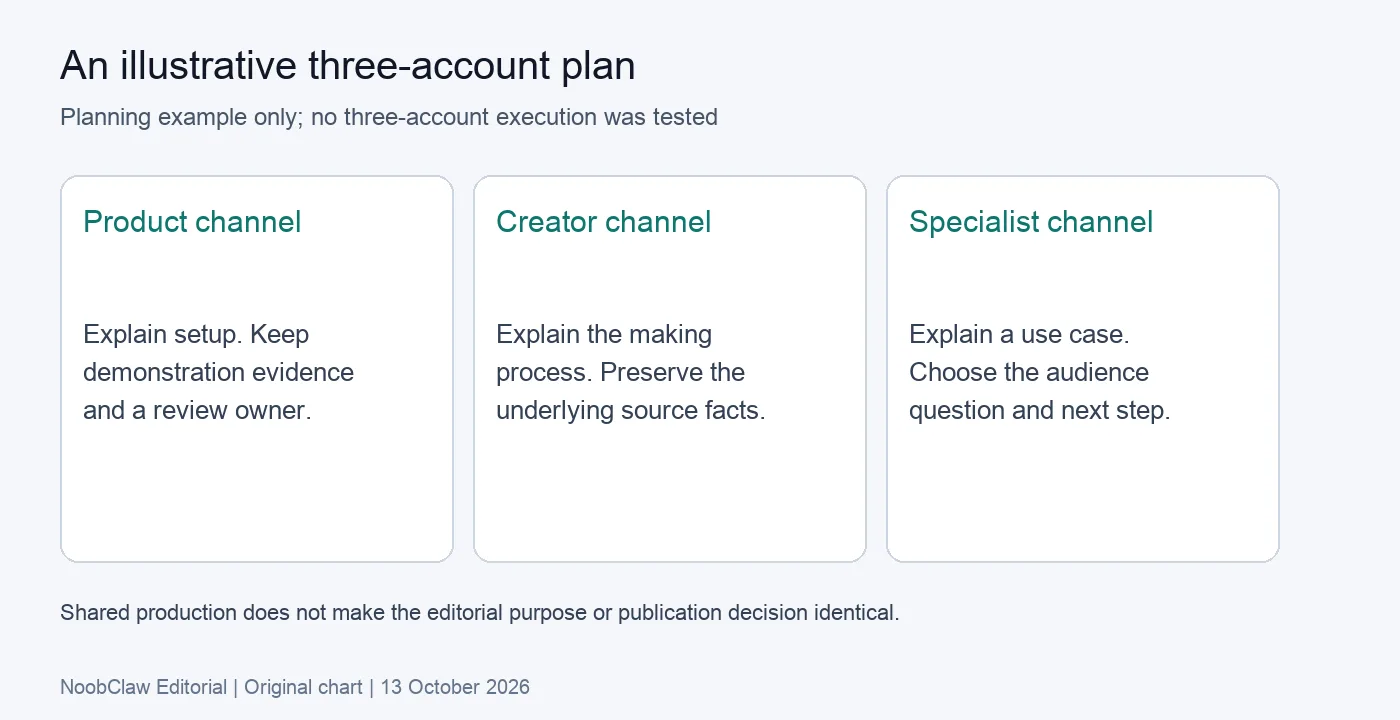
How should shared content differ between accounts?
Start with material you have rights to use and facts you can substantiate. Then change the explanation according to the brief: the question answered, the evidence shown and the next action offered. Replacing a few words is a weaker contribution than explaining a different practical decision.
Meta's April 2024 original-content announcement provides a dated example of why original contribution matters: it described replacing matching reposts with original content in recommendation areas, under stated conditions. That historical example is not a rule that every rewritten caption makes coordination approved on every platform.
For a useful review, ask what the account added. A demonstration can show a step. A commentary can explain why a choice matters. A translated explanation can serve a different language audience, provided the facts and rights remain clear. Keep the source and the account-specific contribution together so that corrections can be applied consistently later.
The opposing case is also worth considering: shared production may be unnecessary if the accounts cover unrelated material. Forcing them into one content template can make the briefs less useful. Coordinate the parts that genuinely share sources or production steps, while allowing separate editorial work where the questions differ.
What do the documented NoobClaw tests actually show?
The 9 October public caption record documents one request returning five caption options. The prompt described a beginner video about organizing three social accounts, reviewing a draft and recording task status. Mentioning those accounts in the prompt did not mean the tool logged into or operated them.
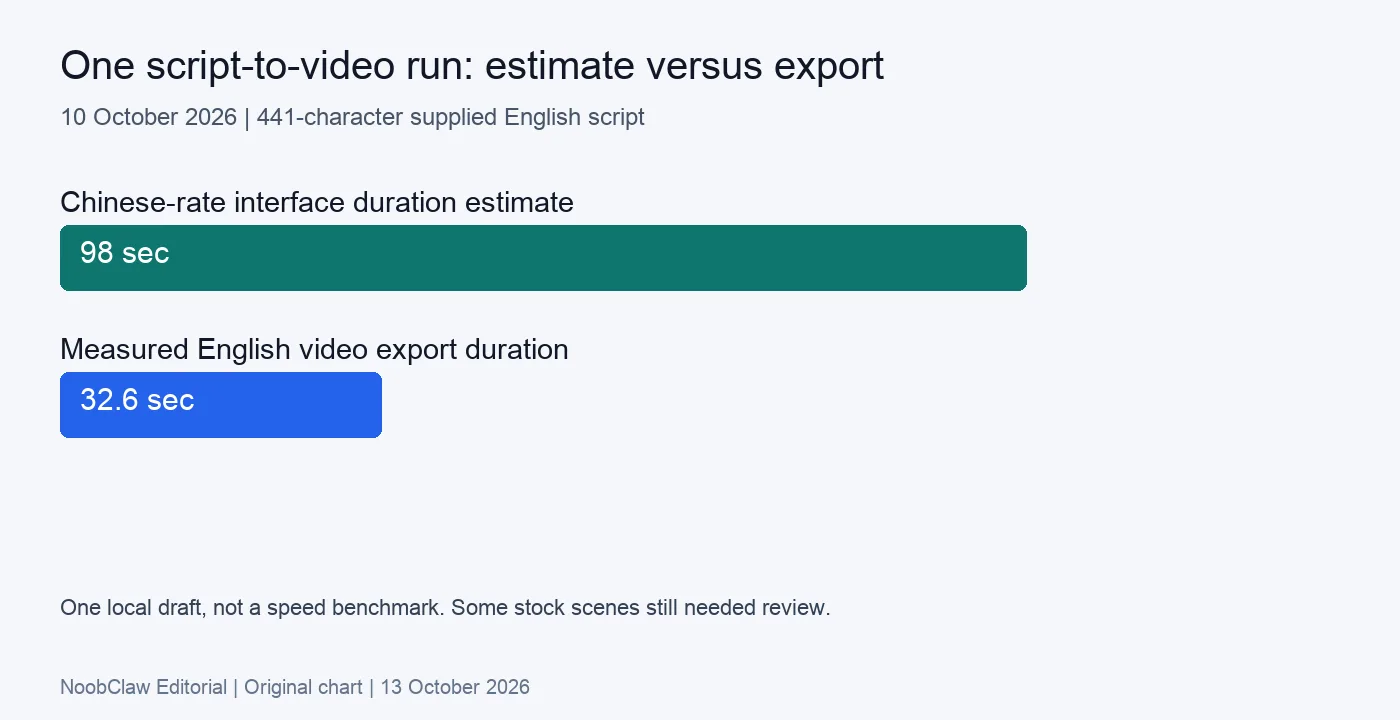
The 10 October desktop record documents a different task. A supplied 441-character English script produced one local video measuring 32.6 seconds, 1080×1920 pixels and 30 frames per second. An existing connected profile was required, and the output mode was local-only.
The interface estimated 98 seconds using a Chinese character-rate heuristic, which did not predict the English export's measured duration. Some selected visuals were generic or off-topic. Subtitle samples were visible, but the record does not independently approve every pronunciation, timing boundary or stock asset's reuse conditions. The tested interface was Chinese, with English text and voice.
These cases establish bounded production results you can inspect. They do not demonstrate multi-account publishing capacity, customer growth or a repeatable throughput benchmark. Use them to understand the missing production step and its review burden, then verify the task you intend to run under its current conditions.
Which workflow should handle each missing step?
If the footage already exists and you need a post description, use a text-drafting workflow. If the opening is unclear, work on the opening before assembling a full video. If the spoken explanation is unfinished, review a script. These jobs can share a source brief without becoming the same output.
NoobClaw has separate caption, hook and script pages for those text jobs. They produce drafts for editing; they do not establish that the content is accurate, original or appropriate to every destination. Check the input, allowance and credit conditions on the selected tool.
When the missing step is assembling supplied narration with voice, visuals and subtitles, the desktop script-to-video workflow has a broader role. Its Guide describes the documented setup and local-output checks. Local saving is a separate choice from uploading to a platform.
Keep account access out of the content brief unless the task requires it. The access-model analysis explains why passwords, tokens and browser sessions need different reviews. The content-generation analysis helps select the output rather than assuming a single workflow solves every creative and account-management job.
How can you review a coordinated content operation?
Use separate states for the brief, generated draft, editorially accepted asset, publication attempt and confirmed destination result. This is an operating framework, not a platform's status taxonomy. The useful property is that a reviewer can tell what actually happened without translating a general “completed” label into an assumed audience outcome.
Preserve the source, settings and selected draft with the account brief. If a wording error appears across several drafts, the team can then correct the shared fact and review the affected outputs. If the issue is specific to one audience's explanation, the account brief can be revised without changing an established fact for every account.
Audience reporting needs its own definitions. A view, a comment, a follow and a sale should remain separate measures. Meta's ranking-transparency explanation describes different systems and surfaces, which is useful context for avoiding a single unsupported account-growth rule. It does not supply evidence for the performance of your operation.
Before expanding the plan, review whether the current outputs are usable and whether each account still has a distinct job. A production process that creates more material than the team can verify may need a narrower brief rather than another account. Review actual plans and credits when evaluating the resource requirements; this article makes no measured cost or time-saving claim.
FAQ
Does an account matrix mean posting identical content everywhere?
It can coordinate shared work, but the editorial purpose should remain account-specific. Preserve substantiated facts and appropriate rights while choosing the explanation and next step for each audience. Identical posting is not, by itself, evidence of useful coordination or audience growth.
Did the caption test operate three accounts?
No. The public record shows a prompt mentioning three accounts and five returned caption options. It does not show those accounts being connected, operated or published to. Treat it as a text-output case rather than a multi-account execution demonstration.
When is it reasonable to add another account?
Use a distinct audience question, usable source material, ownership and a review path as the decision criteria. These are editorial planning recommendations, not a tested growth formula. Review the results of the current operation before assuming that a larger account count will produce a better business outcome.
Sources
- Public caption request record — NoobClaw, 9 October 2026; one text-output case.
- Desktop script-to-video record — NoobClaw, 10 October 2026; one local export with stated limitations.
- Helping creators find new audiences — Meta, April 2024, Portuguese original; historical content example.
- How AI Influences What You See — Meta, June 2023; all sources checked 13 October 2026.
Correction, 13 October 2026: this English page replaces a Chinese-language body. Unsupported workload, growth and automation-safety claims have been removed. The planning illustration is separated from the documented NoobClaw output cases.