Instagram Reels Stuck at 200 Views? Metrics to Check
- A repeated 200-view count does not identify a restriction or a published platform gate.
- Current Reels insights distinguish views, unique Viewers and watch time; preserve observation times.
- Recommendation eligibility does not guarantee distribution. Trial Reels use distinct observation windows.
If your Instagram Reels keep stopping near 200 views, the counter alone cannot tell you why. Check the available account and recommendation notices, then read the Reel's own insights. A repeated rounded count is not evidence of a published 200-view gate, and a normal status screen does not identify the cause of low distribution.
For a creator or small team producing several videos, this distinction changes the next action. A named restriction calls for the offered review process. A measurement problem calls for checking what the metric means. An editorial question calls for reviewing the opening, topic and delivery. Those tasks can overlap; none is resolved by assuming that another platform's typical view count applies to Instagram.
What does the view counter actually measure?
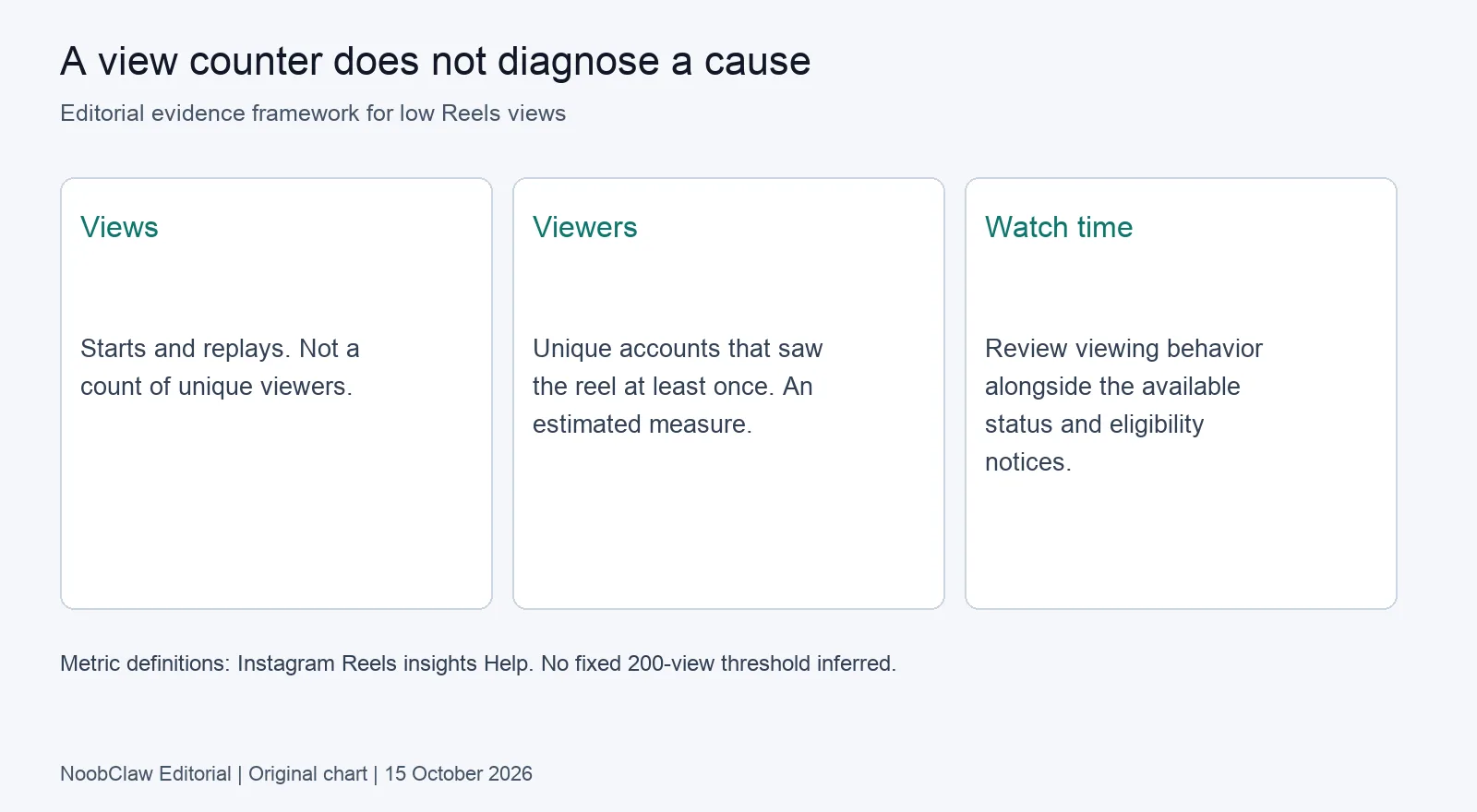
The current Instagram Reels insights Help page defines views as starts or replays. It separately defines Viewers as unique accounts that saw the Reel on screen at least once, whether or not it played, and notes that this metric is estimated and in development. Use the label shown in your interface; do not silently equate views with unique people.
The same page defines total watch time as including replays, and average watch time using initial views as the denominator. Our recommendation is to record those available measures together. A view count without a measurement time or viewing context is a weak basis for deciding what to change. Record the labels and definitions shown in your current interface, together with the observation date.
A repeated result is something to investigate. It is not, by itself, the explanation for that result.
Preserve the Reel URL, publication time and observation time. Note whether it was boosted, shared as a trial or distributed in another way. Read the metrics that are actually available to your account rather than inventing missing follower or non-follower breakdowns. If a field is unavailable, label it unavailable and continue with evidence you can observe.
What can Account Status establish?
Instagram Account Status Help explains listed removals, unavailable features and review options. For professional accounts, recommendation checks can include profile information and content examples. Review the precise notice and the affected item instead of using a screenshot from another account as a substitute for your own account's status.
The separate recommendation eligibility page makes clear that eligible content is not guaranteed to be recommended. It also distinguishes recommendations to non-followers from content that can still be seen by followers. A normal eligibility result is useful evidence about that check, but it is not a complete account-performance diagnosis.
If something is flagged, save the notice and use the offered review or editing option. Do not attach a recovery deadline that the notice does not supply. If nothing relevant is flagged, continue the performance review without announcing that all possible restrictions have been ruled out. Our Account Status analysis gives the fuller distinction.
Why a TikTok median does not explain 200 Reels views
A dataset about TikTok cannot identify the typical outcome for Instagram Reels without an Instagram sample and a justified method. Nor does a list of different numbers in autocomplete disprove every possible distribution mechanism. Search suggestions describe language people use; they are not an engineering specification or an audit of the recommendation system.
Meta's June 2023 ranking explanation describes predictions used in combination and says no single prediction perfectly measures value. This supports checking several observations, not declaring that one metric always outranks every other one. We do not know the current weighting for this account or Reel from that announcement.
Review the content directly. Does the opening tell the intended viewer what they will get? Does the video deliver that promise? Are the visuals relevant, and do the spoken words agree with the caption? These are editorial questions you can inspect. They are useful even when the exact distribution cause remains unknown, but they do not establish why Instagram stopped showing the Reel.
Choose one change you can describe clearly, then record it with the next relevant draft. For example, replace an ambiguous opening with a specific question the rest of the video answers. That is a proposed edit, not an invented successful account case. Compare later observations at the same post age and retain the limitations of the comparison.
Can Trial Reels help you compare new ideas?
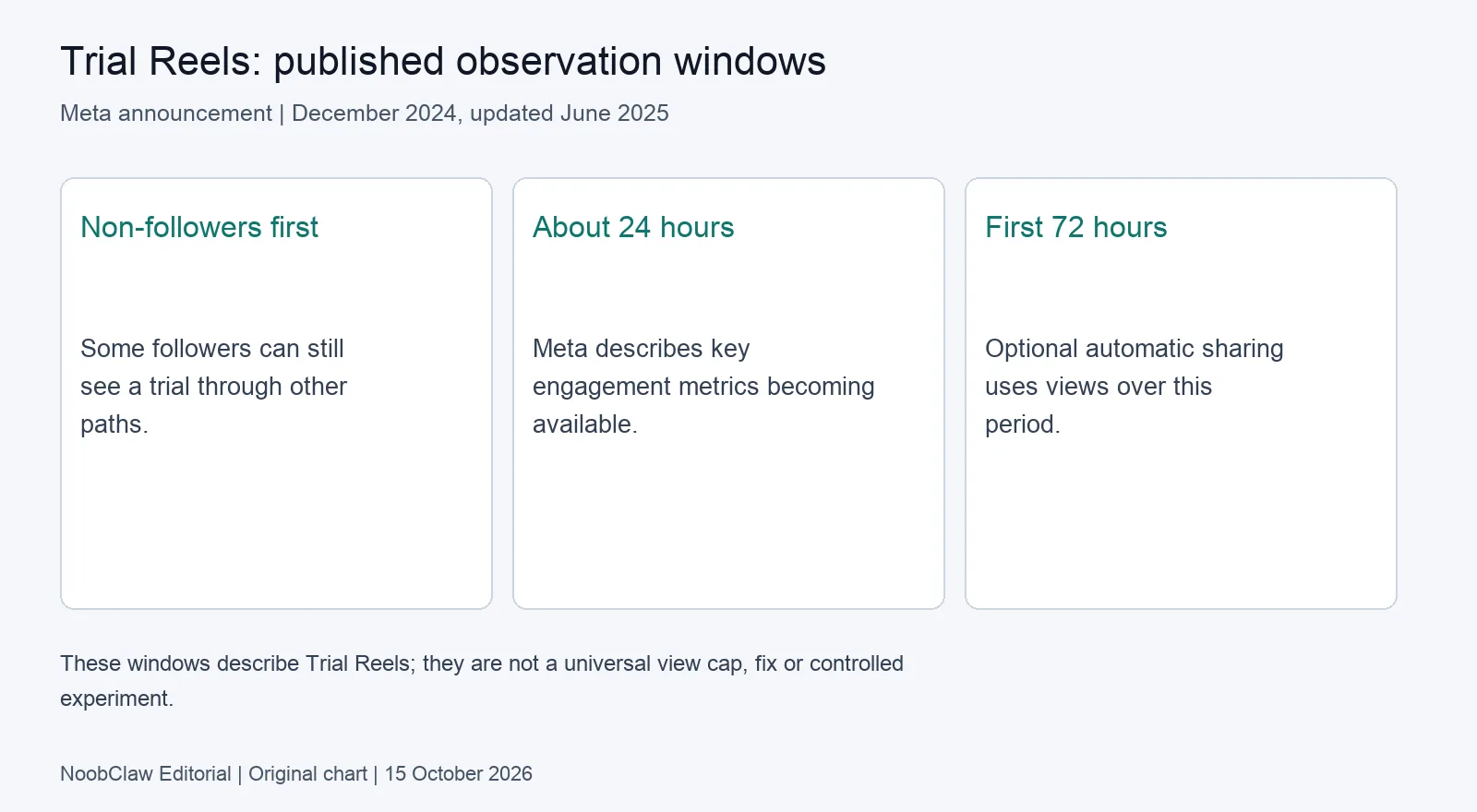
Meta's Trial Reels announcement of December 2024, updated June 2025 describes showing trials to non-followers first, with key engagement readings at roughly 24 hours and optional automatic sharing based on views within the first 72 hours. Some followers can encounter a trial through other routes. These are feature-specific observation windows, not a universal schedule for normal Reels.
If Trial is available to your account, it can provide another way to review an unfamiliar topic or format before choosing wider sharing. Keep trial outcomes separate from normal-post outcomes because the distribution mode differs. Do not call one trial an A/B test or promise that using it will break a view plateau.
For a team, write down whether sharing was manual or automatic and whether that setting later changed. Otherwise, a comparison can mix different exposure conditions without anybody noticing. The log should help explain what you observed and what is still unknown, rather than supply a confident cause from a small sample.
Our 10 October 2026 supplied-script case illustrates the production side: a 441-character English script produced one 32.6-second, 1080 × 1920 MP4 in a manual, non-repeating desktop run. An audio stream and visible subtitle samples were recorded. Some automatically selected stock scenes were generic or off-topic, so the export still needed human review. This was local-only; no Instagram publication, retention or reach outcome was measured.
This example matters when the next step is making a revised video. It shows that a generated file and a finished editorial asset are different stages. A technically exported video may contain weak or irrelevant scenes. Inspecting those scenes is actionable work; it does not imply that a specific scene caused a low-view result.
NoobClaw can be considered for the preparation step: the script-to-video Guide explains the tested local workflow and its prerequisites. It does not diagnose account restrictions or certify a safe posting rate. Check the current plans and credits before starting; a free download does not mean unlimited generation. Keep the edited export separate from the decision to publish it to a particular account.
FAQ
Does Instagram have a documented 200-view cap?
The official materials cited here do not establish one. That is a statement about these sources, not proof about every internal system. A rounded counter cannot identify a restriction. Preserve the actual readings and check the available notices.
Should I delete and repost the Reel?
A low number alone is not a reason to assume this will help. Save the current evidence first, review rights and factual accuracy, and decide whether an edit is warranted. There is no reach guarantee from deleting, reposting or waiting a particular interval.
Will producing more Reels solve the problem?
There is no basis here to promise that. Review the specific evidence and editorial capacity before changing output. For schedule decisions, use our analysis of frequency and content checks; adding drafts does not replace account-specific review.
Review note, 15 October 2026: Metric definitions, account eligibility and production observations are separate evidence. This page does not infer an Instagram median from a TikTok study.
Sources
Official sources checked on 15 October 2026. Announcements describe their dated scope; current account screens and available options can vary.