Posting Too Much on Instagram: Frequency and Content Checks
- Meta spam rules address very high frequency and lower-frequency spam indicators; no universal numeric quota is established here.
- Choose a cadence using current account guidance, comparable observations and realistic editorial capacity.
- Our local video case proves one export, not Instagram publication, reach or a safe posting rate.
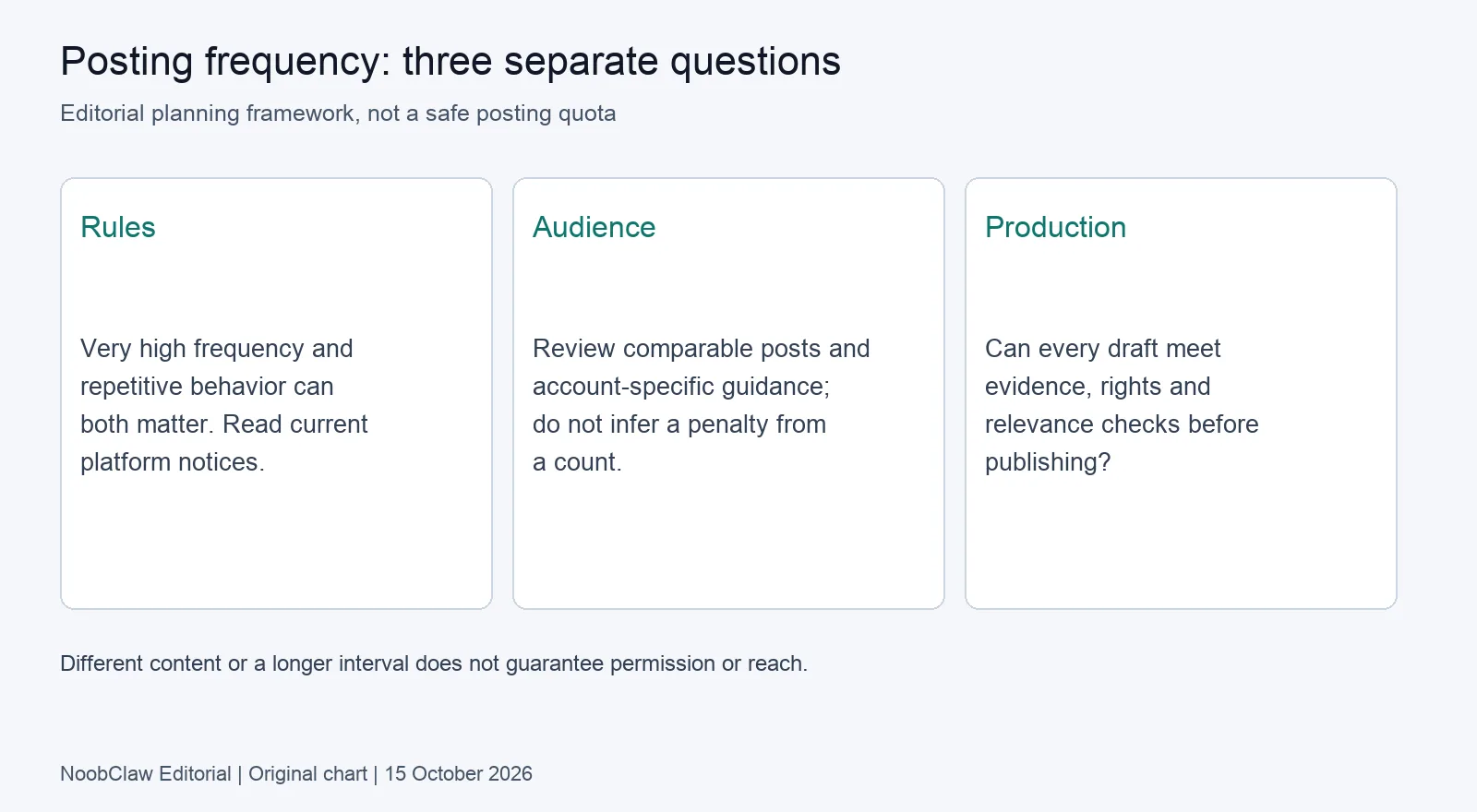
Posting more on Instagram is a decision about platform rules, audience response and your ability to review the work. A low-performing batch does not, by itself, show that Instagram penalized your posting frequency. But it is also wrong to say frequency cannot matter: Meta's published spam policy covers very high-frequency activity as well as lower-frequency activity with other spam indicators.
If you manage several accounts, the useful question is whether a proposed schedule leaves enough room to make and check appropriate content for each audience. A generic posts-per-day number cannot answer that. Start with the account's current notices and guidance, then evaluate the output at comparable ages. This article explains that decision; it does not supply an undisclosed platform quota.
Can publishing too often trigger a restriction?
The current Meta spam policy includes posting and sharing at very high frequencies, whether performed manually or automatically. It also allows restrictions at lower frequencies when other spam or inauthenticity signals are present, including repetitive content. The cited policy does not give a numeric daily allowance for ordinary Instagram editorial posting. That missing number does not establish that any frequency is permitted.
These are separate observations. Distinct posts do not exempt an operator from frequency-related rules, and slower publication does not make repetitive or deceptive behavior acceptable. Neither a browser interval nor a randomized schedule is proof of permission. If the app presents a warning or an unavailable feature, use the reason and action actually offered instead of treating a preferred scheduling pattern as a remedy.
Our editorial recommendation is to keep the rule check, audience review and production review separate. One cannot stand in for the other two.
How should you choose a publishing cadence?
Instagram's Best Practices announcement of October 2024 describes account-specific guidance in the professional dashboard, including advice on how often to post. It organizes advice into five areas: creation, engagement, reach, monetization and guidelines. This supports looking at the guidance available to your account. It does not establish that every creator should use one schedule or that the advice guarantees growth.
Use that guidance alongside a written production plan. For every proposed post, identify the audience, the question being answered and the material that supports the answer. If increasing output removes the time needed for rights checks, factual edits or scene review, hold that draft for editing. This is a quality decision, not an assertion that Instagram detects your workflow in a particular way.
For audience response, compare like with like. Record the publication time, format, length, whether a post was boosted or shared as a trial, and the time at which metrics were collected. Avoid comparing yesterday's Reel with a month-old carousel and attributing the difference to cadence. Changes in topic, distribution mode and viewing opportunity complicate the comparison even before timing is considered.
Choose a manageable observation period and state it in the log. Preserve the initial readings, then record later ones without replacing the originals. Look for whether the proposed schedule is sustainable and whether the available audience evidence supports continuing. This is operational feedback, not a controlled test that isolates the effect of frequency.
Why TikTok frequency data cannot settle a Reels decision
A study of TikTok posting patterns can be useful for a TikTok question. It cannot tell you that Instagram has the same typical view count, that extra Reels only change the upper tail of a distribution, or that your account was not restricted. Before transferring a TikTok result to Reels, check whether the platform, format, sample and measurement method fit the Instagram question. Reusing a chart without preserving those boundaries creates a stronger conclusion than the evidence supports.
The Meta ranking explanation published in June 2023 describes multiple predictions used together rather than one perfect signal. Our inference is modest: a weekly post count alone does not describe the full ranking process. We do not infer how much any factor contributes today or how Instagram will rank a particular batch.
A similar caution applies to two posts published close together. Your audience may respond differently, but an observed difference does not identify timing as the cause. Review content and available metrics rather than promising that spacing posts by a specific number of hours will prevent restrictions or restore distribution.
What changes when you produce for several accounts?
Use an account-level planning sheet rather than averaging all accounts into one result. Record which brief, script, visuals and caption belong to which account. Before publishing, check whether the content fits that audience and whether source rights and factual claims are clear. An account with a visible restriction needs its own review; another account's normal status does not clear it.
Our analysis of Instagram recommendation guidelines explains the distinction between allowed content and recommendation eligibility. Eligibility is a separate consideration from production capacity. A content tool cannot grant it, and changing the wording of a caption does not prove that the underlying issue is resolved.
Our 10 October 2026 supplied-script case illustrates the production side: a 441-character English script produced one 32.6-second, 1080 × 1920 MP4 in a manual, non-repeating desktop run. An audio stream and visible subtitle samples were recorded. Some automatically selected stock scenes were generic or off-topic, so the export still needed human review. This was local-only; no Instagram publication, retention or reach outcome was measured.
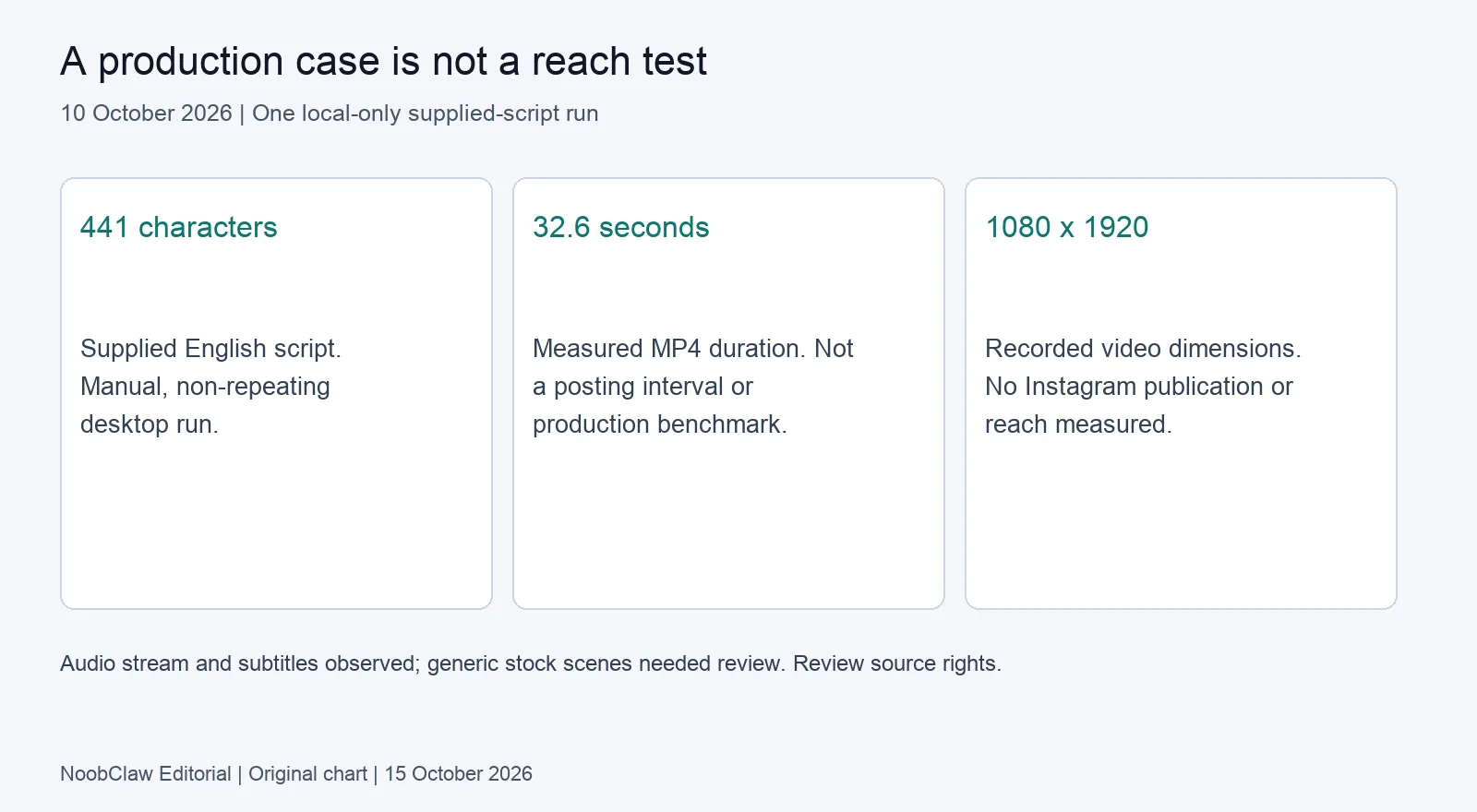
The practical lesson from this case is the remaining review work, not a claim about output volume. Before adding the next draft to a schedule, inspect the scenes and check that narration, subtitles and caption agree. More available exports do not automatically mean more publication-ready posts.
NoobClaw can be considered for the preparation step: the script-to-video Guide explains the tested local workflow and its prerequisites. It does not diagnose account restrictions or certify a safe posting rate. Check the current plans and credits before starting; a free download does not mean unlimited generation. Keep the edited export separate from the decision to publish it to a particular account.
FAQ
How many Instagram posts per day are safe?
The sources cited here do not establish a universal safe number. Review current account guidance and notices, and do not treat a third-party quota as an allowance. Very high-frequency activity and other spam indicators are both relevant to the published policy.
Will posting less fix low reach?
It may create more time for editing, but it is not a documented recovery guarantee. If there is a notice, address that specific issue. If there is none, use comparable performance observations; do not infer that a penalty existed or disappeared. For low Reels counts, see the metrics to check when Reels plateau.
Does unique content make bulk publishing acceptable?
Uniqueness is not a blanket exemption. Check the relevant rules and current account conditions. Our recommendation is to preserve a useful brief and review each draft rather than copy one asset across accounts and assume a schedule makes it acceptable.
Review note, 15 October 2026: This analysis distinguishes platform frequency rules, account guidance and editorial capacity. It makes no safe-quota, reach or recovery promise.
Sources
Official sources checked on 15 October 2026. Announcements describe their dated scope; current account screens and available options can vary.