
Is AI Content Against TikTok Rules in 2026? The Honest Answer
- AI content is not banned. TikTok prompts you to label it at upload through automated detection, and labeled AI content distributes normally.
- The three main suppression triggers in 2026 are watermarked reposts, undisclosed AI content, and automation-like behavioural patterns.
- The algorithm now weights watch time and completion over raw views, favours niche-specific content, and leans toward creators who read as authentically human.
- Suppression is never announced and has no appeal process. The signal is three things at once: views collapsing 90%+, hashtag invisibility, and For You traffic drying up.
Short answer: no, AI content is not against TikTok rules. You can make it, post it, and get distribution.
Long answer: there are three specific things that will quietly kill your reach in 2026, and two of them are things people doing AI content tend to do without noticing. That is the real question worth answering.
What TikTok actually does with AI content
TikTok runs automated detection that prompts you to label AI-generated content at upload. This is a very different posture from banning it — the platform built infrastructure to categorise AI content, which is what you do with something you intend to keep hosting.
By July 2026 it was also testing and expanding controls that let users adjust how much AI content they see. Again: a preference dial, not a prohibition.
What it did simultaneously intensify is enforcement against AI-generated spam that crowds out original creators. Notice the qualifier. Not AI content. AI spam.
A platform that wanted to ban AI content would not build a labeling system and a user preference slider for it. It would build a filter. The infrastructure tells you the intent.

The three things that actually suppress you
In 2026 the biggest risk factors are:
- Reposts with watermarks — content lifted from another platform with the source watermark still on it. This is the most mechanical of the three and the easiest to fix.
- Undisclosed AI content — not AI content, undisclosed AI content. The label is the difference between distribution and suppression.
- Automation behaviour — patterns in how you operate the account that read as machine-driven rather than human.
Read that list again with an honest eye on your own workflow. Most people who think "AI content got me shadowbanned" were actually caught by one or three, not by the AI itself.
The third one is the one nobody fixes
Watermarks you can crop. Disclosure you can toggle. Behaviour is the one that requires changing how your tooling works.
Behavioural signals that read as automation:
- Actions in exact round numbers — always 10 likes, always 20 follows.
- Precise intervals — an action every 60 seconds on the dot.
- Clockwork scheduling — posting at exactly 20:00 every day.
- No rest — 365 days without a gap, active at 4am.
- No wasted motion — a real person misclicks, backs out, scrolls without engaging.
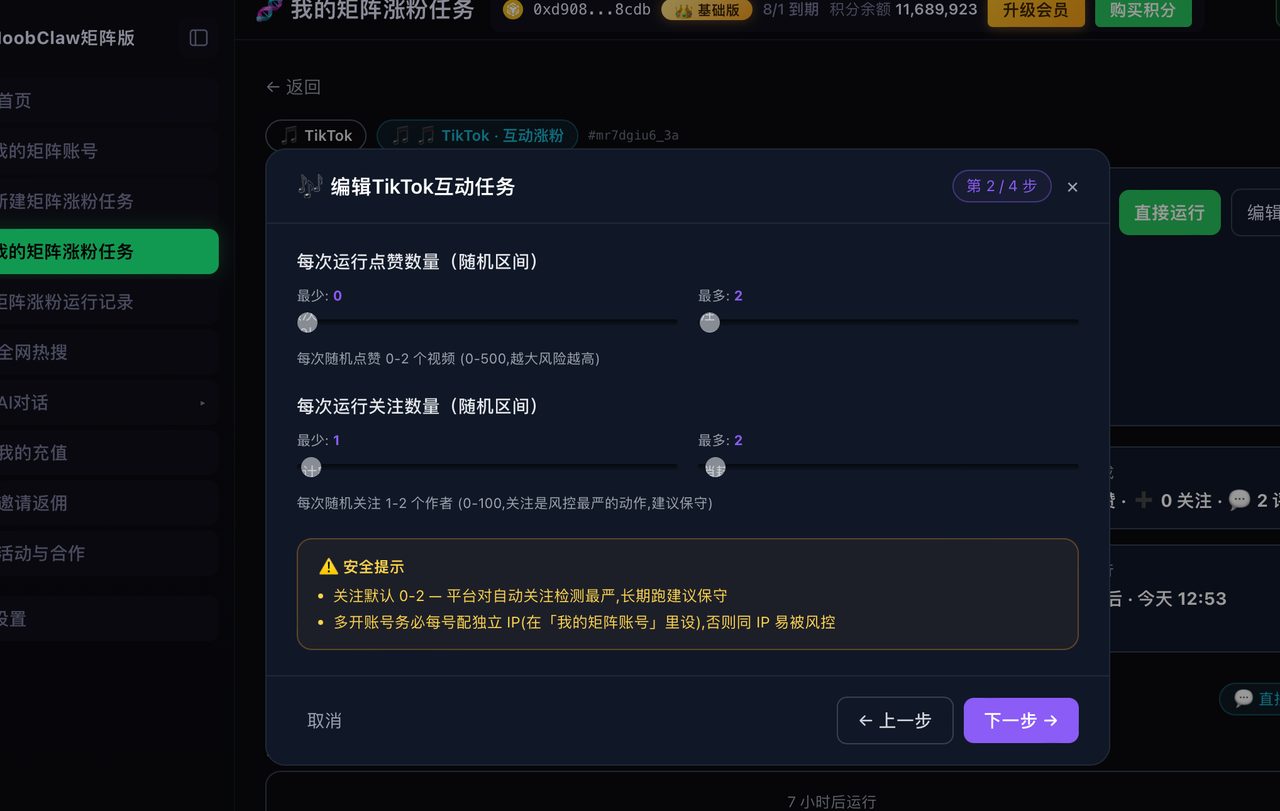
The fix is not doing less. It is randomising everything that is currently fixed: quantities as ranges rather than constants, intervals as ranges, posting inside a window rather than at a timestamp, and actual rest days.
This is a design property of your tools more than a discipline problem. NoobClaw was built around this specifically — quotas are random ranges rather than fixed numbers, scheduled runs fire at a random point inside a window rather than on the hour, and there is deliberate spacing between comment actions. None of that is clever evasion; it is just what a human's activity graph actually looks like.
More on the behavioural layer in TikTok automation safety rules and free bots vs human-like automation.
What the 2026 algorithm actually rewards
Worth knowing, because it changes what "good AI content" means:
- Watch time and completion over raw views. A video that holds people beats one that gets clicked and abandoned.
- Niche-specific content over broad content. The system wants to know who to show you to.
- Content that reads as authentically human. Reports consistently describe the 2026 ranking as favouring authentic human creators over generic AI video.
- Posting frequency and trending audio matter less than they used to.
Practical translation: a small number of AI-assisted videos with a real point of view will outperform a flood of generic ones, and the gap is widening rather than closing.
There is also a structural change worth knowing about: in January 2026 the TikTok USDS joint venture began retraining and updating the US recommendation algorithm on US user data, secured in Oracle's US cloud. The practical implication is that the algorithm is becoming regionally governed and provenance-sensitive rather than simply more personalised.
The watermark problem is bigger than it looks
Of the three triggers, watermarked reposts get dismissed as an amateur mistake — crop it and move on. But the way most people repurpose content quietly reintroduces it.
Downloading your own video back off another platform almost always bakes in that platform's watermark and username overlay. Cropping removes the visible corner but not the encoded artifacts, the aspect ratio scar, or the fact that the audio has been re-encoded twice. Screen-recording is worse on all three counts.
The durable fix is workflow, not editing: keep clean masters. Export from your editor once, and publish that same clean file to each platform separately, rather than treating one platform as the source of truth and pulling copies from it. If you are repurposing content you did not originally publish, use a clean-source download path rather than a screen capture — and be aware that reposting other people's material carries its own problems under the same policy, regardless of watermark.
This one is worth fixing first because it is purely mechanical. No judgement required, no strategy change, and it removes a full third of your exposure.
How to tell if you are actually suppressed
Suppression on TikTok is never announced, is not formally named, and has no appeal process. Most creators only find out by watching analytics collapse.
The diagnostic signal is three things happening together, not in isolation:
- Views dropping 90% or more, suddenly
- Your content not appearing under hashtags you used
- For You page traffic collapsing while follower traffic continues
Any one of these alone is usually just a bad video. All three at once is a pattern. Detection methods are covered in more depth in shadowban detection tools, and if you are starting fresh accounts, warming up before automation matters more than it used to.
A safe-side checklist
- Never post watermarked content. If you are repurposing across platforms, download clean sources.
- Label AI content. Accept the upload prompt when it appears; do not dismiss it.
- Randomise every fixed number in your automation settings today.
- Pick a niche and stay in it. The algorithm rewards being classifiable.
- Optimise for completion, not for volume. Shorter and tighter beats longer and padded.
- Give accounts rest days. Continuous operation is itself a signal.
Engagement mechanics are covered in the TikTok engagement guide.
FAQ
If I label my AI content, will fewer people see it?
Labeled AI content distributes. What suppresses reach is the content being generic — and unlabeled generic content gets suppressed too, plus it accumulates a policy violation. Labeling is strictly the better trade.
Does AI voiceover count as AI content?
Synthetic voice is synthetic media, so treat it as in scope for disclosure. Practically, TikTok's detection often flags it anyway and prompts you at upload, so declining to label is not really an option that stays available.
How long does suppression last?
There is no published duration because there is no formally acknowledged mechanism. Reported recovery generally follows fixing the underlying trigger and then posting normally for a stretch. Trying to power through with more volume while the trigger is still in place is the common mistake.
The short version
TikTok is not against AI. It is against content that anyone could have made, posted by an account that behaves like software.
Label it, make it specific, and stop operating on a metronome. Do those three and the rules simply are not aimed at you.