X Shadowban Checkers: What a Result Can and Can't Prove
- A public visibility check does not prove an account-wide restriction.
- Compare the test, viewing conditions and underlying evidence.
- Official notices and automation permissions require separate checks.
An X shadowban detection tool is useful only if you understand its test. A missing search result, an unavailable reply and a locked account are different observations. Treating all three as a single red warning creates a diagnosis the tool may not be able to support. This guide explains how to compare checkers, repeat a public visibility check and decide whether an official account notice needs action. It does not rank vendors by an invented accuracy score or promise that a paid tool can restore reach.
A checker result is a reason to inspect the evidence. It is not a measured probability that an account has been punished.
What a shadowban checker can actually observe
A checker may search a username, look for a particular public post, inspect a reply or compare results from a separate viewing session. Its output should identify which of those tests it performed. Ask whether the tool displays the underlying result and observation time, or merely turns a collection of checks into a score. The former lets you investigate; the latter needs an explanation of its method before the number is meaningful.
In its search troubleshooting guide, X says that search does not show every post. Protected posts, sensitive-content filters and incomplete account setup can affect what appears. Those are specific conditions to inspect, not proof that every missing result has the same cause. A tool that cannot distinguish the relevant viewing conditions should label its finding as limited. An attractive dashboard does not supply the missing context.
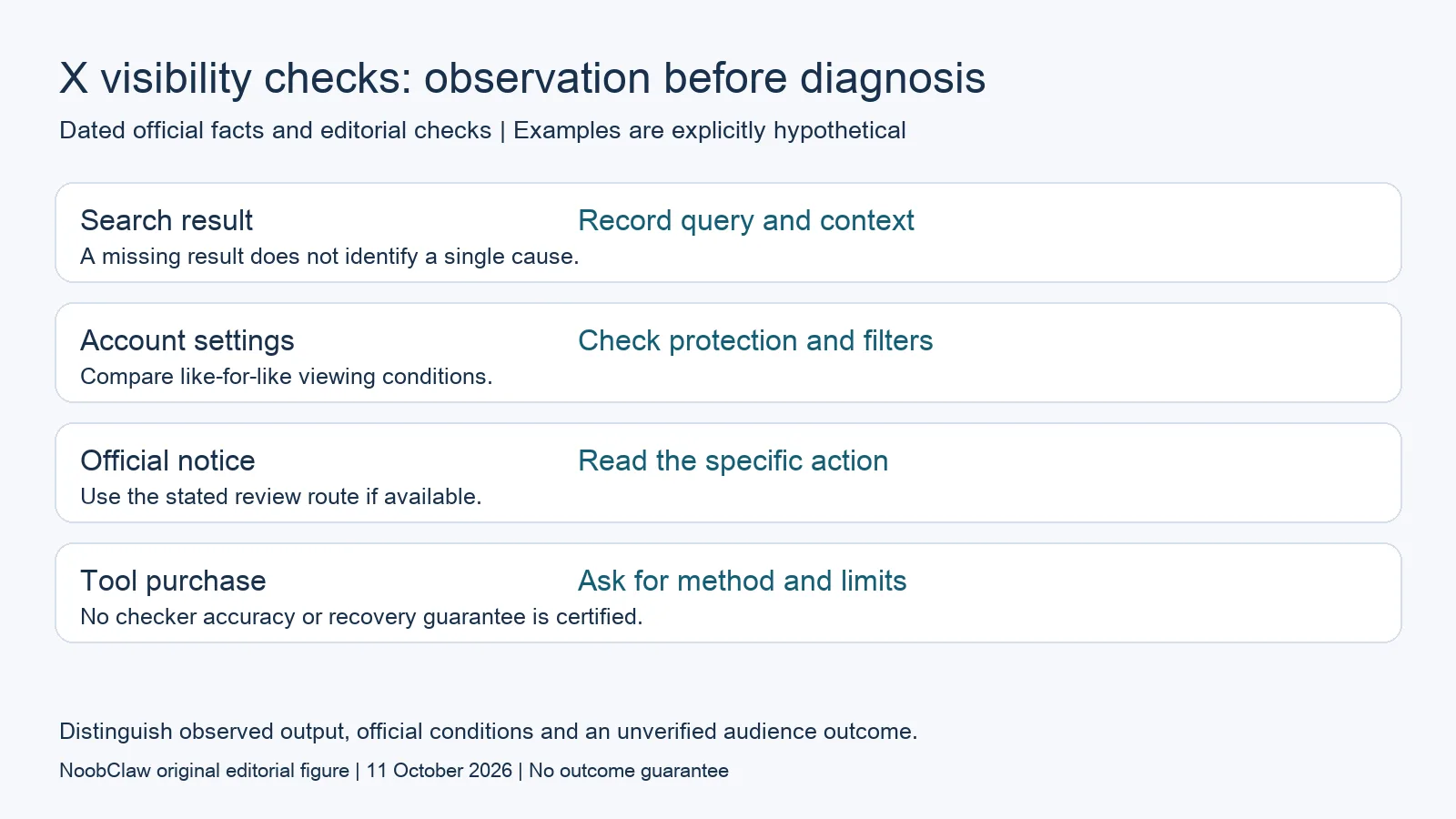
- Search result: Record query and context. A missing result does not identify a single cause.
- Account settings: Check protection and filters. Compare like-for-like viewing conditions.
- Official notice: Read the specific action. Use the stated review route if available.
- Tool purchase: Ask for method and limits. No checker accuracy or recovery guarantee is certified.
Compare tools by evidence rather than a red or green badge
For a tool shortlist, use four questions: what exactly is tested, can the result be repeated, what account access is requested, and how does the vendor explain uncertainty? A public lookup and a connected-account dashboard have different access requirements. Prefer the least access needed for the question you are asking. If a checker requests permissions unrelated to its advertised observation, ask why before connecting an account.
An accuracy claim needs a reference standard. Ask how the vendor determined the true account state, how many accounts were evaluated, when the evaluation occurred and whether the result covers the same test you need. A percentage without those details cannot distinguish a correct finding from a coincidental missing result. This article has not performed a representative checker benchmark, so there is no six-tool league table or measured winner here.
Repeat one missing-result check without changing everything
Start with one public post URL and the exact query that produced the concern. Record the date, time, search tab, viewing account and relevant filters. Check whether the post opens directly and whether it is visible from the author profile under the same viewing conditions. Keep screenshots of the actual surfaces. Those records separate an inaccessible post from a post that exists but did not appear in that query.
For a hypothetical example, suppose a post opens directly and appears on the profile but a keyword search does not return it. The defensible conclusion is that this query did not surface the post in that session. It does not identify a whole-account restriction or predict a recovery date. Change one viewing condition at a time when comparing results. A different query or signed-in account produces a different observation, not necessarily a reversal of a penalty.
Official notices deserve a separate decision path
X documents several enforcement actions, including limits on discovery of particular posts and account-level restrictions. Read any notice for the affected content, stated reason and available review route. A notice about one post should not automatically become a claim about every future post. Save the notice alongside the public observations so that a later comparison uses the same account, content and action.
When an official review route is offered and you believe the action is mistaken, use the information requested there. A third-party checker cannot adjudicate that review. If there is no relevant notice, describe that absence honestly; do not translate it into either confirmed innocence or a confirmed hidden restriction. We have not established a universal waiting period, so there is no two-day, ten-day or guaranteed recovery instruction in this guide.
Automation permissions are independent of checker results
X’s automation rules distinguish permitted activity from prohibited techniques. The current rules explicitly prohibit non-API automation such as scripting the website, and prohibit automated likes. A browser-based tool, local execution or random pauses therefore does not become authorized simply because a checker returns green. A visibility test is not a policy exemption and cannot certify the safety of an unrelated posting workflow.
Before considering any connected service, identify the action it will take and compare that action with current X rules. Review consent, permissions and how to stop the service. For content preparation, you can keep drafting and human review separate from account actions. Do not buy engagement or coordinate duplicate replies as a supposed repair. Those actions do not provide evidence about the original missing result and can create a second, unrelated problem.
Decide whether you need a checker, analytics or content work
Use a repeatable public check when the question is whether a particular post can be found under stated conditions. Use your own account analytics when the question is how an audience responded. Use an official notice when the question is what action the platform says it took. These sources answer different questions. Falling impressions alone cannot supply a hidden enforcement diagnosis or tell you which checker is best.
If the underlying task is producing clearer posts, work on topic, evidence and wording rather than repeatedly purchasing diagnoses. Set a practical review point: what observation would change your decision, and what action would you take then? That keeps the investigation bounded. There is no measured recovery case in this article, no verified follower uplift and no claim that NoobClaw can alter X search decisions.
Where NoobClaw fits in this investigation
NoobClaw publishes this guide and offers a local visibility self-check. That tool uses your answers to organize next checks; it does not access your X account, perform a live search test or confirm a platform restriction. The public self-check does not save those answers. Its result should therefore stay separate from the observation of an actual post or account notice.
For a hypothetical content task, prepare a clear post explaining the specific product feature your audience asked about, review its claims and decide whether to publish through an applicable supported route. Producing that draft does not validate an account diagnosis. The self-check and content preparation address different needs, and neither supplies a recovery timetable. Check the current product offer for the actual supported work before paying for software.
Our observed self-check example: six synthetic input sets
On October 11, 2026, we opened the ordinary public self-check URL in an isolated browser. The page displayed nine question groups and four platform options. We selected X and entered six synthetic answer sets through the visible controls; they produced six distinct evidence summaries. No real X account was accessed. This is a reproducible interface observation, not a detection-accuracy benchmark.
For the baseline, answer no to an explicit notice, yes to profile search, yes to direct-post visibility, yes to usual non-follower reach, one or two to the scope of a drop, and no to bought engagement, watermarks, bulk activity and recent topic change. Re-select X before each case, enter the baseline or stated replacement answers and run the check. The rows below record the actual summary titles we observed.
| Synthetic input | Observed summary |
|---|---|
| Set all nine answers to Not checked. | Record more evidence |
| Use baseline, but answer yes to an explicit notice. | You reported an explicit notice |
| Use baseline, but answer no to profile search. | You reported a visibility difference |
| Use baseline, but answer yes to bought engagement. | Review the activity you reported |
| Use all baseline answers. | No restriction cause established |
| Use baseline, but answer no to usual non-follower reach and all of them to the scope of the drop. | You reported a broad drop in reach |
The practical limit is visible in these results: changing supplied answers changes the checklist summary. It does not reveal an independently measured account state. A reader can repeat this small example on the linked public tool. It supplies no checker ranking, platform detection rate or recovery claim. Normal site resources still load; we are not claiming that the entire page makes no network requests.
Continue with X Account Warm-Up: No Proven Safe Automation Schedule and Grow an X Account with AI: Drafts, Rules and Evidence. Check each guide’s stated date and evidence for the particular decision you are making.
Frequently asked questions
Can a shadowban checker prove that X restricted my whole account?
Not from a missing search result alone. Ask for the test, context and underlying evidence. A relevant official account notice supplies different information from a public lookup.
Why do two checkers disagree?
They may test different queries, posts, viewing contexts or times. Compare those inputs before treating disagreement as evidence that either checker measured the true account state.
Should I pay for a recovery service?
Ask which action the service can actually perform and what evidence supports it. A public visibility check does not establish an ability to reverse a platform decision, and this article certifies no recovery guarantee.
Sources
Official material checked on October 11, 2026. Historical announcements retain their stated dates; reading them today does not certify current account availability. Examples and tool-selection methods are editorial analysis.