
Is Buying Followers Bad in 2026? The Answer Changed, and Not How You Think
- The old answer was "it does nothing." The 2026 answer is "it works against you," because platforms now use follower quality as a distribution input rather than a display number.
- Enforcement usually removes the fake accounts rather than banning the buyer. The direct cost is a visible follower drop plus restricted reach.
- Account-level penalties are reserved for patterns that clearly implicate the owner — repeated large purchases, organised engagement trading, and handing credentials to a growth service.
- That last one is the real red line. Giving a third party your login is the behaviour most likely to cost you the account, whether or not you ever bought a follower.
For about a decade, the honest answer to "should I buy followers" was boring: it is a waste of money, the numbers do nothing, and everyone can tell.
In 2026 the answer changed, and the change is not the one most articles describe. It is not that detection got better and bans got harsher. It is that follower quality became an input to distribution — which means fake followers stopped being inert and started working against you.
The mechanism that changed
Three separate things happened on three platforms within about a year, and they point the same way.
TikTok. Creators and analysts reverse-engineered a testing pattern in which new videos are shown to existing followers before wider distribution, with follower-side completion and sharing determining whether the video expands. Under that model, followers who never watch anything do not merely fail to help — they absorb the seed audience and dampen the signal. It is worth stressing this is a working model inferred by creators, not an official TikTok specification; the detail is in the follower-first breakdown.
Douyin. Publicly circulated summaries of the 2026 ranking changes place engaged-follower interaction near the top of the weighting order and name engaged-follower share as a condition for account tier upgrades. Follower composition, not follower count.
Instagram. Meta ran a large cleanup in May 2026 targeting click farms, third-party growth services and coordinated inauthentic behaviour, removing accounts at a scale that visibly reduced follower counts across the platform.
Fake followers used to be decoration. Now they are ballast — you are paying money to make your own distribution worse.
What actually happens if you get caught
The widely repeated claim is that buying followers gets you banned. That is mostly a myth, and believing it makes people misjudge the real risk.
The observed enforcement pattern is that platforms remove the fake accounts rather than suspending the profiles they followed. Bot removal is a supply-side action; going after every account a bot network touched would punish enormous numbers of people who did nothing.
So the realistic outcomes for a buyer are:
A visible follower drop. Purchased followers disappear, usually in a batch, usually publicly. Anyone watching your account sees it.
Restricted reach. Accounts showing bot-like follower acquisition patterns are reported to see reduced distribution — sudden follower spikes and engagement inconsistent with audience size are exactly the signals detection systems watch for.
Distorted advertising data. Underrated but expensive if you run ads: fake followers corrupt the audience signals used to build lookalikes, so your targeting drifts toward the wrong people and costs rise.
A permanently misleading dashboard. The quiet one. Once a meaningful share of your followers are fake, you can no longer tell whether a piece of content worked. Engagement rate is corrupted, reach comparisons are corrupted, and every subsequent decision is made on bad data. You bought a number and lost your instruments.
What does draw account-level penalties are patterns that unambiguously implicate the owner: repeated large purchases, organised engagement-trading schemes, and sharing credentials with automation or growth services.
The line that actually gets accounts killed
That third item deserves its own section, because it catches people who never bought a single follower.
Any service that grows, posts or engages on your behalf from its own servers needs your login. Once you hand it over, several things become true at once: your account is being operated from infrastructure shared with many other accounts, your activity pattern becomes machine-uniform, and every other customer's behaviour is now correlated with yours. Platforms are good at spotting that — Reddit's behavioural fingerprinting, which reads typing rhythm and voting habits, is the most documented example (see the behavioural fingerprinting piece).
This is the actual distinction worth internalising: platforms tolerate a lot of clumsy growth behaviour, and very little credential sharing. One looks like a person making bad choices. The other looks like an account that is no longer operated by its owner.
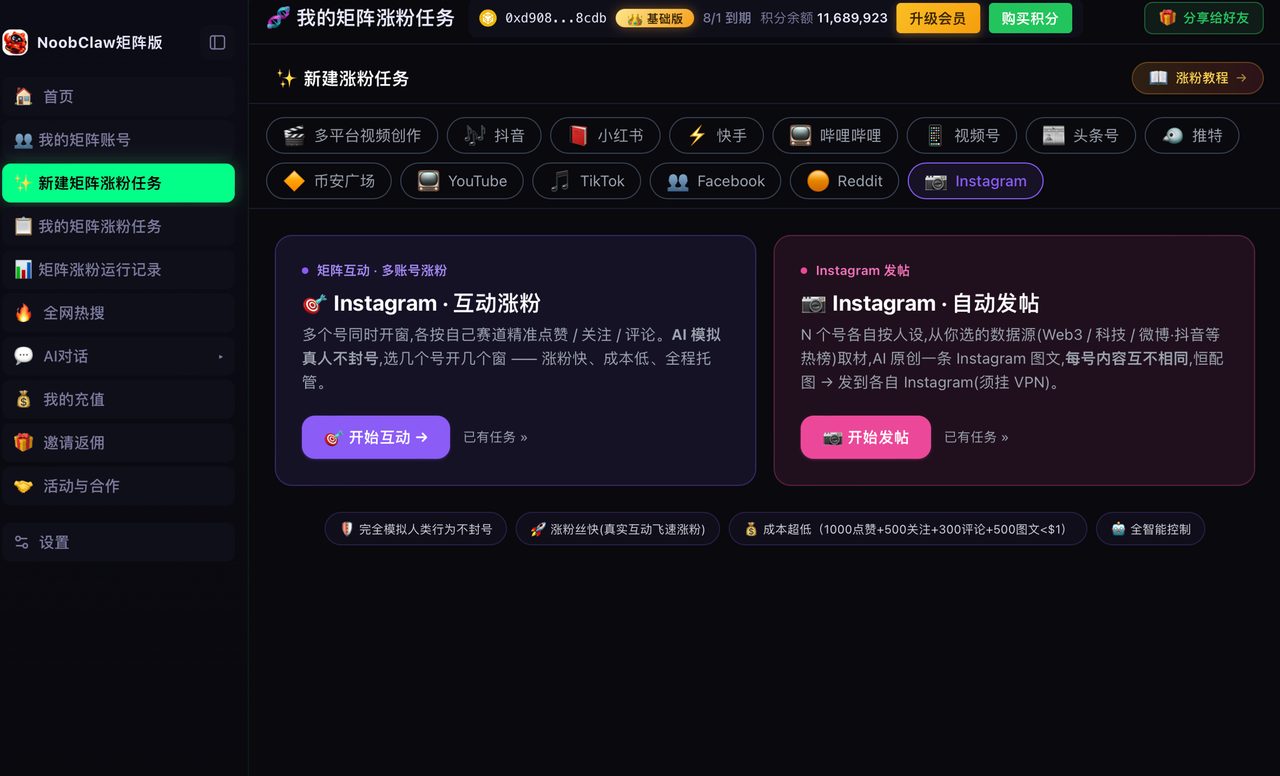
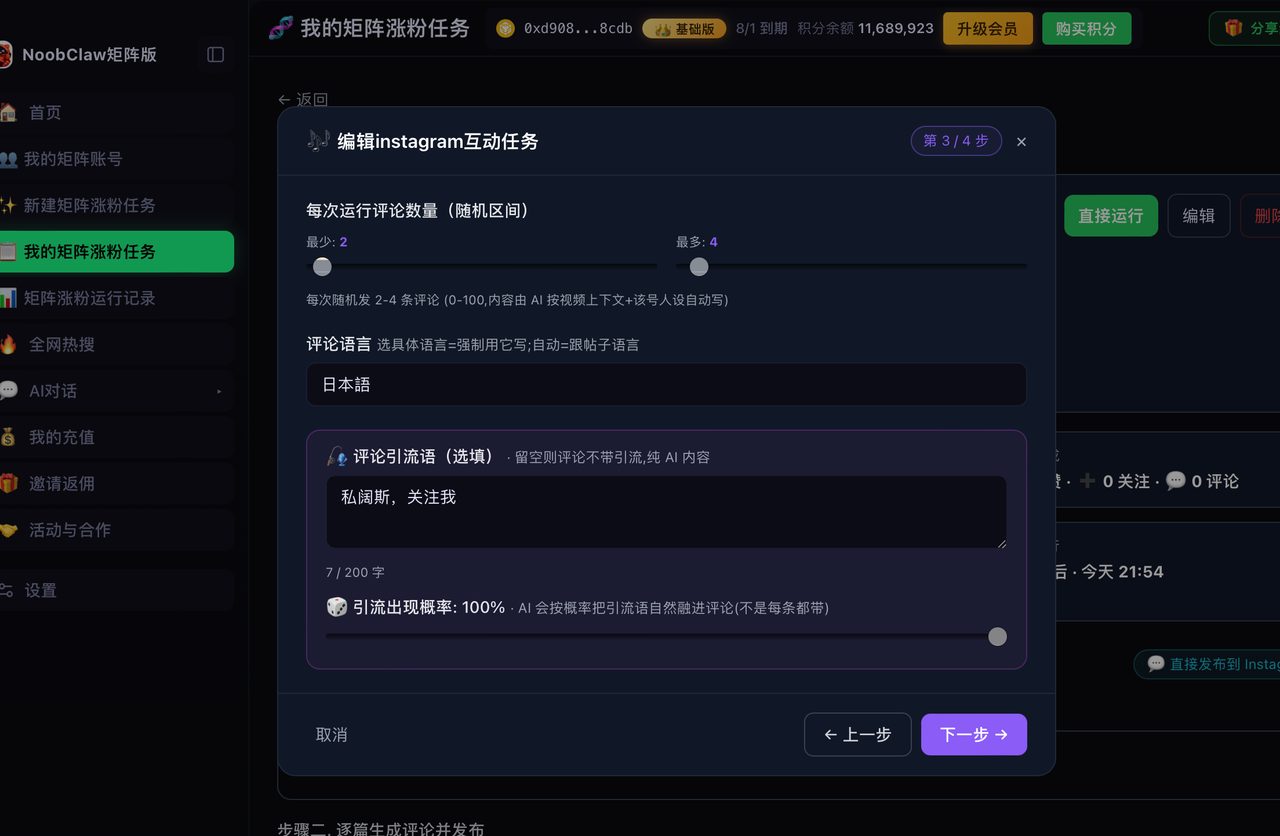
It is also why the architecture of your tooling matters more than its feature list. Software that runs on your own machine, in your own browser, using the session you logged in with yourself, does not create that pattern — nobody else's account is operated from your environment and your credentials never leave it. That is the design NoobClaw uses: local fingerprint browser profiles, one per account, with content generated per account rather than duplicated across a portfolio. Not a claim that automation is risk-free; a claim that where it runs is the variable that changes the risk category.
What to do instead, if the goal was social proof
People rarely buy followers because they want followers. They buy them because a low number looks bad to brands, clients or new visitors. That problem is real, and there are cheaper solutions.
Lead with engagement rate, not follower count. A 2,000-follower account with strong engagement is a better pitch than a 20,000-follower account with dead engagement, and any brand worth working with knows it. Buying followers actively destroys the number you would rather be showing.
Fix the denominator by activating, not acquiring. Every dormant real follower you wake up improves the same ratio that fake followers degrade. Ask questions people want to answer, reply to every comment for a couple of weeks, and optimise for the interactions platforms now weight most — sends and saves rather than likes (see sends vs likes).
If you need scale, add accounts rather than inflating one. Several genuinely small accounts, each with a clear niche and a real audience, outperform one padded account under every 2026 ranking model — because each of them has a functioning seed audience. That takes real production capacity, which is the honest constraint; it is discussed in how many accounts one person can manage.
The through-line in all three is the same. Every tactic that inflates a number without changing who is paying attention has become more expensive this year, not less — because the systems distributing your content moved from counting your audience to assessing it. That shift is unlikely to reverse, which makes it a reasonable thing to build around.
FAQ
What about buying followers from a service that promises real, active accounts?
If they were genuinely real and active, they would be interested in your content, which no purchase can arrange. What such services usually supply is aged or compromised accounts, which is precisely the category platform cleanups target. The premium pricing buys a delay, not an exemption.
I bought followers years ago. Am I still at risk?
Most likely those accounts have already been removed in one cleanup or another, which is self-correcting. The residual issue is a depressed engagement rate if a chunk of your count is still non-participating. Focus on activating real followers rather than trying to identify and purge old purchases manually — bulk removal has its own risks.
Do giveaway followers count as fake?
They are real accounts, so they will not be removed in a bot purge — but they behave like fake followers for distribution purposes, because they followed for a prize rather than your content. Under follower-quality-weighted models they dilute the same signal. Not dangerous, just usually not worth what the giveaway costs.