Post to Multiple Facebook Groups: Methods and Permission
- The old Groups API cannot be assumed to support a current group-posting workflow.
- A local browser session is not proof that a tool is permitted or that every group accepts the post.
- Prepare relevant drafts together, then check each destination and final result.
Posting to several Facebook Groups is a destination-by-destination decision. A scheduler’s old connection screen does not establish a working current integration, and a browser extension is not automatically an approved substitute. Start with the groups you actually need to reach, the role you hold in each, and the permitted way to submit the intended content. Batch preparation can still be useful even when publication needs separate decisions.
Plan the content separately from the permission and the final published result.
What the official API announcement establishes
Meta’s January 23, 2024 Graph API v19 announcement deprecated the Groups API and specified removal from all versions within ninety days. It named publish_to_groups and groups_access_member_info among the affected permissions. The same section described a separate private-reply use case. That exception is not general permission to publish identical posts to arbitrary groups. We read the retrieved German-language official body; this is a dated platform change, not an authenticated test of a current tool.
Ask a vendor claiming group support to identify the present mechanism and its applicable authorization. A screenshot of the former connection procedure is not sufficient. A successful action on a Page also does not establish support for Groups. Write down the destination type and action before comparing tools, so that a Page publisher, a reminder calendar and a group-submission utility do not become interchangeable options in your shortlist.
In a hypothetical brief for five communities, the useful deliverable is five suitable proposals, not a claim that one generic message will be accepted everywhere. Keep the intended group and account beside each draft. Review whether the content belongs in that community and whether links, promotion or a particular format are allowed. If you cannot determine the conditions, ask the group’s administrators rather than interpreting an installed extension as permission.
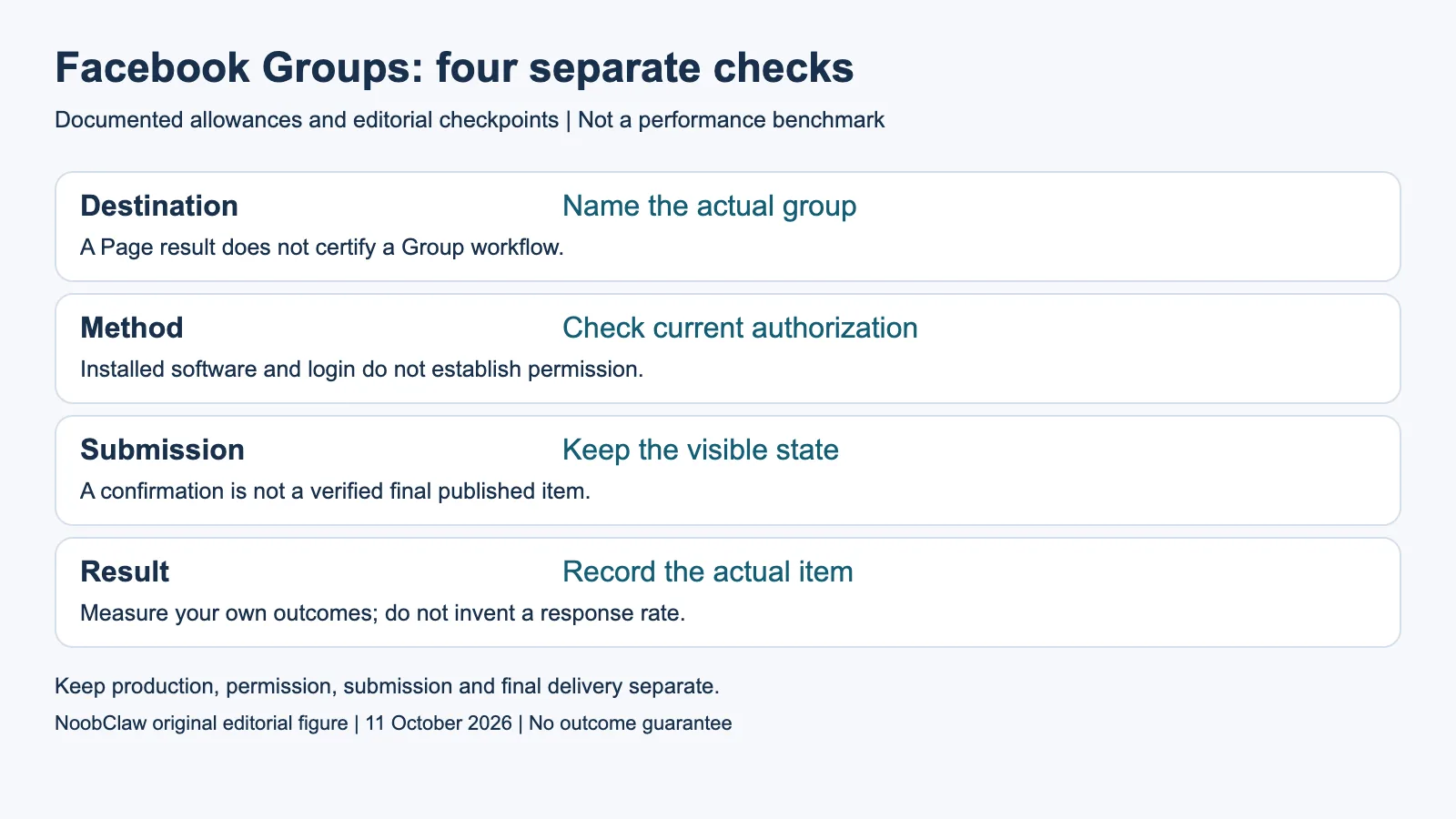
- Destination: Name the actual group. A Page result does not certify a Group workflow.
- Method: Check current authorization. Installed software and login do not establish permission.
- Submission: Keep the visible state. A confirmation is not a verified final published item.
- Result: Record the actual item. Measure your own outcomes; do not invent a response rate.
A logged-in browser still has conditions
The current Facebook Terms we rendered say automated access or collection requires prior permission, whether or not someone is logged in. They also prohibit circumventing access restrictions and misuse such as spam. These provisions matter when evaluating a browser-based offer. Having your own session does not, by itself, establish that a specific automated action is allowed. Account ownership, a working interface and method authorization are separate questions.
For a proposed tool, record what it reads, what it writes, whose session it uses and what confirmation it presents before a write. Review its requested permissions and the handling of credentials or session data. This is an evaluation procedure, not a claim that any particular extension is malicious or secure. A local process can still have dependencies, network traffic and access to sensitive material that need assessment.
Do not choose a delay, a separate profile or a different message as a substitute for the applicable conditions. Those choices can organize a workflow; they cannot certify a platform exemption. If a method is not supported for the task, prepare the drafts offline and use an available permitted route. Do not advertise that browser capability is immune to account restrictions, changing interfaces or removal of a feature.
Keep submission and publication separate
For each proposal, distinguish a draft from an attempted submission and an item you can actually see in the intended group. If the interface shows a pending review, retain that state and avoid presenting it as published. If it shows an error, keep the error. An absent public item does not automatically identify whether the problem is approval, submission, visibility or something else; use the evidence available for that destination.
In the five-group example, suppose two proposals remain drafts, two have visible submission confirmations and one has an ordinary published URL. Your report would contain those three states. It would not say five posts went live, or infer the reason for the other four without evidence. This ledger is an illustrative reporting method, not a claim about how often any group approves a submission or how long its moderators take.
Record the group, submitted version, time zone, status and eventual item URL. Before repeating a submission after an interruption, determine whether the first attempt already created an item. A duplicate copy is a different outcome from a delayed first copy. Decide in advance when to stop and request clarification, instead of repeatedly resending the same material because a dashboard has not yet changed.
Save effort in preparation, then measure the useful result
Draft variations can reflect real differences between communities: a technical explanation for one, an invitation to a relevant discussion for another, or an answer to an existing question where appropriate. This is editorial work, not a promise that different wording produces a particular response rate or defeats moderation. Keep the topic, supporting material and permitted call to action attached to each version so reviewers can see what changed and why.
Measure what happens in your own campaign before deciding which destinations deserve more effort. Suitable observations include an accepted post, substantive responses, relevant visits and the time spent preparing it. Keep visits distinct from purchases or qualified leads unless the appropriate analytics evidence connects those events. This article has no sampled group-response distribution and does not claim that two or three groups produce most of everyone’s results.
NoobClaw’s public creative record documents one 441-character English script exported locally as a 32.6-second video at 1080 × 1920 pixels and 30 frames per second. Footage relevance, listening quality and stock rights still require review. These measured input and file properties help evaluate asset preparation; they establish no platform publication, inbox access, security exemption or growth. Select the documented deliverable you need, then assess the distribution route separately.
For the related content and workflow decisions, read Post to Multiple Social Media at Once: Methods and Checks and Facebook Automated Behavior Warning: What to Check. Each review has its own evidence and scope.
NoobClaw publishes this article. Its script-to-video guide and public creative execution record document a local video result, not external-platform publication. Check the current product offer against the supported action you need.
Frequently asked questions
Can an old API connection guide prove a tool still posts to Groups?
No. Use the dated official change to question legacy instructions, then obtain the vendor’s present mechanism and verify that it fits the intended destination and authorization.
Does a Chrome extension automatically solve the problem?
No. Its ability to operate an interface does not establish permission, security or acceptance by each group. Assess the actual action and requested access.
What can I batch without promising simultaneous publication?
Prepare a destination list, source material and suitable drafts together. Keep permission checks, individual submission decisions and verified final results separate.
Sources
Sources inspected on October 11, 2026. Meta Graph API v19 was read in its retrieved German-language official body. Instagram Help and Meta Terms were read in their retrieved Chinese-language rendered bodies; the inspected account, app and regional scope is retained. TikTok policy versions were parsed from the complete official original-language payload through Google Translate public transport after original-site access failed; the cited access link is that transport, not a direct-origin HTTP200 claim. The current policy chapters do not certify a historical diff. Reused same-day primary copies retain their original receipts and are not new GETs. Workloads are illustrative; local creative output does not demonstrate publication, protection or paid conversion.