
TikTok Branded Content Policy (Effective 31 August 2026): What Changed, What Did Not, and Multi-Account Posting
- The policy was published on 4 August 2026 and took effect on 31 August 2026. It covers any post that promotes or reviews a third-party brand for payment "or any other incentive": gifts, paid posts, af
- We compared it line by line with the archived April 2026 version. The creator duties did not change: switch on the commercial content disclosure setting, and make the product clear inside the post its
- What did change is the map. Restricted industries such as alcohol, dating apps, financial services, over-the-counter medicines, vitamins and gambling are now allowed, with age limits, in more named ma
- Getting it wrong costs reach first: a flagged post has 24 hours to be fixed or appealed before it loses For You eligibility. Repeated failure can lead to temporary posting restrictions or an account b
The short version for anyone who searched the 31 August 2026 date on TikTok's notice: the Branded Content Policy that took effect that day did not add a single new duty for creators. The two rules that matter, switch on the disclosure setting and make the product clear inside the post, were already in the April 2026 text word for word. What moved was where restricted products are allowed to run.
We compared the policy page with TikTok's archived April 2026 version line by line on 26 September 2026. TikTok has not published a change log for this version: its "Updates we are making to our terms" page still describes the July 2025 update, and the policy page still links the old text as "current". Quotes below are from TikTok's pages as of that date.
What does the TikTok Branded Content Policy require since 31 August 2026?
The policy page is dated "Published: 4 August 2026" and "Effective date: 31 August 2026". It defines branded content as "content that promotes or reviews a third-party brand or its products or services in exchange for payment or any other incentive", and it lists four situations that count:
- a product or service gifted to you by or on behalf of a brand;
- a brand, product or service you were paid to post about, in money or in kind;
- a product or service you earn a commission on, "for instance, via an affiliate link or promotional code";
- a brand you have or had a commercial relationship with, such as an ambassador deal.
The test is whether anything of value changed hands. A free product is in scope; so is an affiliate code, even if the brand never contacted you.
Two duties follow. First: "When posting Branded Content, you must enable the commercial content disclosure toggle." Second: "You must ensure that the product or service you are promoting is sufficiently clear, without requiring viewers to access your profile page or any links. For instance, you should explicitly identify the product or service verbally and/or in the text caption." A post with the toggle on but the product left unnamed ("link in bio") meets only half of the rule.
The rest is a list of prohibitions (misleading claims, illegal products, "surreptitious or subliminal techniques", unhealthy body images, protections for children), plus a warning that, "in some instances" such as a new law, TikTok may apply updated rules "to content you have already posted". Old sponsored videos are not guaranteed to be grandfathered.
Every sentence quoted above is identical in the April 2026 archive, apart from "minors" becoming "children". The real edits are in the industry lists.
How does the content disclosure setting work, and does it cost reach?
According to TikTok's help article on the setting, you switch on "Disclose commercial content" under "Content disclosure and ads" on the post screen (under "More options" if you are not in TikTok One), then choose "Your brand" or "Branded content". Choosing "Branded content" shows a "Paid partnership" label, and you can tag the brand partner, with a default authorization period of 60 days.
Two details are easy to miss. You can switch the setting on after publishing, from the post's "Ad settings", so fixing an old sponsored post is a reversible edit. And a disclosed post may be added to TikTok's Commercial Content Library where the law requires it, possibly staying there "even if the original content is deleted or altered". We covered what that library keeps in our piece on the Commercial Content Library.
On reach, TikTok's creator help page says disclosure "will not affect the way TikTok recommends content", citing an internal study of nearly 2 million videos with and without proper disclosure that found no performance difference (2023, tested in Indonesia and Pakistan). That is TikTok grading itself on two markets in 2023: a stated position, not proof. The same page adds: undisclosed commercial content "may not be eligible for distribution in the For You feed".
The 31 August version did not add a new duty for creators. It redrew the map of where restricted products may run, which is why the notice reached everyone and changed things for only some of them.
Which industries are banned outright, and which only go through TikTok One?
The prohibited list has 15 entries, and no disclosure makes them allowed. Among them: tobacco and nicotine (vapes included), drug-related products including CBD, predatory financial offers such as payday loans, healthcare and medicine (clinics, telehealth, teeth whitening, hair growth), professional services, weapons, weight-loss products including detox teas, and political advertising.
The restricted list has 11 entries: alcohol, dating apps and live video, energy drinks, film and game trailers, financial services, over-the-counter medicines, prescription medicines, vitamin supplements, gambling, underwear and, new in this version, government and intergovernmental entities. Branded content in these categories "will only be shown in the market it was posted in and may be age restricted". A creator may post it only "if you have been invited by an approved brand", and the brand must have TikTok's explicit permission, a Registered Business Account, and must work "only through the TikTok One platform". How that route works is in our explainer on TikTok One for restricted industries.
Some names appear on both lists: "financial services" is prohibited in its predatory form and restricted in its ordinary form (loans, cards, insurance). Weight-loss products are prohibited while vitamins are restricted. The 31 August edits sit in the market lists under each restricted category:
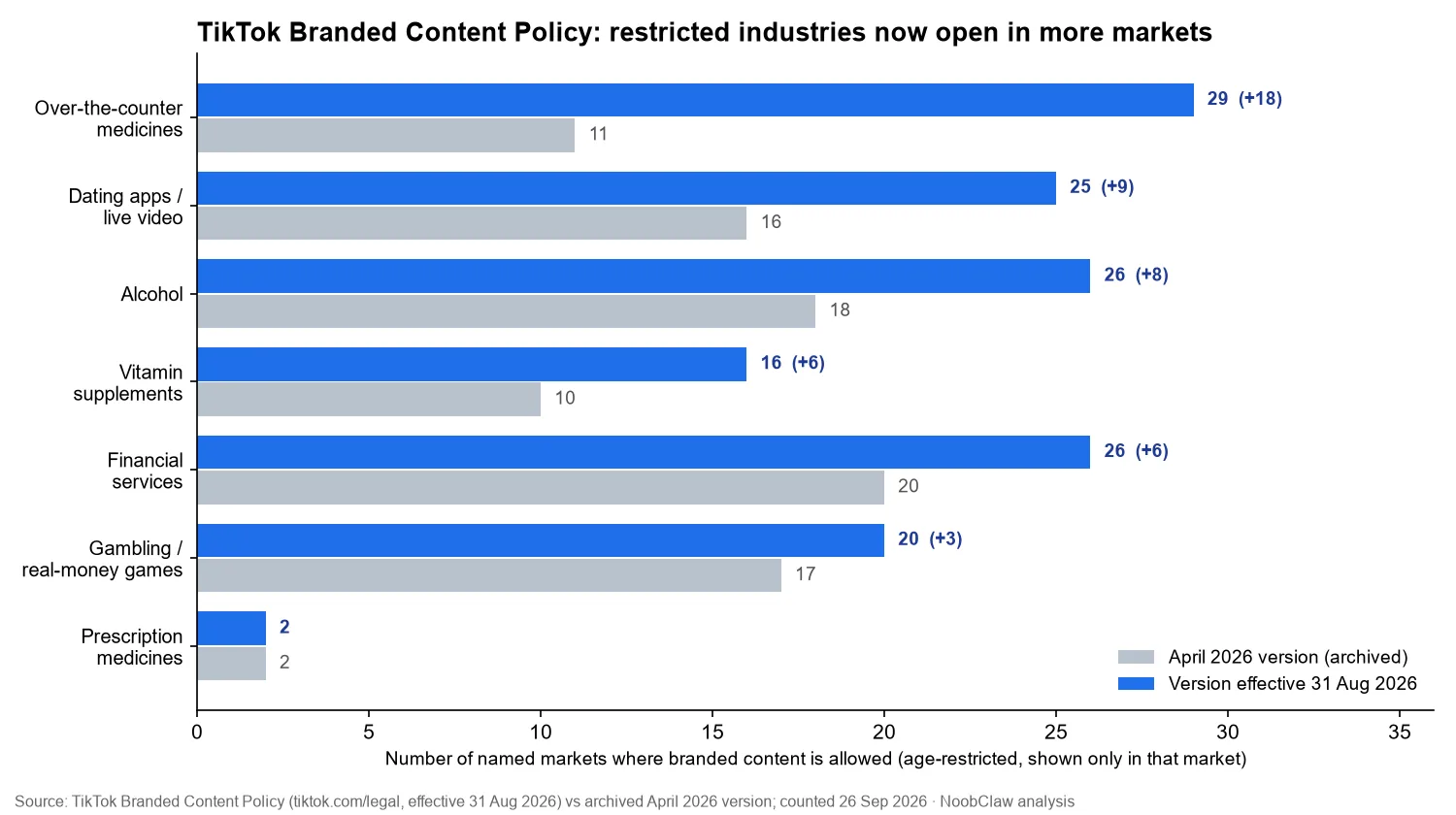
Over-the-counter medicines went from 11 to 29 markets, dating apps from 16 to 25, alcohol from 18 to 26. Across the six categories, just over half of the new entries are European: the UK, Germany, France, Spain and Italy moved from "not allowed" to "allowed with age limits" in several of them. The over-the-counter jump is different: most of its 18 new markets are in the Middle East and Central and South Asia, such as Kuwait, Qatar, Pakistan and Kazakhstan. Luxembourg joined the "not allowed" lists of seven categories, energy drinks are now barred in Kuwait, and prescription medicines stay limited to Canada and the United States. Check the list for the market you publish in, since that is the only market where the post will show; TikTok's page is the version that counts.
What happens if you post branded content without disclosure?
The policy's own enforcement line is one sentence: "we may remove the content or impose other restrictions." The detail sits on two other TikTok pages.
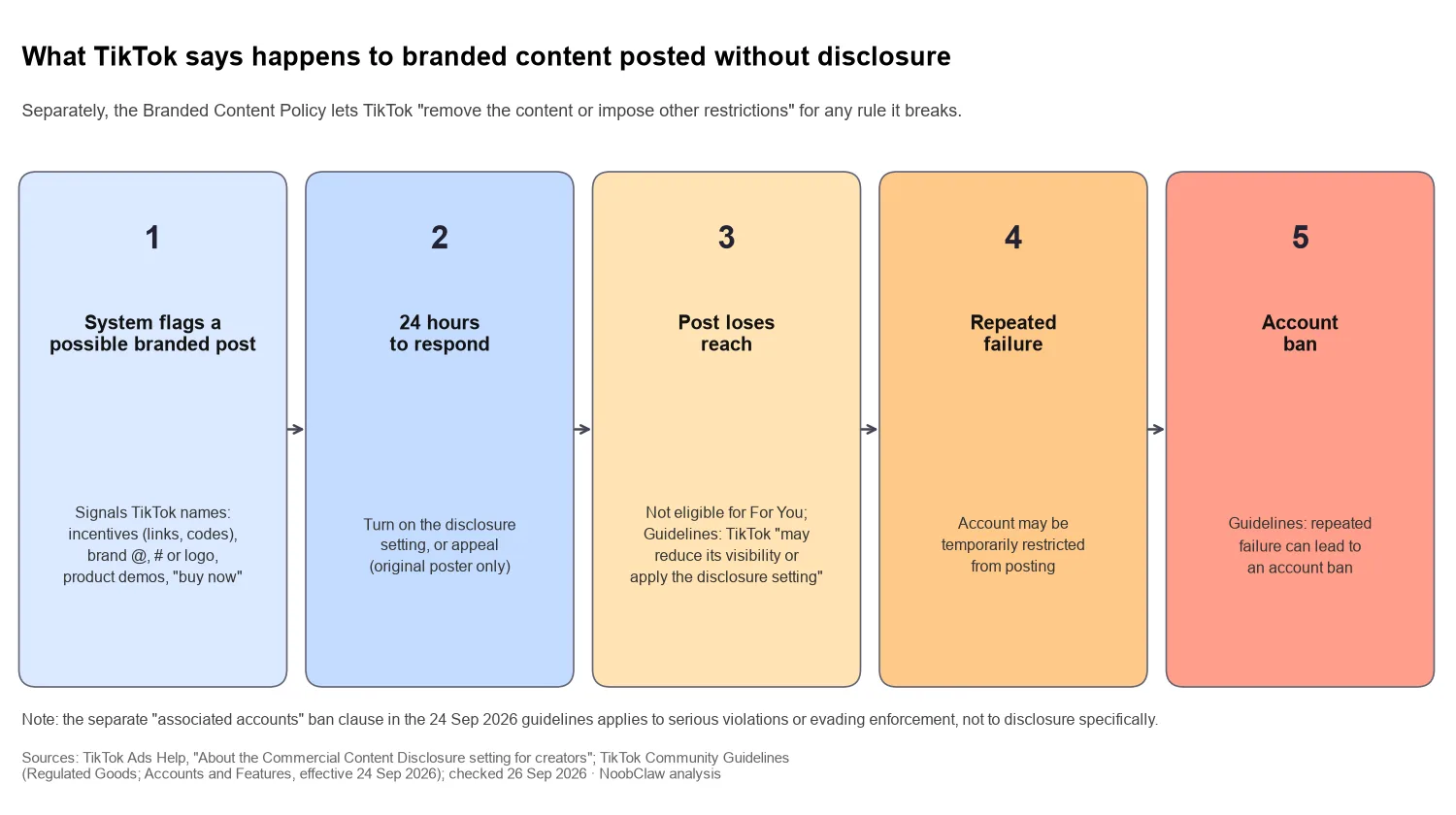
The creator help page says TikTok flags content as commercial on three kinds of signals: financial incentives (links, promo codes, QR codes), brand mentions (a #brand, an @brand or a visible logo) and product recommendations (demos, tutorials, "buy now"). When a post is flagged you get a notification and 24 hours to switch on disclosure or appeal; only the original poster can appeal. If you do neither, the post becomes ineligible for the For You feed.
The Community Guidelines that took effect on 24 September add the account-level step: TikTok "may reduce its visibility or apply the content disclosure setting", and "repeated failure to make a disclosure can lead to your account being temporarily restricted from posting content, or can lead to an account ban." The same update also says that when someone "seriously breaks the rules or tries to dodge enforcement", TikTok may ban all of their accounts, "including associated accounts". That sentence sits in the accounts chapter, not the disclosure rules, but it is the reason a repeated problem across a network of accounts is worth taking seriously. We went through that change in our breakdown of the September guidelines update.
Regulators apply the same idea. In a 19 April 2023 ruling, the UK Advertising Standards Authority upheld a complaint against a paid TikTok post on Tasha Ghouri's account that promoted a song and was labelled only "soundad". The record label argued the "musicad" and "soundad" tags had over 450 million uses on TikTok; the ASA found the label could read as a misspelling of "sounded" and asked for "#ad" at a minimum. A paid sound is a paid promotion, and a label only counts if viewers understand it. The ASA's May 2025 monitoring report estimated that about 1 in 6 pieces of TikTok content in its sample were likely ads, that only 60% of those were adequately disclosed, and that it received over 3,500 complaints about undisclosed social ads in 2024.
What changes if you run several accounts or post for clients?
For one creator, a missed toggle is one flagged post. For an agency or a matrix operator, the risk is a wrong default copied across every account in the same week, while the guidelines treat repeated failure as an account problem. The checklist we would run:
- Log incentives per campaign, not per post. Gifts, affiliate codes, paid sounds and ambassador perks all count, on every account that carries the campaign.
- Make "disclosure on and product named" a publish gate. The setting is per post and per account. Do not assume a scheduler or bulk publisher sets it for you, NoobClaw included. If your tool cannot set it, route commercial posts through a person; NoobClaw's video engines, for example, can save the finished file locally instead of posting it.
- Screen every brief against both lists, for the market you post in. Prohibited categories cannot be fixed with a label; restricted ones need a TikTok One invitation.
- Let content differ per account, never compliance.
- Fix the backlog with reversible edits first: disclosure from the post, product name in the caption.
If you are unsure whether a single post needs the label, our post-by-post disclosure guide walks through the edge cases.
FAQ
I got a "branded content" notification on a post. What should I do?
You have 24 hours. If the post involved any incentive, switch on the disclosure setting from the post. If it did not (you bought the product yourself), appeal from the in-app notification; only the original poster can. If you let it lapse, the post loses For You eligibility, and repeated lapses can lead to posting restrictions.
Does a gifted product or an affiliate link count as branded content?
Yes. The policy names both: a product "gifted to you by (or on behalf of) a brand" and a product you earn commission on "via an affiliate link or promotional code". No money or contract is required.
Does the Branded Content Policy say anything about AI-generated content?
No. Labelling realistic AI content is a separate duty under TikTok's Community Guidelines. See AI content disclosure rules by platform for that side.
Sources
- Branded Content Policy — TikTok — 2026-08-04 — https://www.tiktok.com/legal/page/global/bc-policy/en
- Branded Content Policy, archived version (last updated April 2026) — TikTok — 2026-04 — https://www.tiktok.com/legal/bc-policy-archive
- Updates we are making to our terms — TikTok — 2025 — https://www.tiktok.com/legal/page/global/bc-policy-learn-more/en
- How to turn on the Commercial Content Disclosure setting in TikTok — TikTok Ads Help — undated, checked 2026-09-26 — https://ads.tiktok.com/help/article/how-to-turn-on-the-commercial-content-disclosure-setting-in-tiktok
- About the Commercial Content Disclosure setting for creators — TikTok Ads Help — undated, checked 2026-09-26 — https://ads.tiktok.com/help/article/about-the-content-disclosure-setting-for-creators
- Community Guidelines: Regulated Goods and Commercial Activities — TikTok — 2026-08-25 — https://www.tiktok.com/community-guidelines/en/regulated-commercial-activities
- ASA Ruling on Universal Music Operations Ltd — Advertising Standards Authority (UK) — 2023-04-19 — https://www.asa.org.uk/rulings/universal-music-operations-ltd-a22-1174332-universal-music-operations-ltd.html
- Influencer Ad Disclosure on Social Media: Instagram and TikTok (2024) — Advertising Standards Authority (UK) — 2025-05 — https://www.asa.org.uk/static/3f7df70c-ca5c-499c-8aaa56e8b3e9572e/ASA-influencer-ad-disclosure-report.pdf