
TikTok One for Restricted Industries: 31 August 2026 Rule
- Restricted industries (alcohol, finance, gambling, dating apps, medicines and more): under the policy in force since 31 August 2026, brands need TikTok's permission and must use TikTok One.
- Creators may post such branded content only "if you have been invited by an approved brand." It shows only in the market where it was posted and may be age-restricted, e.g. 21+ for US alcohol.
- Joining TikTok One has no follower bar, but taking part in projects needs at least 1,000 followers plus the brand's own requirements. The video passes a platform review before it is published.
- The UK Au Vodka ruling (24 September 2025) shows the gap: nothing stopped under-18s seeing a creator's alcohol post on For You. The TikTok One route, in our reading, attaches that age gate.
If a restricted-industry brand wants you to promote it on TikTok, the Branded Content Policy that took effect on 31 August 2026 names exactly one legitimate route. The brand must "receive explicit permission from TikTok," must have a Registered Business Account, and "may only partner with content creators through the TikTok One platform." The creator half of the rule is one sentence: "You can only post Branded Content to promote the following industries and products if you have been invited by an approved brand."
This page is about that route: which categories it covers, where the content is allowed to run, and how a deal actually moves through TikTok One. The rest of the policy (the disclosure setting, the prohibited list, and what changed from the April 2026 text) is covered in our TikTok Branded Content Policy breakdown.
What the 31 August 2026 rule says about TikTok One
We read the Branded Content Policy (published 4 August 2026, effective 31 August 2026) on 26 September 2026. The "Restricted Industries and Products" section opens with the key limitation: branded content for these industries "is allowed, but will only be shown in the market it was posted in and may be age restricted." It then sets four gates, three on the brand and one on you:
- The brand has explicit permission from TikTok for the category.
- The brand has a Registered Business Account and completes "any additional required qualification processes."
- The partnership runs through TikTok One, not through DMs, email or an agency spreadsheet.
- You post only after being invited by an approved brand.
Restricted is not prohibited, and the difference is not always intuitive. The same category name appears on both lists: financial services are restricted, but pyramid schemes, multi-level marketing, payday loans and "get-rich-quick" schemes are prohibited outright; dating apps are restricted, while dating services that encourage "transactional relationships, infidelity or sexual encounters" are prohibited. Alcohol and gambling, often described as banned, are on the restricted list: allowed, with a route.
For restricted categories the question is not "can I take this deal" but "did this deal arrive through TikTok One." The invitation is the permission slip.
Which categories need TikTok One, and where they can run
The restricted list covers alcohol; dating and live video apps; energy drinks; film, TV and game trailers; financial services; over-the-counter medicines; prescription medicines; vitamin supplements; gambling, lotteries and real-money games; underwear; and advertising by government and intergovernmental entities. For most of them the policy names the markets where the content may run (with an age gate) and the markets where it is "not allowed." We counted both lists for each category:
| Category | Markets where allowed (age-gated) | Markets named "not allowed" | Age gate |
|---|---|---|---|
| Over-the-counter medicines | 29 | 57 | 18+ |
| Alcohol | 26 | 60 | 18+ (18 markets), 21+ (Canada, Japan, US), 25+ (Indonesia, Korea, Malaysia, Thailand, Ukraine) |
| Financial services | 26 | 60 | 18+ |
| Dating and live video apps | 25 | 61 | 18+ |
| Gambling, lotteries, real-money games | 20 | 66 | 18+ |
| Vitamin supplements | 16 | 70 | 18+ |
| Prescription medicines | 2 (Canada, US) | 84 | 18+ |
Energy drinks are allowed for audiences 18+ except in Kuwait (and Bangladesh, per the separate Market-specific Requirements page). Trailers and underwear are governed by that page too: trailers rated for adults are not allowed in Japan, South Korea and Taiwan, and underwear cannot be shown on a model in South Korea and Taiwan. Government bodies may only partner on tourism, culture, public-interest topics such as health and safety, jobs and volunteering, and election logistics. If you want to see how these market lists grew since the April 2026 version, the comparison is in the breakdown linked above.
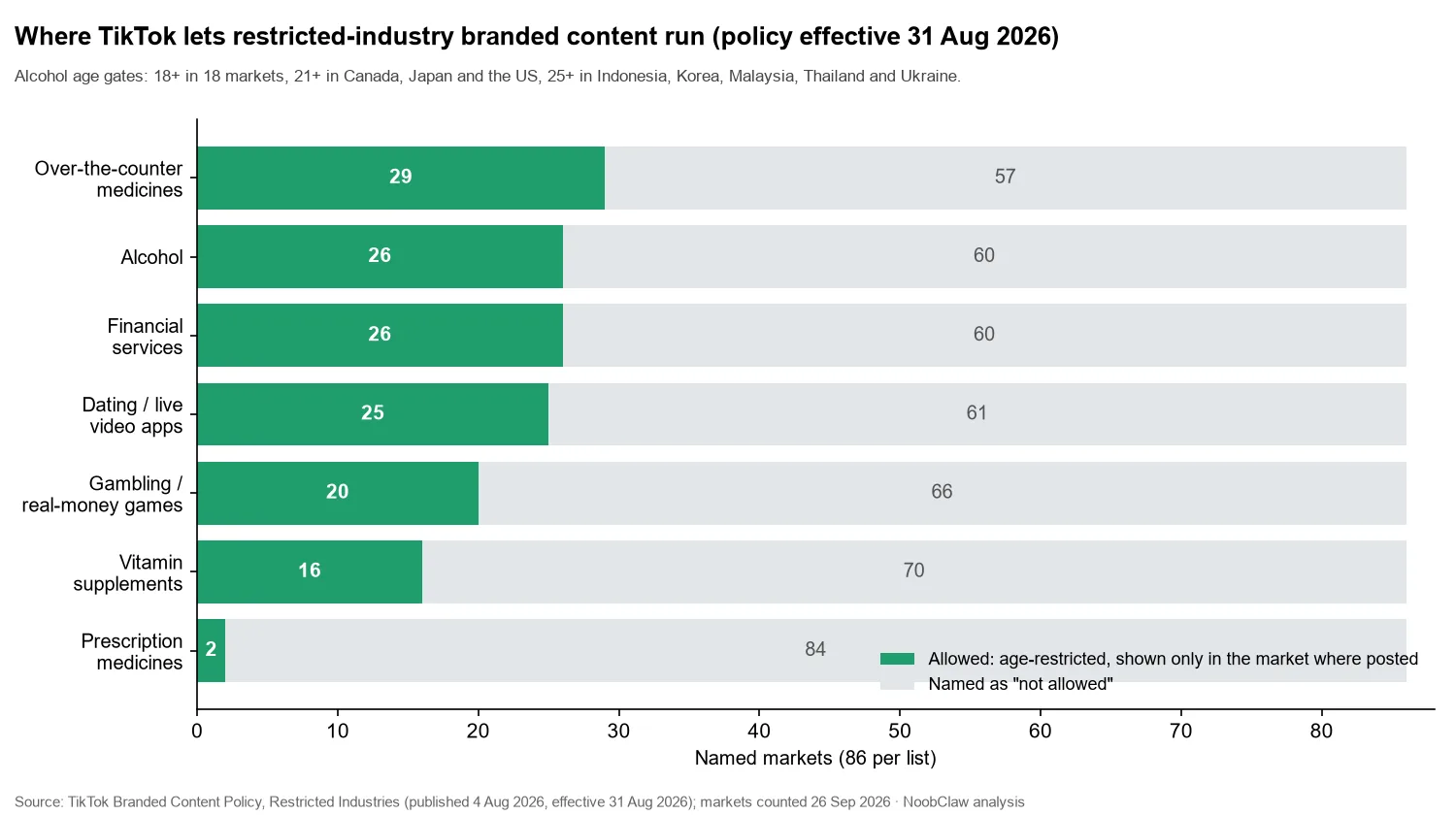
Two practical consequences follow from "shown only in the market it was posted in." A finance creator whose audience is split across the UK and Ireland reaches only part of it with a sponsored post, because financial services branded content is not allowed in Ireland. And an operator who runs accounts in several countries cannot reach a market from an account based somewhere else: each restricted post is bound to where it was posted.
How a restricted-industry deal runs inside TikTok One
TikTok One launched at TikTok World on 22 May 2024 as a single login where advertisers could "access nearly 2 million creators," and TikTok's May 2026 update says Creator Marketplace and Partner Exchange have since moved into it. For creators there are two bars, and both are lower than some guides say. To join, TikTok's "About TikTok One for creators" page (updated April 2026) lists three requirements: TikTok One has launched in your country or region, you are at least 18, and you meet the Community Guidelines and Branded Content Policy. That page has no follower number. Getting work is the second bar. TikTok's creator sign-up page (updated July 2026) says: "To participate in projects, creators must have at least 1,000+ followers and other requirements. These requirements vary by project and are subject to change." Creator Academy (18 August 2026) puts it the same way: "Projects require at least 1,000 followers as a baseline, plus whatever the brand adds on top." Restricted-industry deals run as TikTok One projects, so expect the 1,000-follower baseline to apply; TikTok adds that requirements "vary by project and are subject to change." Some third-party guides still quote higher numbers, such as 10,000 followers; TikTok's current creator pages state no such number. Our step-by-step for creators is in how to join TikTok One.
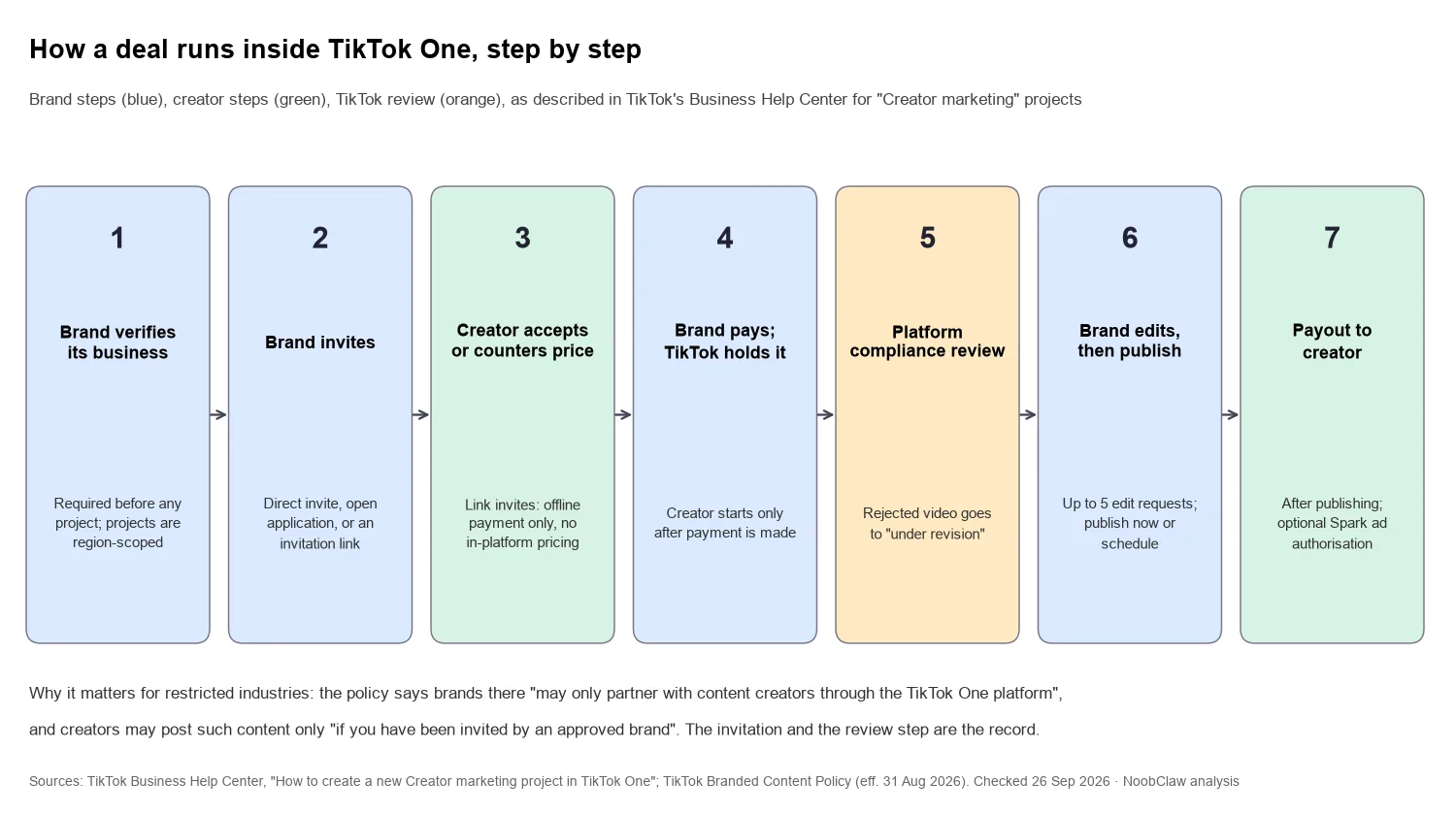
The brand side is where the policy's gates live. TikTok's help article on creating a Creator marketing project describes the flow:
- The business must be verified before it can create a project, and projects are tied to a country or region.
- The brand invites creators directly, opens the project for applications, or sends an invitation link. Link invites "only support offline payment and pricing"; direct invites and applications let you counter the price inside the platform.
- After you accept, the brand pays, and "the payment will be collected and held by the TikTok One platform" until the brand approves the video and it is published. You start creating only after payment.
- The video goes through a compliance review by the platform; if it fails, it returns to you as "Video under revision." The brand can then ask for up to 5 edits.
- The approved video is published from the project, now or on a schedule, to your account. The brand can separately ask for authorization to run it as a Spark ad.
One naming mismatch is worth knowing. The policy asks for a "Registered Business Account," while TikTok One requires business verification, and the Community Guidelines that took effect on 24 September 2026 now say "verified business accounts" in the regulated goods section. In a conversation with a brand, "are you verified in TikTok One and approved for this category?" covers both.
For operators who publish in bulk, one detail matters: in TikTok One the approved video is published from the project. If you run accounts through a batch uploader, NoobClaw included, keep restricted-category sponsored videos out of the batch, and make sure the disclosure setting is on for anything commercial you post yourself.
The Au Vodka ruling: the gap the TikTok One route closes
On 24 September 2025 the UK Advertising Standards Authority upheld a complaint against Au Vodka. One of the three ads was a TikTok post by influencer Lucinda Strafford showing an Au Vodka vending machine delivered to her house, captioned with "@Au Vodka ad." The brand argued she was over 25 and supplied a follower breakdown; the screenshot left out followers aged 13 to 17, so the ASA could not use it. The deciding passage is about the platform: TikTok's advertising policy prohibited alcohol ads in the UK, so "it was not possible to exclude under-18s from viewing the ad," and the For You page shows posts to people who do not follow the account. The ASA found the ad breached CAP Code rule 18.15.
Now compare the 31 August 2026 policy. UK alcohol branded content is allowed only for audiences 18+, only in the UK, and only through TikTok One. Our reading: the missing piece in the Au Vodka case, an age gate that works on the For You feed, is exactly what the TikTok One route attaches to the post. A direct deal posted from a creator's account carries none of it. Whether TikTok's age restriction fully satisfies the UK code's audience tests is for the ASA to decide; we found no ruling on it yet.
FAQ
Is TikTok One the same as TikTok Creator Marketplace?
Creator Marketplace now lives inside TikTok One. TikTok says it migrated Creator Marketplace and Partner Exchange into the platform after the 2024 launch. For the policy, the name that matters is TikTok One: restricted-industry partnerships must be set up there.
Do I need a minimum follower count to receive restricted-industry deals?
Expect to need at least 1,000 followers. TikTok's "About TikTok One for creators" page lists only region availability, age 18+ and policy compliance to join, but the creator sign-up page (updated July 2026) and Creator Academy say projects require at least 1,000 followers, and each brand can add its own requirements on top. Restricted-industry deals run as projects, and TikTok says these requirements "vary by project and are subject to change." Brands then search for and shortlist creators inside TikTok One, so audience fit still decides who gets invited. What brands filter on is covered in our TikTok One joining guide.
Does the rule cover affiliate links and gifted products?
Yes. The policy defines branded content as content promoting a brand "in exchange for payment or any other incentive," including gifted products and commissions via an affiliate link or promotional code. If the product is in a restricted industry, the TikTok One and invitation requirements apply however you are paid. The disclosure setting also applies; see our paid partnership label guide for how it compares across platforms.
Sources
- Branded Content Policy (Restricted Industries and Products) — TikTok — published 4 Aug 2026, effective 31 Aug 2026 — https://www.tiktok.com/legal/page/global/bc-policy/en
- Branded Content Policy: Market-specific Requirements — TikTok Business Help Center — accessed 26 Sep 2026 — https://ads.tiktok.com/help/article/branded-content-policy-country-specific-requirements
- About TikTok One for creators — TikTok Business Help Center — updated Apr 2026 — https://ads.tiktok.com/help/article/about-tiktok-one-for-creators
- How creators can sign up for TikTok One — TikTok Business Help Center — updated Jul 2026 — https://ads.tiktok.com/help/article/how-creators-can-sign-up-for-tiktok-one
- How to set up TikTok One so brands want to work with you — TikTok Creator Academy — updated 18 Aug 2026 — https://www.tiktok.com/creator-academy/article/tiktok-one
- How to create a new Creator marketing project in TikTok One — TikTok Business Help Center — accessed 26 Sep 2026 — https://ads.tiktok.com/help/article/how-to-create-a-new-creator-marketing-project-in-tiktok-one
- TikTok World 2024: New Ad Solutions — TikTok Newsroom — 22 May 2024 — https://newsroom.tiktok.com/en-us/tiktok-world-2024
- TikTok One: Your all-in-one creative platform — TikTok For Business Blog — 13 May 2026 — https://ads.tiktok.com/business/en/blog/tiktok-one-creative-platform
- Regulated commercial activities — TikTok Community Guidelines — effective 24 Sep 2026 — https://www.tiktok.com/community-guidelines/en/regulated-commercial-activities
- ASA Ruling on Au Vodka Ltd — Advertising Standards Authority (UK) — 24 Sep 2025 — https://www.asa.org.uk/rulings/au-vodka-ltd-g25-1299893-au-vodka-ltd.html
Correction (27 September 2026): an earlier version of this article said TikTok's official pages set no follower threshold, including in the FAQ answer on restricted-industry deals. That is true only of joining TikTok One. TikTok's creator sign-up page (updated July 2026) and Creator Academy say taking part in projects requires at least 1,000 followers plus any brand requirements. The text, FAQ and summary have been corrected.