TikTok Branded Content Policy: Disclosure and Eligibility
- TikTok requires disclosure when a post promotes a brand, product or service.
- The cited 24-hour window concerns suspected branded-content disclosure notices, not every violation.
- A label does not approve a restricted product or guarantee views.
TikTok branded content policy questions usually contain two different decisions: whether a commercial relationship needs disclosure, and whether the product and promotion are eligible in the intended market. Answer both before publishing. A paid-partnership label records the relationship; it does not make every product, claim or destination permissible. The official creator and disclosure guides establish the setting, notices and response routes discussed here. They do not establish a complete country-by-country eligibility list or a verified comparison between successive policy versions.
Treat disclosure, product eligibility and permission to use a post in advertising as three separate decisions.
When commercial disclosure is required
TikTok’s January 2026 disclosure guide says to turn on commercial disclosure when posting content that promotes a brand, product or service. The April 2026 creator guide describes financial incentives, brand mentions and product recommendations as factors used to identify marketing intent. Its examples include benefits received for a promotion, promo codes, brand tags, product demos and purchase calls to action. Those factors support reviewing the relationship and purpose of the post; they are not evidence that every incidental logo automatically creates a paid partnership.
Consider a hypothetical creator who receives a product in exchange for a demonstration. The benefit and promotional purpose matter even if the arrangement has no cash invoice. A business promoting its own service faces a different relationship from a creator promoting a third party. TikTok’s documented setting distinguishes Your brand from Branded content. Identify that relationship accurately instead of selecting whichever label appears more likely to attract viewers.
The same video can carry several obligations. An accurate label does not replace evidence for its product claims, permission to use its music, or the restrictions applying to the promoted category. Keep the agreement, approved claims and intended audience with the asset so that the person publishing it can identify what was approved. This is an editorial preparation method, not a claim that TikTok requires our particular record format.
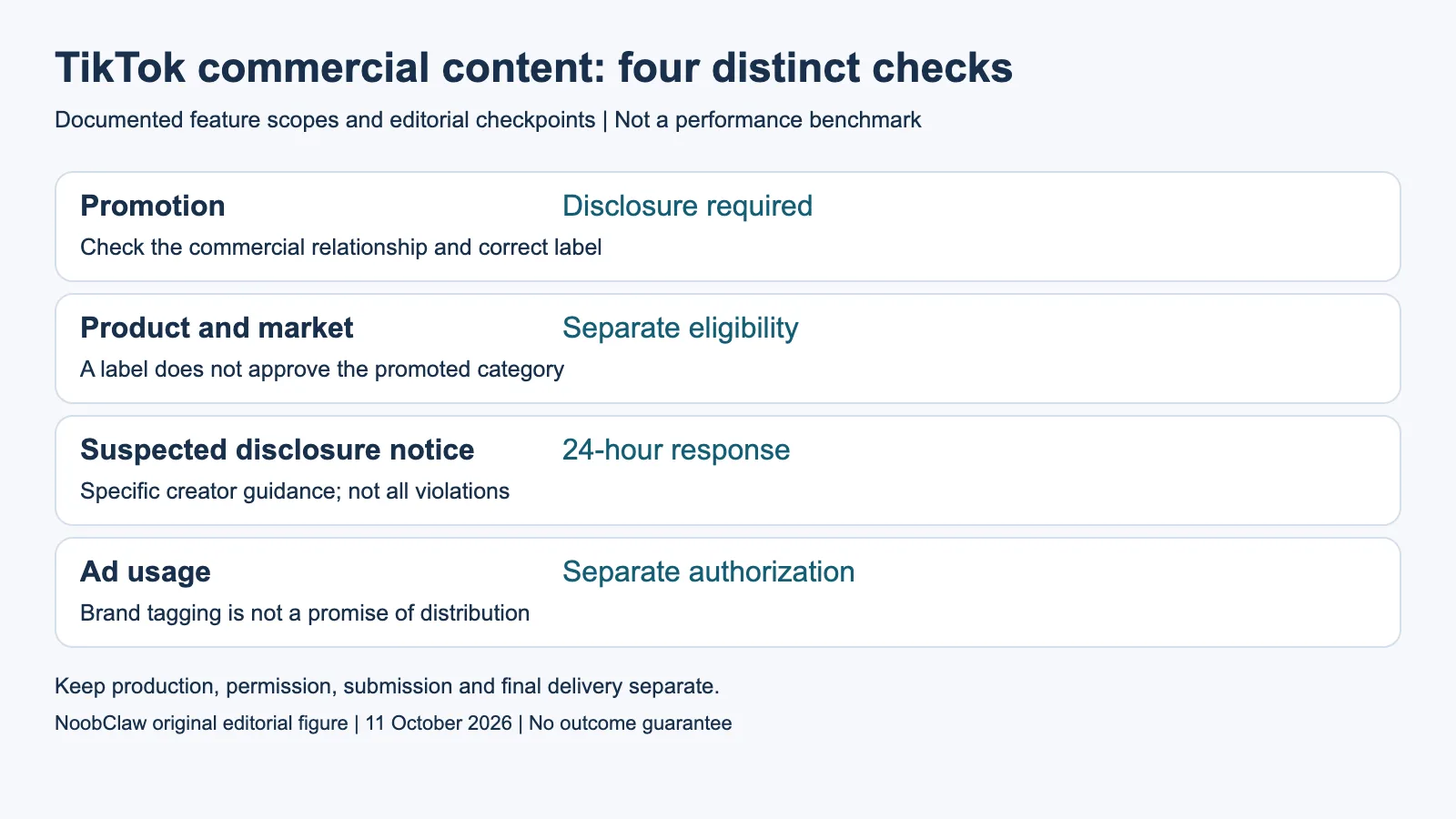
- Promotion: Disclosure required. Check the commercial relationship and correct label
- Product and market: Separate eligibility. A label does not approve the promoted category
- Suspected disclosure notice: 24-hour response. Specific creator guidance; not all violations
- Ad usage: Separate authorization. Brand tagging is not a promise of distribution
What the setting and brand-partner tag establish
TikTok documents disclosure entry points for a new app post, an existing post, LIVE and browser upload. The labels and paths differ by surface. Its app instructions distinguish creators in TikTok One from others, who may reach Content disclosure and ads through More options. Use the available control for the actual post and account rather than assuming that a scheduler’s generic approval checkbox carries the same meaning.
For branded content, the guide describes tagging a brand partner and states a default authorization period of 60 days. That default is an advertising-authorization detail; it is not a 60-day permission to promote any product or a deadline after which every post must disappear. Confirm the partner and intended ad usage when agreeing to a campaign. A business relationship, organic publication and subsequent advertising use should not be silently treated as one permission.
TikTok says its TikTok One collaboration projects manage disclosure automatically. That statement is about the documented TikTok One process. It does not certify a third-party automation product or establish that every upload outside that process is compliant. For an outside collaboration, check the commercial-disclosure setting and published label on the actual post. Keep a distinction between a prepared file, a submitted post and the visible result.
Eligibility needs the product, market and current policy
TikTok’s disclosure guide requires compliance with its Terms of Service, Community Guidelines, Branded Content Policy where applicable, and applicable laws. The TikTok One policy index links the relevant policy families. Disclosure is therefore one condition within a wider review. A category or claim can remain unsuitable even when its commercial relationship is labeled correctly.
For a hypothetical campaign spanning two countries, record the promoted product, the audience markets, the claim and the landing page. Review the current policy applicable to each placement and market before approving the creative. Do not infer that permission in one country carries over to another, or that a rule for paid advertising is identical to a rule for creator branded content. Where interpretation is uncertain, obtain clarification from the appropriate platform or professional adviser.
This review could verify the current disclosure guides and policy index, but could not verify the full branded-policy text through its public retrieval route. Accordingly, it does not certify an August 31 effective date, reproduce prohibited-category counts, or promise that an older agreement is exempt from a later rule. If your decision depends on a specific category or effective date, inspect that policy text directly before proceeding. An unavailable source is a missing verification step, not proof of permission.
What a suspected disclosure notice actually means
The April 2026 creator guide describes notifications for videos that potentially contain branded content without proper disclosure. It gives an opportunity to respond within 24 hours before that video becomes ineligible for the For You feed. This is a specific suspected-disclosure workflow. It should not be generalized into a universal deadline for all TikTok violations, an account-wide strike schedule or a prediction of when traffic will recover.
The documented responses are to turn on the proper disclosure or appeal if the post does not include branded content. TikTok says only the original poster can appeal a flagged video and that the appeal route is linked from the in-app notification. Read the actual notice and retain its wording and post identity. A low view count without a notice does not establish that this particular disclosure process caused the result.
For a successful appeal, TikTok says the video resumes eligibility for organic distribution in the For You feed. Eligibility is not a guaranteed number of views, a promised recovery time or approval of unrelated material. If another notice concerns the asset, evaluate that separately. Avoid deleting evidence or changing several unrelated settings before understanding which decision the notice asks you to address.
Prepare the creative without confusing production with approval
TikTok says disclosure itself will not change how it recommends content. The creator guide cites an internal comparison of nearly two million videos, identified as 2023 research in Indonesia and Pakistan. That is a vendor-reported finding with a stated historical sample. It is useful context for avoiding concealment of a commercial relationship, but it does not predict the performance of your 2026 campaign or isolate a causal effect in your own audience.
For content preparation, distinguish the words needed for the video from the commercial relationship that the platform must display. A hypothetical script can be revised to remove an unsupported product promise while the disclosure setting remains required. Track those as separate changes. If a caption, voice-over or destination changes after a brand review, check whether the approved claim and authorization still describe the final asset.
NoobClaw’s public creative record documents one local script-to-video output with audio and subtitles. It did not establish TikTok publication, commercial-disclosure handling, campaign approval or improved distribution. Use that production evidence only for the preparation stage it demonstrates. The practical outcome sought here is an accurate asset with the right relationship recorded and the relevant eligibility checked, followed by verification of the actual published result.
For the related content and workflow decisions, read TikTok Shadowban: Check Notices, Delivery and Privacy and No Views on a New TikTok Account: Checks and Evidence. Each review has its own evidence and scope.
NoobClaw publishes this article. Its script-to-video guide and public creative execution record document a local video result, not external-platform publication. Check the current product offer against the supported action you need.
Frequently asked questions
Does turning on disclosure make a restricted promotion eligible?
No. Disclosure identifies the commercial relationship. TikTok separately requires compliance with the applicable policies and laws. Check the promoted product, claim, market and placement.
Does the 24-hour window apply to every account violation?
The cited creator guide describes a window for responding to suspected branded-content disclosure notifications. It does not establish a universal deadline, strike interval or account-recovery schedule.
Will a successful appeal restore my previous view count?
TikTok describes restoration of eligibility for organic For You distribution. It does not promise a particular view count, a recovery time or a result for other posts.
Sources
Official material read on October 11, 2026. Announcement dates and documented feature scopes are identified in the text; vendor statements are not measured outcomes for your account. Examples are hypothetical; the public local-production record has its own limitations.