TikTok Shadowban: Check Notices, Delivery and Privacy
- Low TikTok views do not establish a shadowban, its cause or a fixed recovery period.
- Read an actual notice and check the intended audience and final publication state separately.
- Unaudited Direct Post API clients have a documented private-viewing condition; an upload acknowledgement is not a public post.
- NoobClaw’s content tools and local video export do not diagnose or reverse platform decisions.
TikTok shadowban is a search term that can hide several different questions: can a post be viewed, is it eligible for recommendation, is a feature restricted, or is the response simply small? Start with the observation you actually have. This review explains the separate notices and delivery conditions described in official Newsroom and developer material, then sets out the limits of what a low view count can establish. Official developer material and separately dated newsroom announcements were read on October 11, 2026. Current Help pages could not be retrieved, so this guide does not certify their menu paths, detailed account-check functions or current enforcement intervals. We have not inspected your platform account.
A low view count is an observation. The relevant notice, visibility setting and delivery record are needed before diagnosing the cause.
Separate the word shadowban from the underlying observation
A view count cannot tell you whether a post was removed, privately delivered, excluded from For You or seen by a small audience. Those conditions have different evidence. An account can also have a restriction on a particular feature without every function being unavailable. Treat shadowban as the reader’s description of a symptom, not an official diagnosis that can be established from a single number or a third-party label.
TikTok’s separately dated newsroom material discusses moderation and available appeals. The current Direct Post developer guide documents a private-viewing condition for unaudited clients. Those are different scopes. A vendor upload message is not the same observation as a live post with the intended audience setting. Keep the notices and delivery records separate so that a publication question does not become an unsupported account-enforcement story.
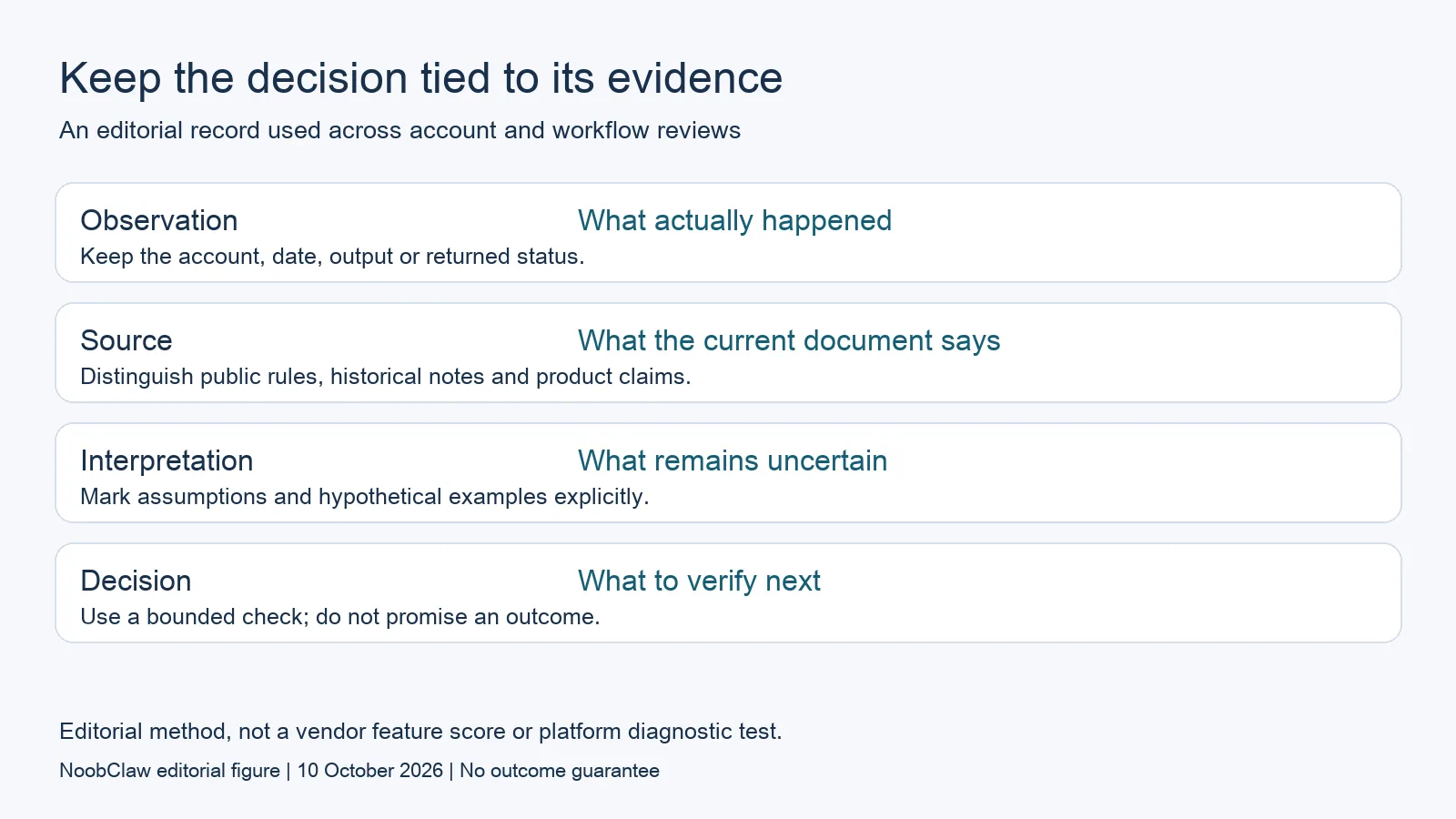
For a hypothetical creator with three low-view posts, record each post, creation and publication time, audience setting, available notice and the window in which views were observed. The example does not establish a required sample size or a fixed test duration. It gives you a way to ask the next question with evidence. If a page cannot load, retain the access failure instead of treating it as proof of removal or zero audience.
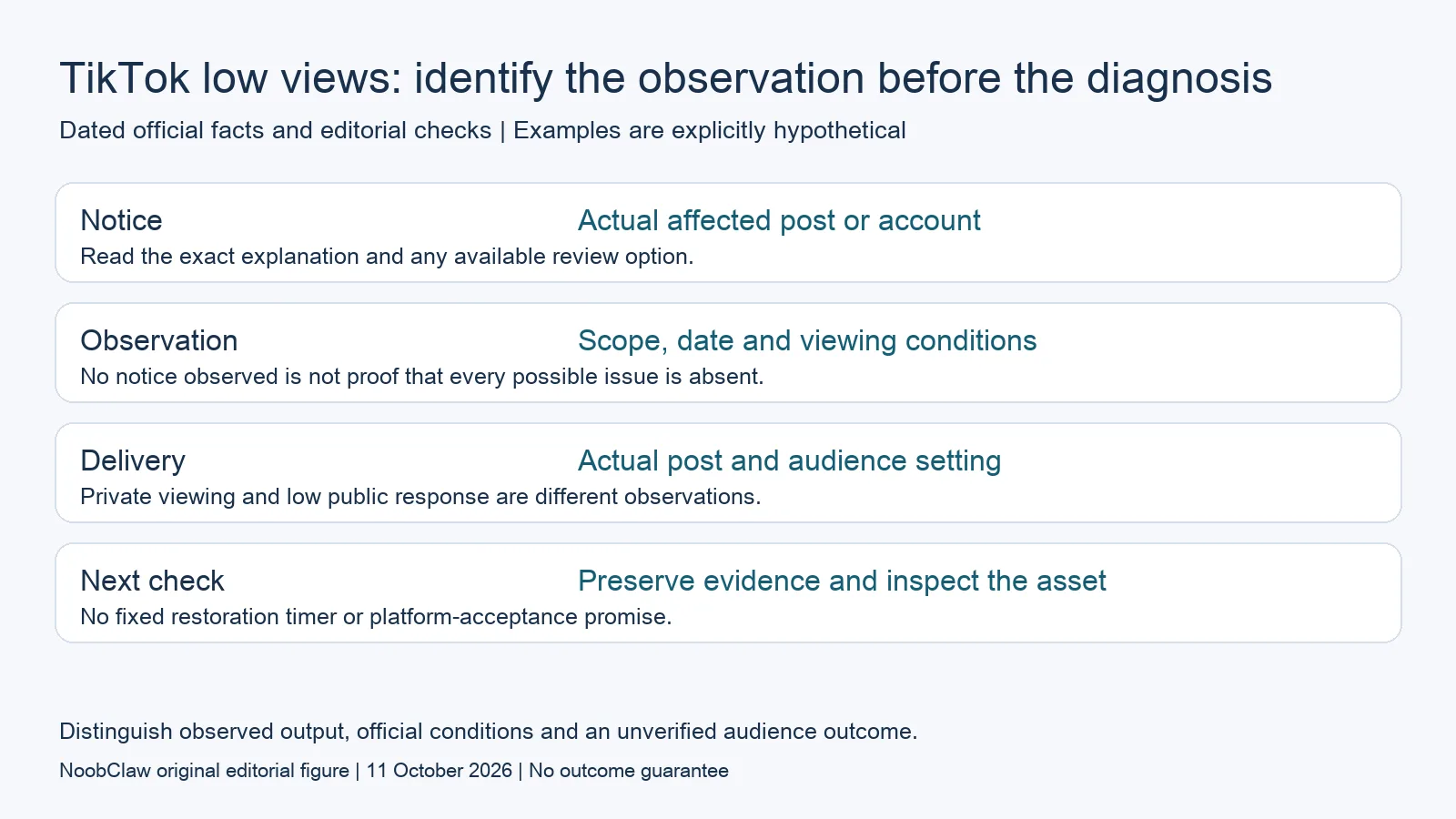
- Notice: Actual affected post or account. Read the exact explanation and any available review option.
- Observation: Scope, date and viewing conditions. No notice observed is not proof that every possible issue is absent.
- Delivery: Actual post and audience setting. Private viewing and low public response are different observations.
- Next check: Preserve evidence and inspect the asset. No fixed restoration timer or platform-acceptance promise.
Read the notice that actually exists
Record the wording, date and scope of an account or post notice if one is available. A message about an affected post, an account restriction and a delivery failure are different observations. If you cannot find a notice, say that no relevant notice was observed under the conditions you checked. That does not establish either a hidden restriction or the absence of every possible issue.
TikTok’s August 2025 Community Guidelines announcement describes appeals for removals or restrictions. It does not identify the status of your account or establish a universal current menu path. Check the information and options available with the actual notice. This guide does not certify a live account-status screen or tell you to wait a fixed number of days before inspecting a concern.
For a hypothetical creator concerned about one upload, preserve the post URL, intended audience setting and any displayed explanation before changing the file or account. If the tool used for publication returned only a submission acknowledgement, inspect the later delivery state separately. These are steps for organizing evidence, not a promise that an appeal succeeds or that a particular post receives recommendations.
Distinguish private delivery from recommendation eligibility
Check the intended account and the actual audience setting for the post. A file exported on your computer does not establish a TikTok publication. A private post and a public post excluded from For You also have different visibility conditions. An external attempt to open a link can be affected by account access, region, login requirements or transport failures; an inaccessible link alone does not identify the reason.
The current TikTok Direct Post guide requires app approval and target-user authorization for video.publish. It also says content from unaudited clients is restricted to private viewing until the relevant client audit. That is a condition of a particular integration, not proof that every scheduler uses an unaudited client or that every private post is a penalty. The guide provides a publish identifier and a separate status-check stage; an accepted request is not itself public publication.
If a third-party tool was used, preserve its returned publication status and the post’s actual setting. Ask about the relevant client and delivery route instead of blaming a shared developer quota without evidence. A failed transfer, a privately delivered post and a public post with little response call for different checks. Do not describe a browser-based production or delivery tool as bypassing review, restoring an account or guaranteeing a more visible result.
Use the offered review route without a restoration clock
When a relevant notice offers a review or appeal, follow the instructions presented there and keep the affected material and stated reason together. An available appeal does not establish that the decision will be reversed. A successful review, if one occurs, also does not promise a particular audience size. This guide has not submitted an appeal or measured a recovery period for your account.
TikTok’s February 2023 enforcement announcement documents its historical approach to account strikes and notification. Read that as a dated explanation, not certification of every present policy condition or screen. A strike period, an account review and distribution of a video answer different questions. We do not convert any historical enforcement interval into a countdown for restoring reach.
Keep the actual publication and audience observations visible when deciding the next action. Do not switch accounts as a supposed general remedy or purchase interactions to create the appearance of a recovered post. If a desired account-specific fact cannot be checked, mark it unknown and inspect the relevant current platform information. The available evidence determines the next check; a vendor label does not settle the account’s status.
Review the actual asset when production is the missing step
Once visibility, delivery and available notices have been checked, inspect the accepted asset. Ask whether its opening states the task, the script supports the claim and the caption describes what a viewer actually sees. These are editorial questions, not a formula for earning recommendations. A clear revision can be worth testing without claiming that a particular length, posting time, theme or number of attempts controls the recommendation system.
NoobClaw publishes this article and offers separate post-caption, opening-hook and spoken-script outputs alongside a documented local script-to-video workflow. These can help prepare an asset for review. They do not establish the reason for low TikTok views, remove a restriction, approve an appeal or demonstrate external publication. Keep the accepted script and exported file linked so the next reviewer can inspect the actual version rather than an earlier idea.
For an illustrative product explanation, choose a concrete opening, support it with a demonstration and check that the selected footage matches the spoken claim. Inspect captions and narration together. If stock imagery is irrelevant or its intended rights are unresolved, the local export is not ready merely because a file exists. A production tool can support the missing asset step; it cannot replace permission, the destination’s rules or observation of the audience response.
Choose the output you need: post-caption drafts, opening-line drafts or spoken-script drafts. These text tools have a limited anonymous allowance; they do not transcribe or publish a video.
For the related content and workflow decisions, read No Views on a New TikTok Account: Checks and Evidence and TikTok AI Spam Detection: What the Tests Actually Establish. Each review has its own evidence and scope.
What our own production record actually establishes
NoobClaw publishes this guide. Its public October 10, 2026 execution record documents one local creative run: a 441-character English script produced a 32.6-second video at 1080 × 1920 and 30 frames per second. Audio and subtitles were observed, but generic stock footage did not fully match the subject. Voice quality and asset rights were not approved for publication. This is a real bounded production case, not a TikTok upload, audience test or account diagnosis. Inspect the output and remaining editorial work before assessing a production tool.
NoobClaw publishes this article. Its script-to-video guide and public creative execution record document a local video result, not external-platform publication. Check the current product offer against the supported action you need.
Frequently asked questions
Does a missing notice prove normal reach?
No. It means no relevant notice was observed under the checked conditions; it does not establish an account-wide status or guarantee recommendations.
Does an enforcement interval predict recovery?
No. A dated description of account enforcement is not a distribution-restoration clock. This guide establishes no fixed recovery period.
Should a blocked link be treated as a removed post?
No. Access can depend on privacy, login, region or a transport failure. Preserve the actual status and inspect the relevant notice or setting before deciding.
Sources
Official material read on October 11, 2026. The 2020 recommendation explanation, 2023 enforcement announcement and 2025 guidelines update retain their historical scope; they do not certify current account menus, ranking weights or recovery times. The developer document describes its specified integration. Examples are hypothetical except the separately documented local production record.