
How to Join TikTok One as a Creator: Account, Profile, Brand
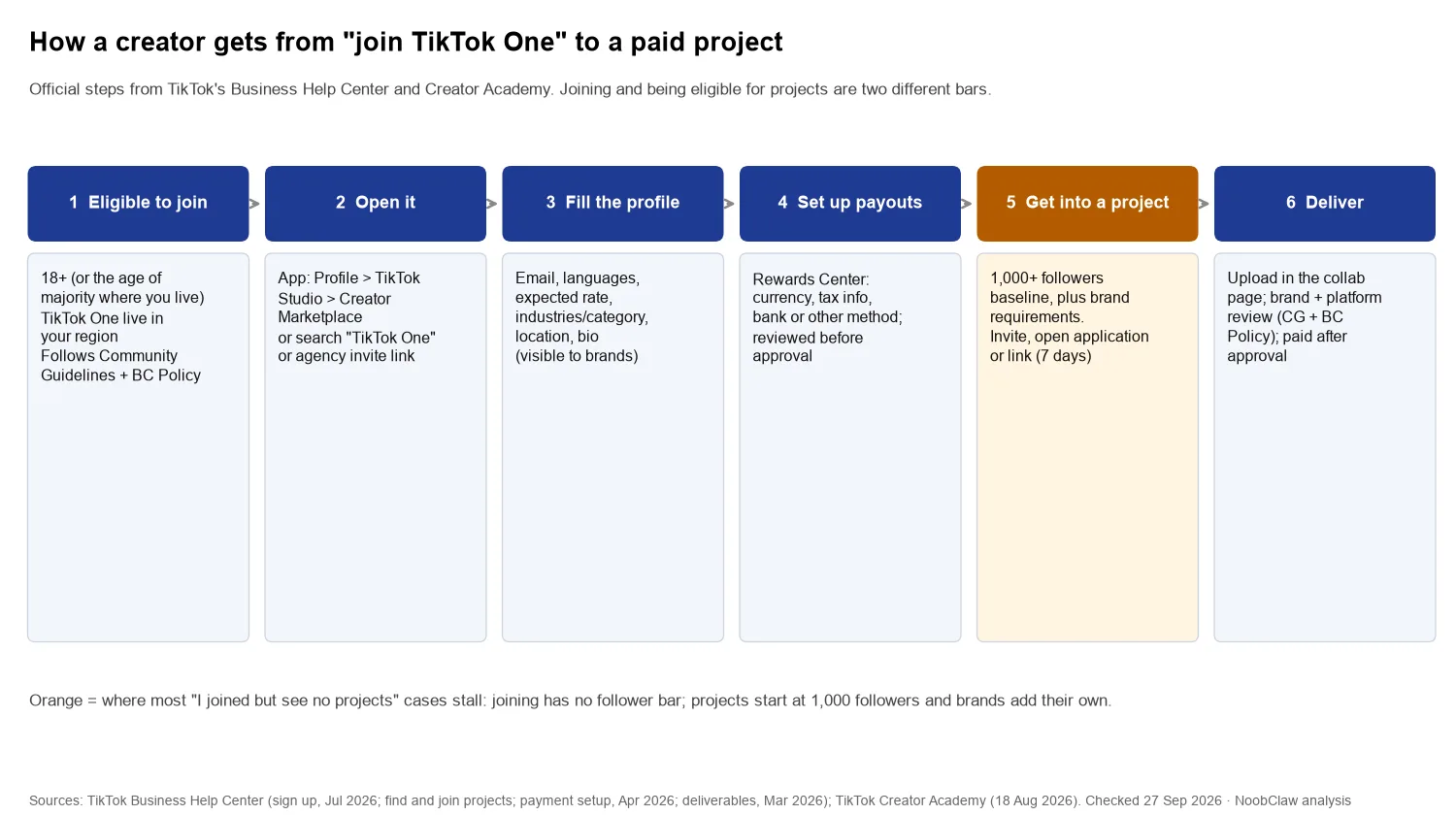
- Creators do not open a separate TikTok One account. You join from the TikTok app (Profile, TikTok Studio, Creator Marketplace, or search "TikTok One"), a sign-up link, or an agency invitation.
- Joining requires three things: TikTok One launched in your region, age 18 or over, and compliance with the Community Guidelines and Branded Content Policy. Taking part in projects is a separate bar: a
- The profile is what brands search: email, languages, expected rate, industries and location, plus performance data such as median views and engagement rate. Set up payouts early: currency, tax informa
- At least one third-party guide published in September 2026 still says creators need 10,000 followers and 100,000 likes. It presents them as Creator Marketplace requirements; TikTok's current creator p
You don't sign up for TikTok One the way a brand does. As a creator, you join from inside the TikTok app with the account you already have. TikTok's help page "How creators can sign up for TikTok One" (last updated July 2026) lists four entrances: tap Profile, then TikTok Studio, then Creator Marketplace; search "TikTok One" in the app and tap the TikTok One Creator Marketplace result; open TikTok's sign-up link or QR code; or join through your agency's invitation link.
Joining is the easy part. The same page carries a note most guides skip: "To participate in projects, creators must have at least 1,000+ followers and other requirements. These requirements vary by project and are subject to change." So there are two bars: one to get in, and one to be offered work.
What account do you need to join TikTok One?
To join, TikTok lists three requirements on both the sign-up page and "About TikTok One for creators": TikTok One has launched in your country or region, you are at least 18, and you meet the Community Guidelines and Branded Content Policy. Creator Academy phrases the age rule as "18 or older (or the age of majority where you live)" and adds a detail that catches people out: "Branded posts and sponsored posts have different region lists, so check both before applying to a project."
No follower number is needed to join. The 1,000-follower baseline applies to projects, and TikTok repeats it on its find-and-join page and in Creator Academy ("Projects require at least 1,000 followers as a baseline, plus whatever the brand adds on top"). Treat stricter numbers with suspicion. A Stackmatix guide published on 7 September 2026, for example, says creators need 10,000 followers and 100,000 video likes in 28 days. We found neither figure on TikTok's current creator pages. The guide presents them as Creator Marketplace requirements, and TikTok says Creator Marketplace has moved into TikTok One, where its current creator pages set the bars described above.
If you searched "TikTok One account" because a brand asked for yours, they may mean the business side. Brands sign up separately at TikTok One with a TikTok for Business login, choose a business type and region, then verify the business to unlock all features. That verification is theirs to do; your side is the creator profile.
How do you set up a TikTok One profile brands will find?
Your TikTok One profile is a search result. TikTok's page on how brands find creators (June 2026) shows what they filter on: creator details (country or region, follower count, gender ratio of followers, language), audience details (country, age range, gender ratio, audience personas) and performance metrics (median video views and engagement rate). Brands can also see a "collaboration evaluation score" based on recent content quality and reach, how active you are on TikTok One and how your published content performed.
That gives you a checklist. Fill in the fields TikTok names in its discovery best practices: bio, contact email, preferred language, location, content category and expected rate. Creator Academy adds that these details are "public to advertisers and partners (e.g., agencies)", and asks you to list every language you speak. Then look at what you cannot type in. Brands search by keyword and category, so an account that posts in three unrelated niches is harder to match to any one of them. TikTok's advice is to "post consistently within your content category so that the platform can best try to classify you."
Set up payouts before you need them. TikTok's payment setup page sends you to the Rewards Center (Profile, Monetization, Creator Marketplace, Rewards) to choose a payout currency, submit tax information where required, and add a bank account or other method. It is reviewed before approval, and TikTok lists the common reasons setup fails: unreadable IDs, black-and-white photocopies, and an address that does not match the ID.
How do you get into a project and get paid?
There are three ways in, per TikTok's find-and-join page. A direct invitation arrives in your TikTok inbox under Monetization notifications; you review it, tap "I'm interested", then accept the payment or negotiate. An open application is a project you apply to from the Explore tab; the brand or TikTok accepts you, some projects auto-accept, and there is a weekly limit on applications that rises as you complete projects with well-performing videos. An invite link asks you to approve an existing video for a project; it expires after 7 days and supports only offline payment and pricing.
Invite links are also where scams go. TikTok's own checklist: confirm the sender is a known brand contact, check that the link domain starts with tiktok.com, make sure the message names the project, requirements and deadline, and "never enter bank passwords, full card details, or one time passwords on an invite page."
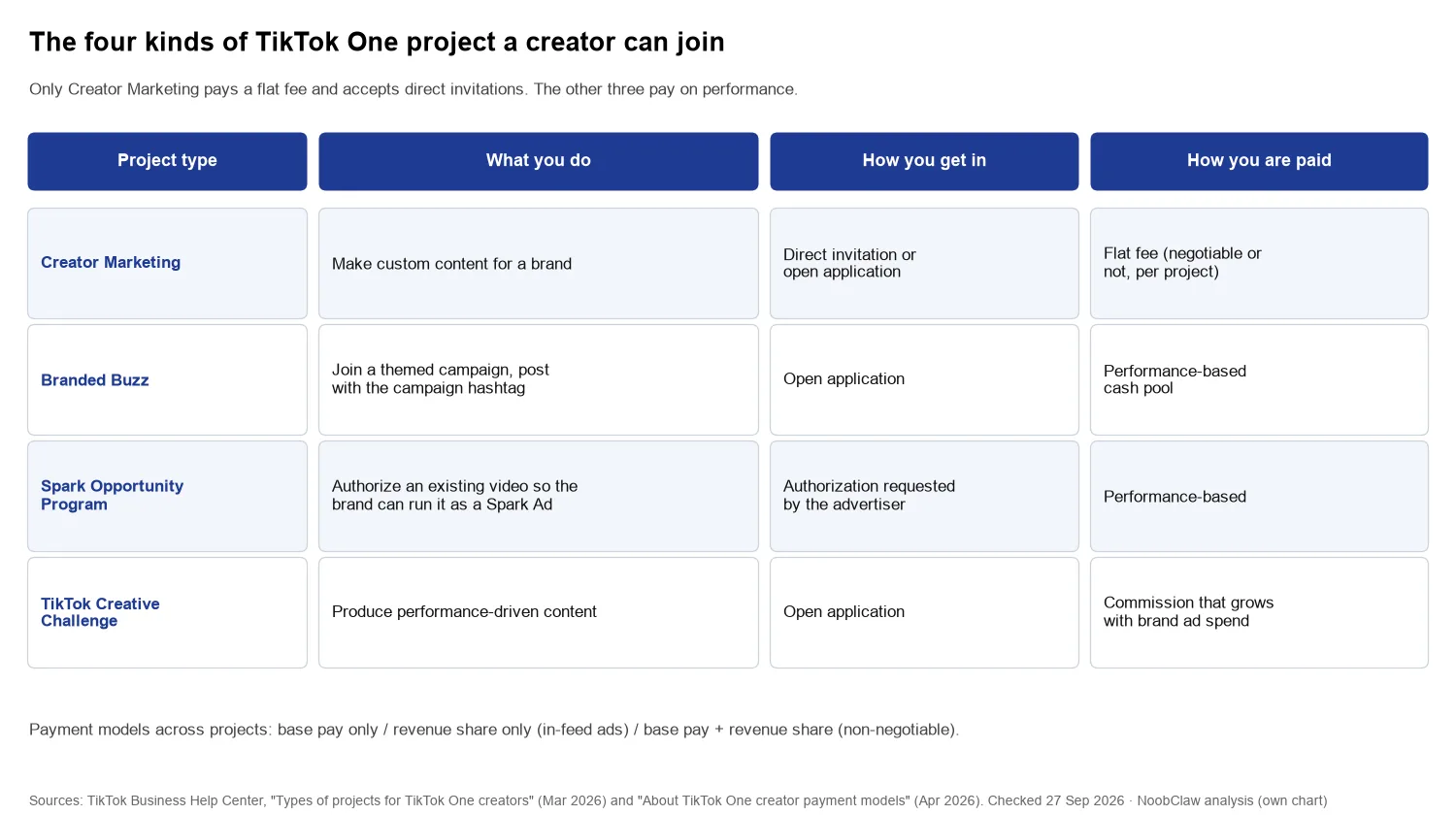
What you are paid depends on the project type. TikTok lists four: Creator Marketing (custom content for a flat fee), Branded Buzz (themed campaigns paid from a performance-based cash pool), the Spark Opportunity Program (you authorize an existing video and earn when brands run it as a Spark Ad) and the TikTok Creative Challenge (a commission that grows with the brand's ad spend). The payment models page adds that base-pay-plus-revenue-share projects are non-negotiable.
Delivery happens in the project, not in your normal posting flow. On the deliverables page, you upload on the collab page, the video goes through advertiser and platform review against the Community Guidelines and Branded Content Policy, and edits come back to you until it is approved or you appeal. A branded post runs on the brand's account; a sponsored post goes out from yours with a partnership tag. Creator Academy says either can be set to skip your profile page while still appearing on For You (the closest TikTok comes to the organic "don't show on profile" option people ask about). If you publish through a batch tool, NoobClaw included, keep TikTok One deliverables out of the batch: they are uploaded and approved in the project.
Joining TikTok One gets you into the room. The 1,000-follower baseline, the region list for each deliverable type and your profile decide whether anyone invites you.
A case that shows the agency route: TikTok's own STARZ case study (January 2025) describes the network working with TikTok Marketing Partner Open Influence, through a TikTok Creative Exchange package, to hire comedy creators Kyle Flood and Jalen Hinton and entertainment creator Bryce Vaughn. Their videos ran as TopView and In-Feed ads, which is closest to the branded-post pattern: the creator makes it, the brand runs it as an ad. TikTok reports 25.3 million impressions and 44% higher average watch time than the studio-made asset. Those are TikTok's own figures, and the case study does not say whether the deal ran inside TikTok One. What it shows is the agency pattern that the agency-invitation entrance exists for, and TikTok's May 2026 blog says Partner Exchange, "formerly TikTok Creative Exchange", has since moved into TikTok One.
What changes if the brand is in a restricted industry?
For restricted categories (alcohol, financial services, gambling, dating apps, supplements, medicines and others), the Branded Content Policy effective 31 August 2026 makes TikTok One the only route. The brand needs explicit permission from TikTok and a registered business account, and you can post such content only "if you have been invited by an approved brand." The category list, market limits and a UK ruling that shows why the rule exists are in our TikTok One restricted-industries guide. The disclosure rules that apply to every brand deal, restricted or not, are in our Branded Content Policy breakdown.
In practice: ask a restricted-category brand to invite you inside TikTok One before you agree to anything in DMs. If they cannot, the deal cannot run on TikTok as branded content, however the paperwork is written.
FAQ
Is TikTok One the same as TikTok Creator Marketplace?
Creator Marketplace now lives inside TikTok One, which is why the in-app entrance is still labelled Creator Marketplace. Guides that still quote Creator Marketplace eligibility (often 10,000 followers) do not match TikTok's current pages, which set 18+, a launched region and policy compliance to join, and 1,000 followers for projects.
I joined TikTok One. Why don't I see any projects?
Check four things in order: whether you have 1,000 followers, whether your region is on the list for the deliverable type (branded and sponsored posts differ), whether notifications are on for your System notifications inbox, Monetization inbox and email, and whether you have hit the weekly application limit. Brands can also add their own requirements on top of the baseline.
Can I negotiate the fee?
For direct invitations, yes: you can accept or tap Negotiate. Flat-fee projects may be negotiable or not, as stated in the project details. Base pay plus revenue share projects are non-negotiable, and invite-link projects use offline pricing agreed outside the platform.
Sources
- How creators can sign up for TikTok One — TikTok Business Help Center — updated Jul 2026 — https://ads.tiktok.com/help/article/how-creators-can-sign-up-for-tiktok-one
- About TikTok One for creators — TikTok Business Help Center — updated Apr 2026 — https://ads.tiktok.com/help/article/about-tiktok-one-for-creators?lang=en
- How creators can find and join TikTok One projects — TikTok Business Help Center — accessed 27 Sep 2026 — https://ads.tiktok.com/help/article/how-creators-can-find-and-join-tiktok-one-projects
- How to set up TikTok One so brands want to work with you — TikTok Creator Academy — updated 18 Aug 2026 — https://www.tiktok.com/creator-academy/article/tiktok-one
- How to find creators who work with TikTok One — TikTok Business Help Center — updated Jun 2026 — https://ads.tiktok.com/help/article/how-to-find-creators-who-work-with-tiktok-one?lang=en
- Best practices for creators to be discovered for brand collaboration — TikTok Business Help Center — accessed 27 Sep 2026 — https://ads.tiktok.com/help/article/best-practices-for-creators-to-be-discovered-for-brand-collaboration?lang=en
- How creators can set up payment for TikTok One — TikTok Business Help Center — updated Apr 2026 — https://ads.tiktok.com/help/article/how-creators-can-set-up-payment-for-tiktok-one?lang=en
- Types of projects for TikTok One creators — TikTok Business Help Center — updated Mar 2026 — https://ads.tiktok.com/help/article/types-of-projects-for-tiktok-one-creators?lang=en
- About TikTok One creator payment models — TikTok Business Help Center — updated Apr 2026 — https://ads.tiktok.com/help/article/about-tiktok-one-creator-payment-models?lang=en
- How creators can complete deliverables for TikTok One — TikTok Business Help Center — updated Mar 2026 — https://ads.tiktok.com/help/article/how-creators-can-complete-deliverables-for-tiktok-one?lang=en
- How to sign up for TikTok One (business) — TikTok Business Help Center — updated Jun 2025 — https://ads.tiktok.com/resources/help/article/how-to-sign-up-for-tiktok-one?lang=en
- How STARZ Engaged New Audiences With TopView and Creators — TikTok for Business — 16 Jan 2025 — https://ads.tiktok.com/business/en-US/inspiration/starz-tiktok-case-study
- TikTok Creator Marketplace Guide (third-party, cited as an example of outdated requirements) — Stackmatix — 7 Sep 2026 — https://www.stackmatix.com/blog/tiktok-creator-marketplace-guide
- TikTok One: Your all-in-one creative platform — TikTok For Business Blog — 13 May 2026 — https://ads.tiktok.com/business/en/blog/tiktok-one-creative-platform
- Branded Content Policy — TikTok — published 4 Aug 2026, effective 31 Aug 2026 — https://www.tiktok.com/legal/page/global/bc-policy/en