
Qualified Shorts Views Meaning: What YouTube Has Published
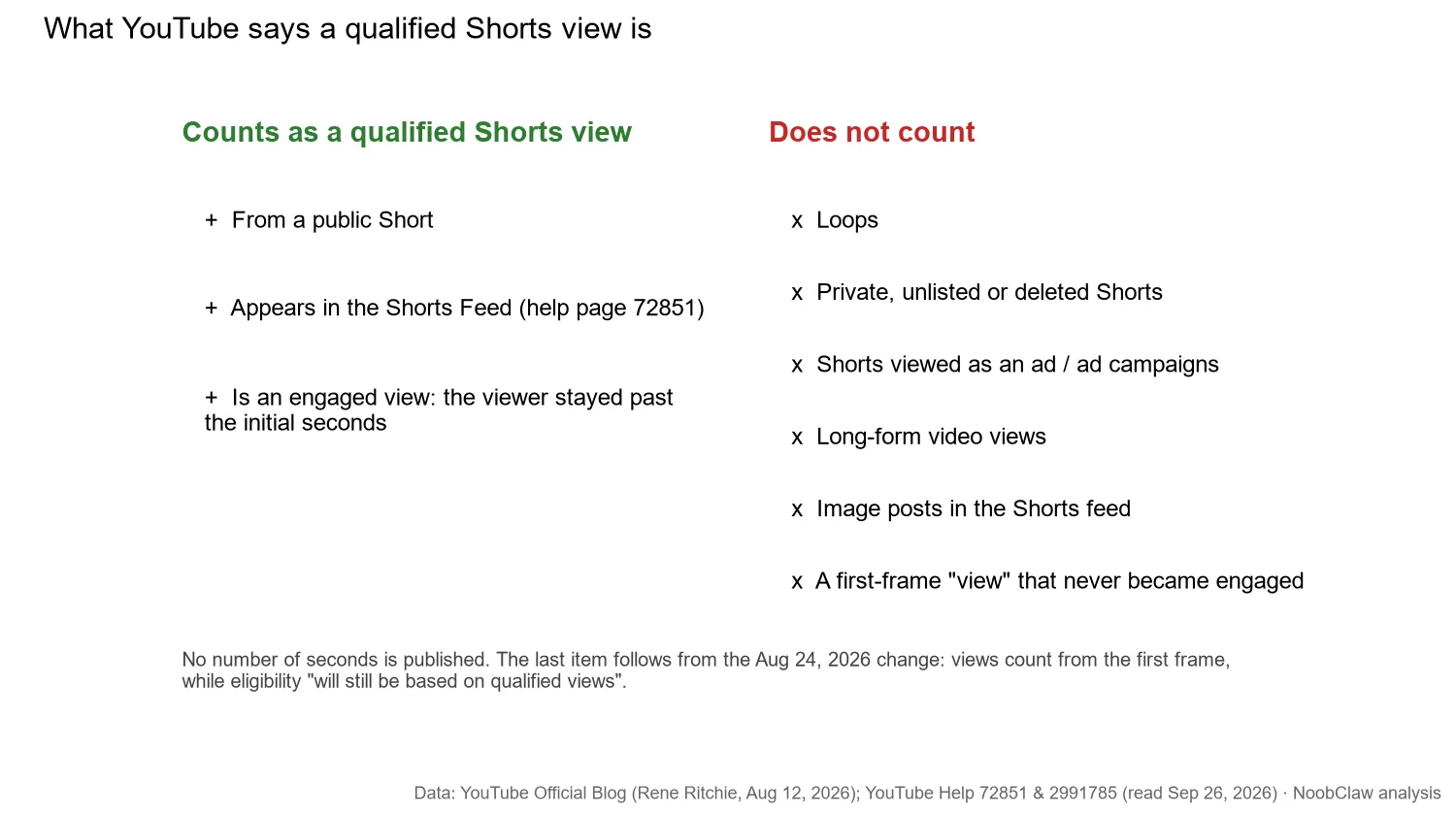
- A qualified Shorts view is a view on a public Short that is also an engaged view: the viewer "stayed to watch past the initial seconds", and loops do not count. YouTube published this on August 12, 20
- Excluded: private, unlisted and deleted Shorts, Shorts viewed as an ad, long-form views and image posts in the Shorts feed. YouTube gives no number of seconds.
- Since August 24, 2026 the public counter starts at the first frame, but YPP eligibility "will still be based on qualified views". The Earn tab counts only qualified views; in two public Help Community
- The unit matters for 3M (fan funding), 10M (monthly Shorts pay for members) and 20M (joining YPP via Shorts from February 2027). Check engaged views per video in Analytics to estimate your own figure.
Qualified Shorts views are views of your public Shorts that YouTube also counts as engaged views: the viewer watched past the first few seconds, and replays in a loop are not counted. That is the whole definition YouTube has published, in a post by Creator Liaison Rene Ritchie on August 12, 2026, What are qualified watch hours and Shorts views for the YouTube Partner Program?: "To count as qualified, Shorts views have to come from public Shorts and be engaged views."
An earlier version of this article, published August 22, 2026, said YouTube had not explained what a qualified view is. That was wrong: the eligibility page had long tied the count to engaged views, and YouTube's own post spelling it out had been live for ten days. This rewrite works from the official text, the YPP eligibility page and the Shorts monetization policy, all read again on September 26, 2026.
What counts as a qualified Shorts view?
The blog post gives one positive rule and one exclusion list. An engaged view "means the viewer stayed to watch past the initial seconds, and does not include any loops." Views that do not count as qualified:
- Private Shorts
- Unlisted Shorts
- Deleted Shorts
- Shorts viewed as an ad
- Long-form video views
- Image posts that appear in the Shorts feed
The YouTube Partner Program eligibility page words it slightly differently: what counts is "Qualified views from Shorts you've set public that appear in the Shorts Feed", and "ad campaigns" replaces "viewed as an ad". We found one practical addition there: the Shorts Feed condition. Neither page gives a number of seconds. Anyone quoting "3 seconds" or "70% watched" as the rule is guessing.
The post also tells creators where to look: "Creators can check engaged views per video directly in YouTube Analytics." That per-video figure is the closest thing to a self-check you have, before subtracting anything that was private, unlisted or deleted, or came from ads.
Views, engaged views, qualified views: which one does YouTube use for what?
Since August 24, 2026, YouTube counts a view "the moment a video starts to play across all formats, including Shorts." The same engagement metrics page adds: "YPP earnings will still be based on 'engaged views' and 'engaged watch hours'. YPP eligibility will still be based on 'qualified views.'" YouTube's explainer on engaged views says the previous definition of a view is now called an engaged view, "defined as clicking to watch or watching past the initial seconds."
| Number | What it counts | What YouTube uses it for |
|---|---|---|
| Views | Every play from the first frame (since Aug 24, 2026) | Public counter |
| Engaged views | Clicks to watch, or watching past the initial seconds | Paying creators (Shorts Creator Pool share) |
| Qualified Shorts views | Engaged views on public Shorts, minus loops, ads and image posts | Eligibility thresholds: 3M, 10M, 20M |
The payment side has its own exclusions. The Shorts monetization policy says that "for the purposes of calculating payments, YouTube uses eligible 'Engaged views'" and lists as ineligible "Non-original Shorts, such as unedited clips from others' movies or TV shows, reuploading other creators' content from YouTube or other platform, or compilations with no original content added", "Artificial or fake views of Shorts, such as from automated click or scroll bots", and views of Shorts inconsistent with the advertiser-friendly guidelines. These are not on the qualified list. Our reading is that a channel built on those formats has a bigger problem than its view count: YouTube's channel monetization policies say the reused content policy "applies to your channel as a whole". A longer comparison of the three metrics is in views vs engaged views vs qualified views.
The public counter now answers "how many times did this start playing?" The eligibility counter answers "how many times did someone choose to keep watching a public Short?" Only the second decides YPP.
Why is my qualified Shorts view count so much lower than Analytics?
Two public threads in the YouTube Help Community show the size of the gap and how long creators argued about it before YouTube's August 2026 post spelled it out.
On September 14, 2025, a creator named Nikolay Yachmienov posted "Critical issue: 4.6M+ Shorts views missing from monetization counter". His channel showed 9.3 million public Shorts views in Analytics over 90 days, while the Earn tab showed 4.7 million "valid public Shorts views", and he reported the tab had not updated since September 9. A community member replied that the Earn tab counts engaged views, not views, quoting the eligibility page, which then read "Valid engaged views from Shorts you've set public". The creator rejected that answer, saying YouTube's own policy asked for "views," not "engaged views." Eleven months later, YouTube's August 12, 2026 post settled the point on the community member's side: qualified Shorts views "have to come from public Shorts and be engaged views." ("Valid public Shorts views" was the Earn tab's earlier label for this count.)
On January 7, 2026, another creator reported 20 million Shorts views in Analytics against 6 million on the eligibility bar in a thread about the YPP Shorts requirement; the recommended answer again said only engaged views count. We look at what that means for the 20 million entry path in the 20 million Shorts views breakdown.
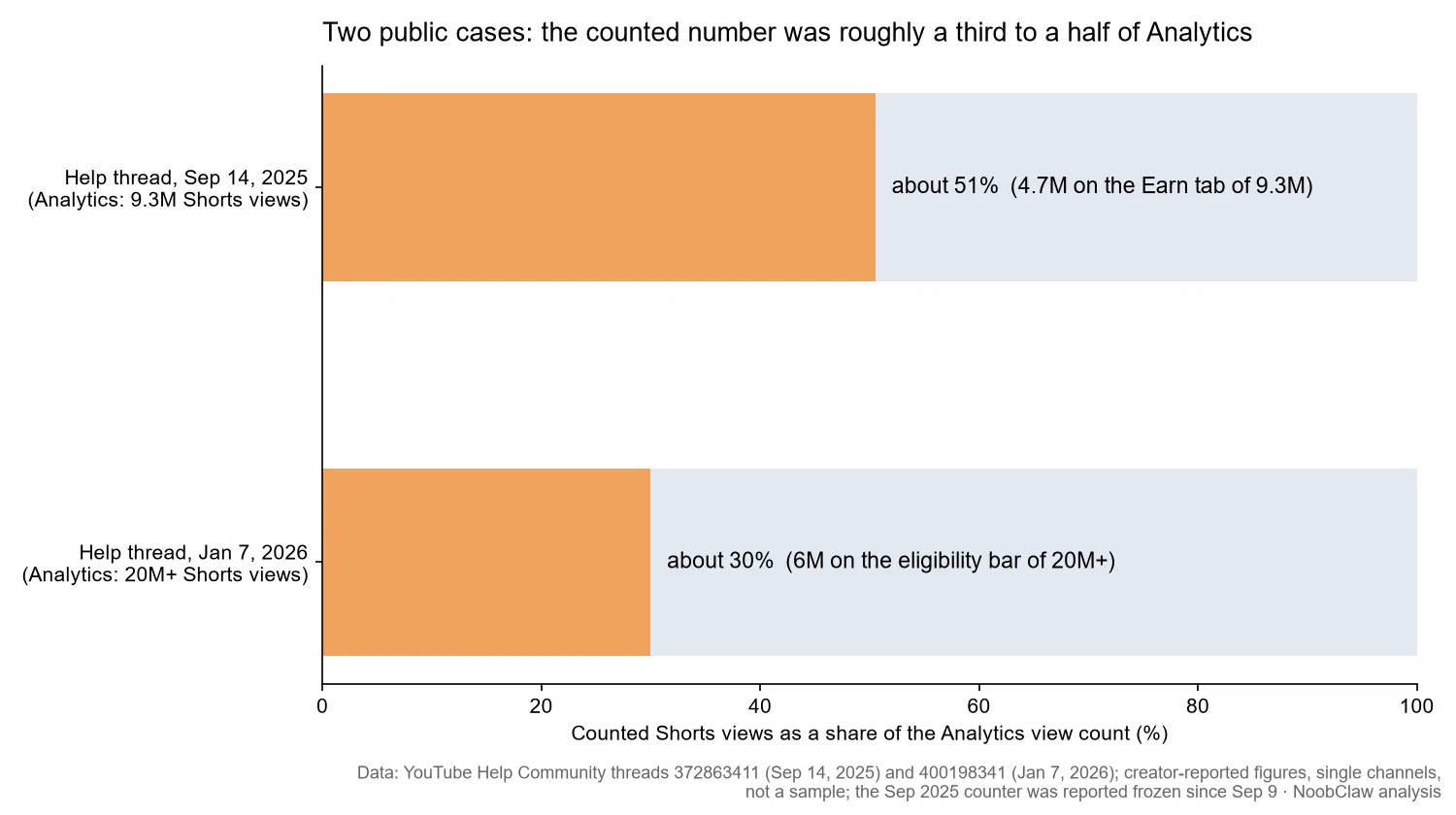
Two cases are not a benchmark, and your ratio depends on how many people swipe away in the first seconds. Still, the pattern tells you which way to adjust. To estimate your own figure:
- In Analytics, read engaged views per Short for the last 90 days rather than total views.
- Drop Shorts that are now private, unlisted or deleted, and subtract views that came from ad campaigns (a promoted Short's organic views still count).
- Compare the result with the Earn tab, remembering that the tab can lag by days. In an October 2025 thread the recommended answer noted the screen's data was dated five days earlier.
Where does the definition decide money?
Every Shorts number in the YPP rules uses this unit. From the Changes to the YouTube Partner Program page and YouTube's August 10, 2026 announcement:
- 3 million qualified Shorts views in 90 days (with 500 subscribers) for fan funding, Shopping and Creator Partnerships, unchanged.
- 10 million in 90 days to join YPP via Shorts until January 31, 2027; from February 1, 2027, the monthly condition for existing partners to earn from the Shorts Creator Pool. See the 10 million rule for members.
- 20 million in 90 days to join YPP via Shorts from February 1, 2027.
- 1 million in 90 days as one way to count as an active channel from February 1, 2027.
The long-form equivalent, qualified watch hours, has a parallel definition covered in what qualified watch hours are. The two units never combine.
FAQ
Does a qualified Shorts view require watching the whole Short?
No. YouTube's wording is that the viewer "stayed to watch past the initial seconds." It publishes no number of seconds and no percentage, so any specific figure you see quoted is not from YouTube.
Do loops or replays count as qualified Shorts views?
Loops do not. The definition says an engaged view "does not include any loops." A viewer who watches past the opening and lets the Short replay adds one qualified view, not several.
Do views from promoting a Short with ads count?
No. "Shorts viewed as an ad" is on the exclusion list, and the eligibility page lists "Ad campaigns". Promotion can bring viewers who later watch organically, but the paid views themselves are not qualified.
Sources
- What are qualified watch hours and Shorts views for the YouTube Partner Program? (Rene Ritchie) — YouTube Official Blog — 2026-08-12 — blog.youtube
- YouTube Partner Program overview and eligibility — YouTube Help — read 2026-09-26 — support.google.com
- How engagement metrics are counted — YouTube Help — read 2026-09-26 — support.google.com
- What are 'Engaged' Views on YouTube? — YouTube Official Blog — 2026-08-19 — blog.youtube
- YouTube Shorts monetization policies — YouTube Help — read 2026-09-26 — support.google.com
- Changes to the YouTube Partner Program — YouTube Help — read 2026-09-26 — support.google.com
- YouTube channel monetization policies — YouTube Help — read 2026-09-26 — support.google.com
- New opportunities to earn and changes to the YouTube Partner Program — YouTube Official Blog — 2026-08-10 — blog.youtube
- Critical issue: 4.6M+ Shorts views missing from monetization counter — YouTube Help Community — 2025-09-14 — support.google.com
- YPP Shorts views requirement not matching analytics — YouTube Help Community — 2026-01-07 — support.google.com
- My YouTube Shorts views are not counting towards monetization — YouTube Help Community — 2025-10-10 — support.google.com
Updated September 26, 2026: rewritten around YouTube's published definition (August 12, 2026). The earlier version said YouTube had not explained the term; it had, and this version cites it.