
What Are Qualified Watch Hours on YouTube? YouTube's Own Definition, and Why Your Studio Number Is Lower
- Qualified watch hours come from public long-form videos, including podcasts, and archived livestreams.
- Eligibility uses a rolling time window. Older hours leave the count, so qualified watch hours can fall even when you keep uploading.
- Check the Earn tab for eligibility. Analytics can include watch time from excluded formats or a different date range.
- Deleting, privatizing or unlisting videos removes their hours from eligibility, and YouTube warns this can affect an application in progress. Leave working videos public.
Qualified watch hours are the watch time from public long-form videos, including podcasts, and archived livestreams that counts toward YouTube Partner Program eligibility. Shorts watch time, private, unlisted or deleted videos, ad views and unarchived streams are excluded. That is why the Earn tab can show fewer hours than your broader Analytics total. The guide below explains what counts and which filters can cause a difference.
On August 12, 2026, YouTube Creator Liaison Rene Ritchie published a short official definition, and the YouTube Partner Program eligibility page carries essentially the same exclusion list. This guide puts both side by side, explains why the Studio figure is lower, and shows which everyday decisions move it.
What counts as a qualified watch hour?
In YouTube's words: "To count as qualified, watch hours have to come from public long form videos (including podcasts) or archived livestreams." Everything else is excluded. The two official sources phrase the exclusions slightly differently, so here they are merged:
| Watch time from… | Counts toward YPP? | Where YouTube says so |
|---|---|---|
| Public long-form videos, including podcasts | Yes | Blog (Aug 12, 2026); help page 72851 says "long-form videos you've set public" and does not mention podcasts |
| Livestreams archived / converted to VOD | Yes | Blog; help page implies it by excluding streams "not converted to VOD" |
| Livestreams that are unlisted, deleted or not converted to VOD | No | Both |
| Private videos | No | Both |
| Unlisted videos | No | Both |
| Deleted videos | No | Both |
| Videos watched as an ad (ad campaigns) | No | Both |
| Shorts, including Shorts watch hours in the Shorts Feed | No | Both |
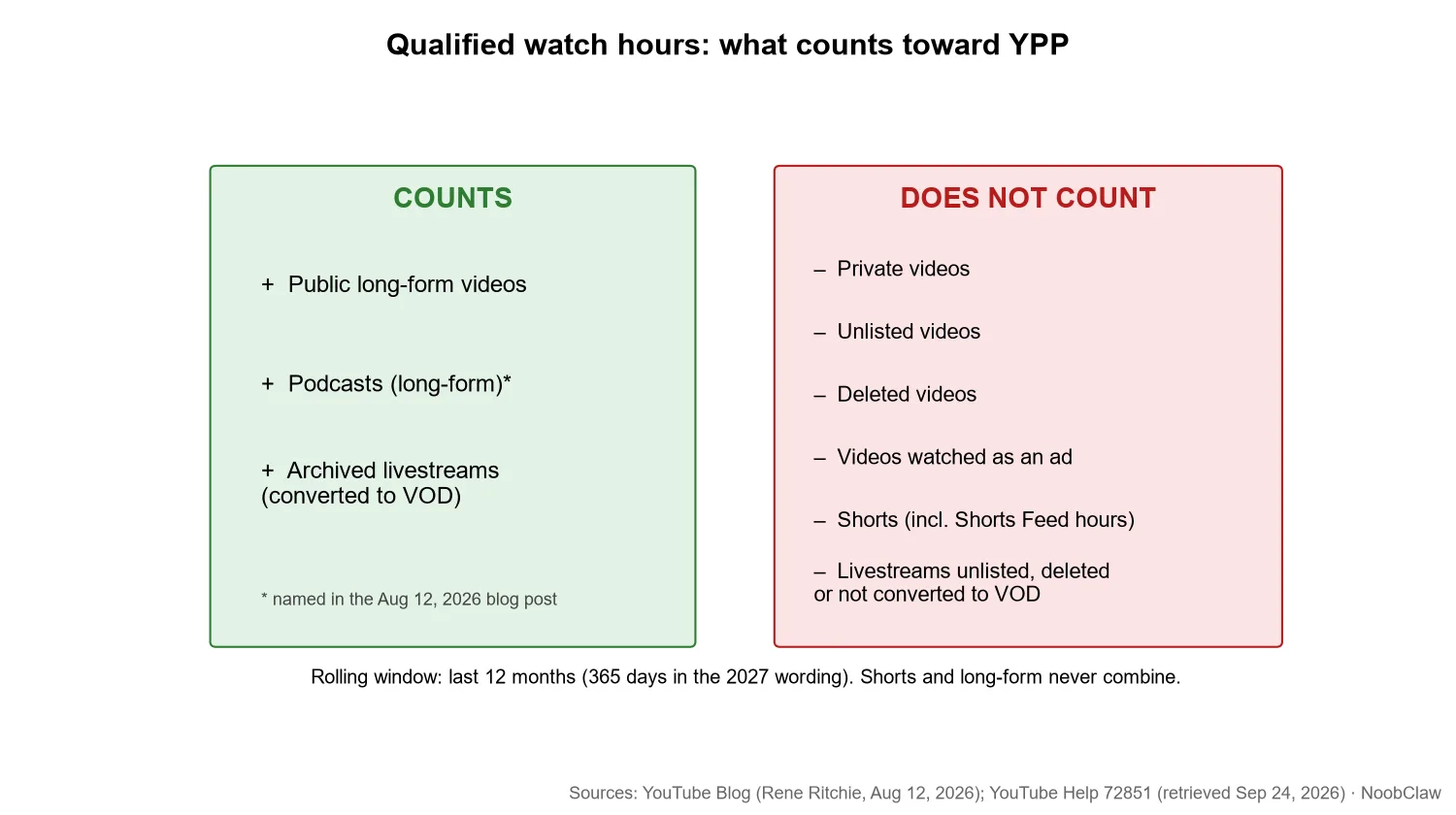
Qualified Shorts views are the parallel metric for the Shorts route. They must come from public Shorts and be engaged views, which the blog post defines as a view where "the viewer stayed to watch past the initial seconds, and does not include any loops." Private, unlisted and deleted Shorts, Shorts viewed as an ad, long-form views and image posts in the Shorts feed do not count. YouTube gives no number of seconds, and neither should anyone quoting it.
One consequence people miss: Shorts and long-form never combine. The help page says "any qualified watch hours from Shorts views in the Shorts Feed won't count towards the 4,000 qualified public watch hours threshold." You clear one path or the other.
Why is the number in YouTube Studio lower than my Analytics watch time?
Four separate filters stack up between the two numbers:
- The window. Eligibility looks at the last 12 months (365 days in the 2027 wording). Analytics can show lifetime totals. Hours older than the window leave the eligibility count every day, so a channel whose best videos are aging can lose qualified hours while still uploading.
- Excluded formats. Shorts watch time, unlisted and private uploads, and unarchived streams can show up in Analytics but not in eligibility.
- Ad traffic. Views bought through ad campaigns are excluded from qualified hours. YouTube's engagement metrics page also explains that paid views are measured as a separate TrueView category.
- Quality checks. The same page says YouTube "may temporarily slow down, freeze, or change your metric count, and discard low-quality playbacks", naming "Using several devices to watch the same video" as an example.
The August 24, 2026 change to view counting does not close this gap. Since then views count from the first frame in every format, but YouTube states that "YPP eligibility will still be based on 'qualified views'" and earnings on engaged views. Your public view counter went up; your eligibility did not. The three metrics are compared in views vs engaged views vs qualified views.
Two public help threads show what this looks like from the creator's side. In December 2023, the owner of the channel @Alone_islive posted screenshots in "Watch Hours are Decreasing on Youtube"; the reply marked as the recommended answer said watch time "earned before 365 days" "wont count towards monetization" and listed the excluded video types. In October 2025, a creator in "YouTube Watch Hours Not Updating" reported that watch hours stayed "the same or 0" despite new views; a reply noted the channel's uploads were Shorts, whose watch hours "do not count toward the monetization threshold." Both are single-channel accounts answered in the community forum, not by YouTube staff, but both match the definition above. A reading of "0 qualified watch hours" on a Shorts-only channel is usually just that: correct.
Analytics tells you how much was watched. The Earn tab tells you how much of it YouTube will count. Only the second one opens the door.
How many qualified watch hours do you need, and what changes in 2027?
The numbers below come from the YPP changes page and the August 10, 2026 announcement, both re-read on September 24, 2026.
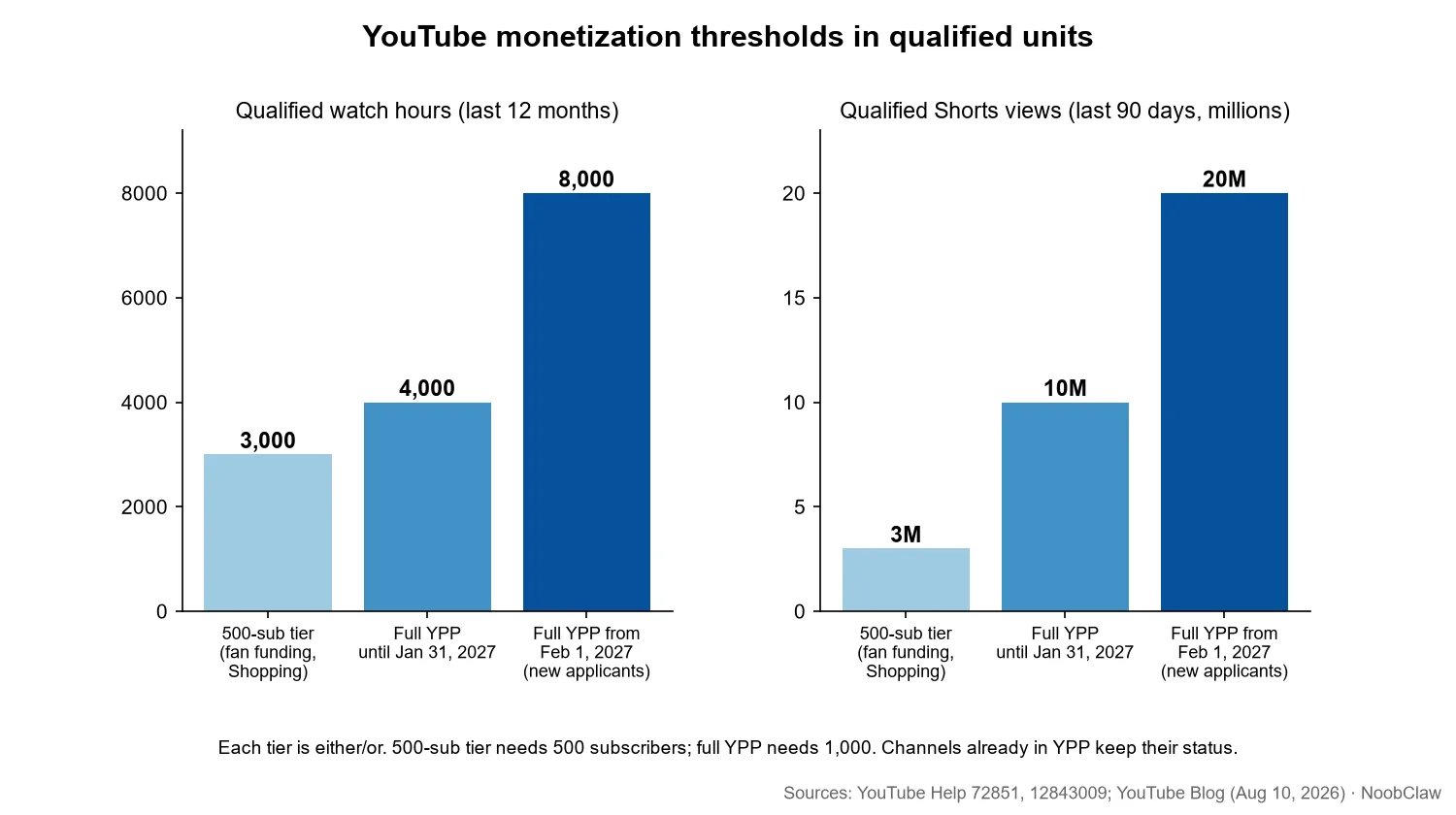
| Tier | Subscribers | Long-form path | Shorts path |
|---|---|---|---|
| Fan funding, Shopping, Creator Partnerships (unchanged) | 500 | 3,000 qualified hours, last year | 3M qualified Shorts views, 90 days |
| Full YPP entry, until Jan 31, 2027 | 1,000 | 4,000 qualified hours, 12 months | 10M qualified Shorts views, 90 days |
| Full YPP entry, from Feb 1, 2027 (new applicants) | 1,000 | 8,000 qualified hours, 365 days | 20M qualified Shorts views, 90 days |
"If you are already in YPP, your status is not impacted by this update," the changes page says. Two related rules also use the same qualified units from February 1, 2027: earning from the Shorts Creator Pool requires maintaining 10M qualified Shorts views over 90 days (missing it does not remove you from YPP), and a channel counts as active with 1,000 qualified watch hours in 365 days, or 1M qualified Shorts views in 90 days, or 2 long-form videos or 5 Shorts uploaded every 90 days. If a channel drops below, it gets a 90-day window to get back to 1,000 qualified watch hours in 365 days or 1M qualified Shorts views in 90 days "to stay in the program"; the upload option is not listed as a way to restore active status. Existing partners also need to accept the updated terms in YouTube Studio by January 31, 2027 to keep earning from the affected features. The current page still allows YouTube to remove monetization from channels with no uploads or posts for 6 months. The full picture is in the 2027 YPP requirements breakdown, and the lower door that did not move is covered in the fan funding piece.
Our judgment for channels between 4,000 and 8,000 qualified hours: the old bar now has an end date, so it is worth aiming at. YouTube says counts dropping below the threshold after you apply do not matter while you wait for review; it has not spelled out how applications still pending on February 1, 2027 are handled, so applying well before the cutoff is the safer plan. Reaching the threshold is not acceptance, though. Every channel goes through a review of the channel "as a whole", typically about a month, with a 21-day appeal window and a 30-day (or 90-day for repeat rejections) wait to re-apply.
Which everyday decisions quietly cost you qualified hours?
Deleting, privatizing or unlisting old videos. Each of those moves the video into an excluded category, so its hours inside the window leave your count. YouTube adds a warning on the eligibility page: "Changes to your video privacy settings or deletion of video might impact the status of your application." If a video embarrasses you but breaks no policy, leaving it public is the option that costs nothing. Content with a genuine policy or accuracy problem should still come down; eligibility math does not outrank that.
Ending a stream without keeping the archive. Streams that are not converted to VOD are excluded. If you stream to build hours, keep the archive public. On mobile, YouTube's live streaming page says channels with 50 to 1,000 subscribers get their archived stream "set to private by default", so check the archive's visibility after each stream.
Treating ads as a shortcut. Watch time from ad campaigns is excluded by name. Promotion can bring subscribers who later watch organically, but the promoted views themselves do not count.
Assuming Shorts success carries over. A channel with millions of Shorts views can show near-zero qualified hours. That is the either/or design, not a bug.
If you run several channels, each one is reviewed on its own record. Tools such as NoobClaw can keep each channel's content different, generated from that account's niche and persona and published from your own logged-in browser, but no tool can turn excluded watch time into qualified watch time or get a channel through the human review. That depends on what the channel publishes.
FAQ
Do Shorts count toward qualified watch hours?
No. YouTube lists "Shorts watch hours" as not qualified, and the eligibility page says Shorts Feed watch hours "won't count towards the 4,000 qualified public watch hours threshold." Shorts count toward the separate qualified Shorts views path (10M in 90 days today, 20M for new applicants from February 1, 2027).
Do livestreams count toward qualified watch hours?
Yes, if the stream is archived. YouTube counts "archived livestreams" and excludes streams that are unlisted, deleted or not converted to video on demand.
Does watching my own videos count?
Do not plan around it. YouTube says it discards "low-quality playbacks" and names watching the same video on several devices or across several tabs as examples. And 4,000 hours in a year works out to about 11 hours of viewing every day.
Sources
- What are qualified watch hours and Shorts views for the YouTube Partner Program? (Rene Ritchie) · YouTube Official Blog · 2026-08-12 · blog.youtube
- YouTube Partner Program overview and eligibility · YouTube Help · retrieved 2026-09-24 · support.google.com
- Changes to the YouTube Partner Program · YouTube Help · retrieved 2026-09-24 · support.google.com
- YouTube Partner Program updates for 2027 · YouTube Official Blog · 2026-08-10 · blog.youtube
- How engagement metrics are counted · YouTube Help · retrieved 2026-09-24 · support.google.com
- Live stream on mobile: eligibility and archive defaults · YouTube Help · retrieved 2026-09-24 · support.google.com
- Watch Hours are Decreasing on Youtube · YouTube Help Community · 2023-12-24 · support.google.com
- YouTube Watch Hours Not Updating · YouTube Help Community · 2025-10-08 · support.google.com
Related YouTube guide: posting the same video on two YouTube channels: rights, monetization and spam rules. Meeting a watch-time threshold and passing the channel review are separate questions.
Updated September 24, 2026: rewritten around YouTube's published definition of qualified watch hours (August 12, 2026). The earlier version said YouTube never defined the term plainly and did not cite sources; both points are corrected here.