X Account Warm-Up: No Proven Safe Automation Schedule
- There is no documented twelve-account warm-up experiment here.
- A delay or account age does not authorize a prohibited operation.
- Plan useful content and verify the intended action instead of inventing a safe quota.
An X account warm-up schedule does not establish permission for the activity that follows it. This article has no recorded twelve-account trial, two-week result or platform-approved daily quota. X's current automation rules describe permitted and prohibited actions; they do not supply a warm-up interval that overrides those conditions. Begin by defining the account's legitimate purpose and the work you intend to perform. If the real problem is producing useful content, solve that production task directly. Time spent browsing or pacing an operation is not evidence that a later workflow is approved or that followers will arrive.
A waiting period is a setting, not permission for the next action.
Identify what the account is for before planning activity
A hypothetical product team may need a company announcement account and a founder's account for distinct editorial purposes. Write those purposes in ordinary language. The company account might explain a release and its limitations; the founder may discuss a design decision. Each proposed post needs its own question and evidence. An account count does not make either brief more useful, and a group of repetitive identities does not become distinct because each has a separate browser label.
Record who owns the account and who can approve its content. Separate access administration from drafting, publication and interaction with other users. These tasks have different evidence requirements. A person can approve a factual release note while the publishing method remains unresolved. A local export can be ready while the destination conditions still need checking. Keeping these stages visible helps the team identify the actual missing work rather than treating warm-up as a universal prerequisite.
Chrome's profile documentation describes separate browser information such as history, settings and passwords, and notes that someone with device access can switch profiles. A profile can help an operator distinguish work contexts. That function does not prove a separate identity, complete access protection or immunity from destination restrictions. Keep ownership and approval records alongside organizational labels; do not advertise session separation as a mechanism that makes every proposed action acceptable.
If an account has an actual notice, preserve the notice and its stated scope. Do not infer a specific restriction from a low view count alone. An account's observed performance and a platform message are different pieces of evidence. Creating another account or changing the activity schedule does not establish that the issue is resolved. This review supplies no restoration timetable, penalty prediction or guarantee that a quiet period changes the account's status.
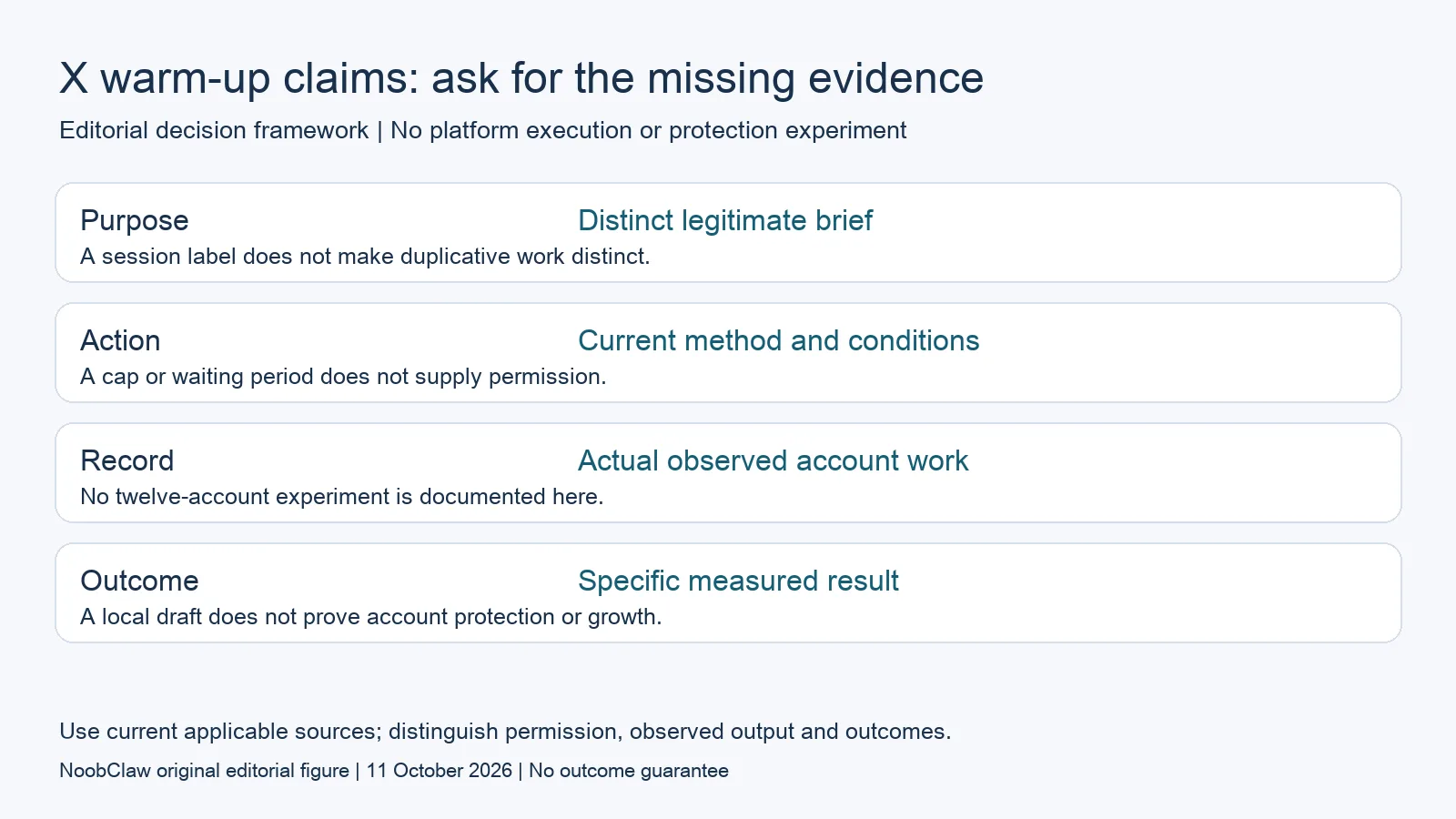
- Purpose: Distinct legitimate brief. A session label does not make duplicative work distinct.
- Action: Current method and conditions. A cap or waiting period does not supply permission.
- Record: Actual observed account work. No twelve-account experiment is documented here.
- Outcome: Specific measured result. A local draft does not prove account protection or growth.
A pacing setting cannot replace the current action rules
X's current automation rules prohibit automated likes, non-API website automation and bulk, aggressive or indiscriminate following. They also distinguish related non-duplicative account purposes from duplicative activity. A vendor's warm-up plan does not override those stated conditions. Check the actual proposed action and method against the applicable current document, rather than describing an arbitrary daily count as safe.
Ask for evidence when a vendor claims that a particular waiting period protects an account. What was authorized, which accounts were observed, what actions occurred and which outcomes were recorded? A table of suggested limits is a configuration proposal, not an official quota. The absence of a visible warning during a short demonstration cannot establish a universal result. A convincing-looking story about many accounts still needs the underlying record before it can be presented as an experiment.
For a hypothetical buyer review, require the tool to state whether it prepares content, publishes an authorized post or interacts with another person. Review consent and destination conditions where they apply. Do not let a feature name such as human-like behavior stand in for those answers. Technical execution, platform permission and business usefulness are separate questions. A method that finishes an action can still leave the other two unresolved.
If the intended work is not permitted or its conditions remain unclear, narrowing the task can still make progress. A local editor can prepare a sourced explanation, identify weak claims and export a candidate artifact. That does not certify a later publishing connection. Record the bounded work actually completed and the step still unresolved. Preparing content is useful when it addresses a real brief, not because it provides a waiting-period ritual before an unrelated operation.
Use a content pilot that measures what it actually produces
A hypothetical content pilot could begin with one audience question, one verified product fact and one example that supports the explanation. Prepare a small number of introductions and have an editor choose the one that makes the point clearly. Count accepted drafts and rejected claims rather than simulated account actions. Keep the reason for each revision. This produces an editorial record that a team can inspect without claiming it has established a safe account-automation formula.
For a release explanation, check that the demonstration matches the current feature and that limitations are visible. For an educational post, preserve the original source and distinguish it from the writer's interpretation. A more specific answer can be useful even if the team has not published it. Volume alone does not establish quality. The task is complete when the agreed artifact meets the brief, while destination publication remains a separate result with its own requirements.
When a permitted publication does occur, retain the actual version, date, destination and observed response. Views, follower changes, qualified inquiries and sales are different measures. Do not divide an invented follower gain by account count and days to create a precise-looking average. A useful report identifies the period, baseline and sample, then states the limits of attribution. Several accounts with different audiences do not become a controlled experiment simply because they use the same tool.
NoobClaw's documented local creation example below is relevant to the drafting stage. It does not test X warm-up or establish platform approval. The related drafting and workflow reviews can help separate the content requirement from the operating method. Choose the stage that is actually missing from your team's work and ask for evidence at that stage. An accepted script or video is a concrete deliverable; a promise of account protection, follower growth or a guaranteed return is not established by the record here.
For the related content and workflow decisions, read Blotato Alternatives: Choose by the Workflow You Need and AI Content Generation for Social Media: Drafts to Video. Each review has its own evidence and scope.
Inspect the recorded output without adding an account experiment
NoobClaw publishes this article and sells content tools. Its public execution record demonstrates one supplied script producing a local video draft, with recorded dimensions, duration and sampled subtitle checks. It also records imperfect stock-image relevance and the need for full visual and audio review. The record contains no X messaging operation, account warm-up trial, follower measurement or destination publication. Use it to inspect the documented content output, not to validate a different action. A purchaser who needs to prepare an explanation may find that creation stage relevant. A purchaser seeking a live inbox or account-management integration needs separate evidence. The guide describes the local controls, and the current product offer should be checked against the intended task. Neither the example nor a subscription capacity establishes platform permission or a promised commercial result.
Inspect the public script-to-video execution record and the script-to-video operating guide. Check the current product offer against the task you need.
Frequently asked questions
How many days make an X account safe for automation?
No proven safe warm-up interval is established here. Check the specific action and current method conditions; a delay does not override them.
Do separate browser profiles protect all accounts?
Chrome documents organization of browser information, with limits on access separation. It does not establish protection from X enforcement or approval of an operation.
Does a follower increase prove the warm-up caused growth?
No. Preserve the actual baseline, observation period and other changes before interpreting a result. This article has no recorded warm-up trial or follower outcome.
Sources
Official material reviewed on October 11, 2026. Document conditions apply to their stated service and scope; the editorial examples are explicitly hypothetical.