Xiaohongshu Marketing: AI Drafts, Evidence and Disclosure
- Start from a real experience or supported explanation rather than an invented persona.
- The current covenant encourages clear disclosure of AI participation and rejects fabricated product effects and data.
- Review the language and visual output for the actual audience; an English example does not prove Chinese typography quality.
- No private ranking formula, safe posting ramp or follower-growth forecast is established here.
Xiaohongshu marketing starts with what you can truthfully share and why a reader would find it useful. AI can assist a draft, but it cannot supply a personal experience, product test or customer outcome that did not happen. The platform’s current Community Covenant 2.0 provides a better starting point than an invented description of its recommendation weights. This review evaluates content preparation; it does not establish a follower-growth campaign or verified NoobClaw Xiaohongshu publication.
Keep the real experience in the brief and the commercial identity visible. A persuasive voice cannot turn an invented experience into evidence.
Build a brief from experience you can substantiate
A useful brief identifies the audience’s question, the information you actually have and the explanation you can support. For a creator describing a local video workflow, that could include the supplied script, selected settings, exported file and corrections still needed. It should not include an imagined month of audience growth. The assistant can help organize the explanation without inventing a more impressive history for its author.
Keep firsthand observations, public documentation and hypothetical examples visibly different. A product specification can support a feature statement, while a measured output can support the result of one run. Neither establishes that a customer bought the software or that a community accepted a post. A proposed example can still be useful when labeled as a proposal instead of written as a testimonial.
Consider a hypothetical creator comparing two ways to explain a video export. One draft begins with the task and shows the actual file’s limits; another claims the software doubled saves without a measurement. The reviewer can choose the first explanation and reject the unsupported claim. This is an editorial exercise, not a Xiaohongshu test we operated. Its purpose is making the content review concrete before evaluating style.
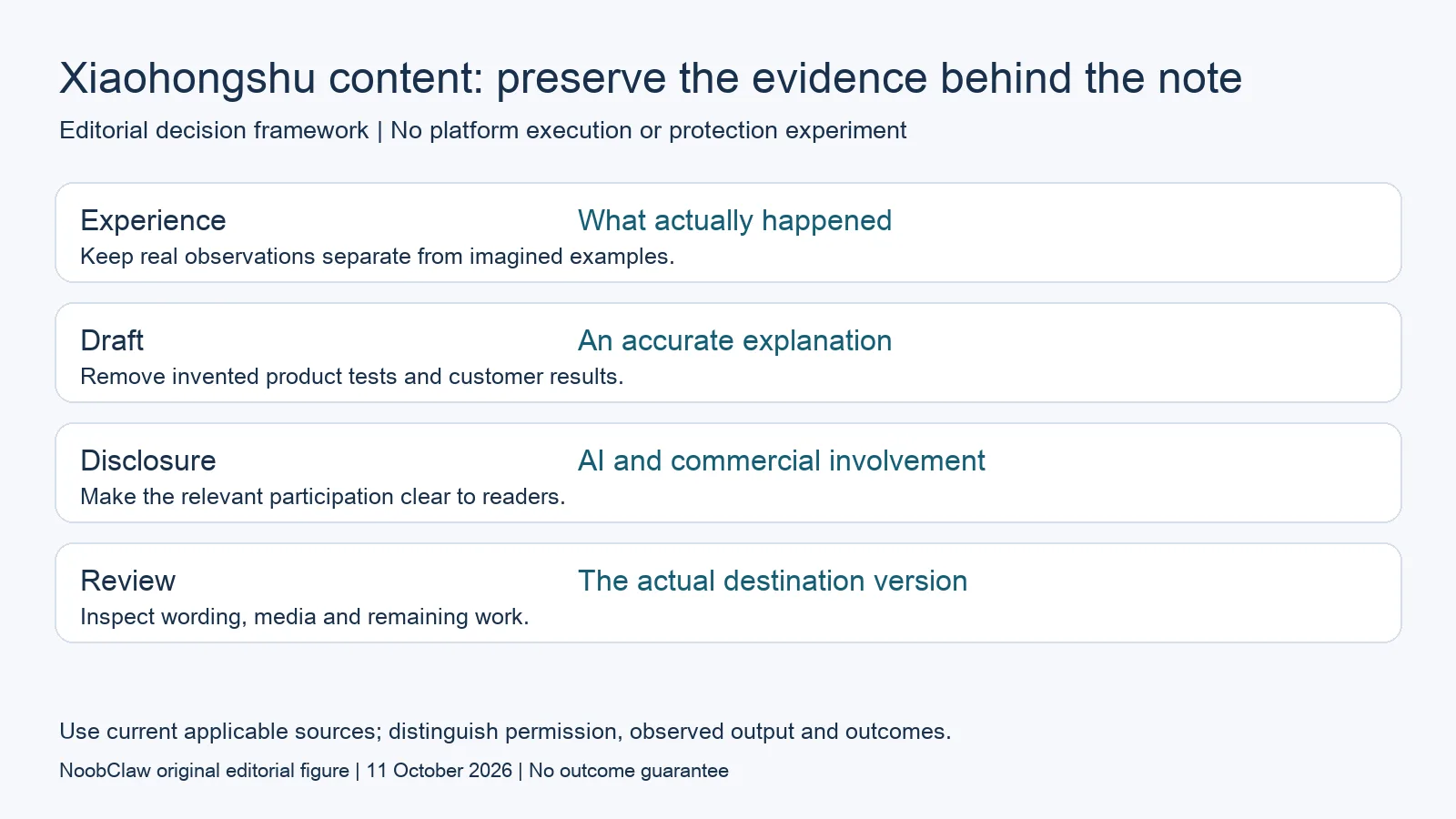
- Experience: What actually happened. Keep real observations separate from imagined examples.
- Draft: An accurate explanation. Remove invented product tests and customer results.
- Disclosure: AI and commercial involvement. Make the relevant participation clear to readers.
- Review: The actual destination version. Inspect wording, media and remaining work.
Use the current covenant for truth and disclosure
The current official Community Covenant 2.0 asks for truthful material, rights to borrowed work and verification of uncertain information. It encourages clear disclosure when AI assists creation, including polishing and ideation. Its commercial section rejects fabricated product effects, sales, reviews and engagement data, and asks businesses to make their identity clear. These are public community expectations, not a formula for ranking a note.
An account’s writing style should therefore not create a false biography. A tone card can request concise language or a practical explanation; it cannot establish the author’s income, qualifications, customer experience or travel history. Ask the tool to preserve the source facts rather than manufacture a supposedly more convincing persona. Inspect every sentence written in the first person against the person who will present it.
The covenant also opposes disguised marketing and unwanted promotional messages. Creating an editable draft and deciding whether to publish it are distinct tasks. This article does not certify a product’s automated account activity or establish permission from a draft-generation demonstration. Keep content preparation, destination requirements and actual publication evidence separate in a purchase evaluation.
Review the destination version rather than a generic template
Inspect the actual language the audience will read. An English script-to-video example cannot certify Chinese wording, idiom, rendered characters or subtitles. A product claiming Chinese cover generation should demonstrate the intended text and image combination so you can inspect each character and its relationship to the source. A fluent sample in another language is insufficient evidence for that particular requirement.
Check the title, cover and body together. They should describe the same explanation. Do not turn an ordinary workflow note into a promise of viral results. If a draft adds a before-and-after outcome, identify the actual observations and conditions or remove it. This is a proposed editorial acceptance method, not an account-specific prediction about what the platform will recommend.
When adapting a supported topic for another audience, change the explanation to address that audience’s real question. Rewriting the same invented experience in three voices does not produce three genuine experiences. Keep the approved source facts and accepted version associated with the intended account. The goal is an accurate destination version whose corrections can be traced, not a dashboard filled with nominally different posts. Chrome profiles can organize separate history and settings, but Google notes that device users can switch profiles; that feature does not certify platform permission.
Judge NoobClaw by the bounded output available
NoobClaw publishes this article and sells content software. Its public creative record documents one 441-character English script rendered into a 32.6-second local MP4 at 1080 by 1920 pixels and 30 frames per second, with voiceover and subtitles. The record supports that specific local creation result. It does not demonstrate Xiaohongshu publication, Chinese cover rendering, a note’s saves or follower acquisition.
Some sampled stock footage needed further relevance review. Inspect the exported file against the explanation rather than assuming that related imagery explains each sentence. The file’s existence does not establish completed audiovisual review or asset rights for every element. If the proposed task requires your own demonstration footage, require that capability and a matching output before treating a short stock-video example as sufficient.
If your missing work is a content draft or local narrated file, review the demonstrated task and its prerequisites. If the missing work is Xiaohongshu publishing or reporting, ask for separate current destination evidence. Compare costs only after identifying the accepted output and remaining human work. A rendered file, published note, save, follower and paid order remain different events.
For the related content and workflow decisions, read AI Content Generation for Social Media: Drafts to Video and Human-Like Automation: Execution Is Not Account Approval. Each review has its own evidence and scope.
A proposed acceptance brief for an overseas creator
Specify the actual language, audience question, factual material, source-media rights, AI participation and commercial relationship. Record the accepted text, cover and media version together with remaining corrections. This is a proposed brief, not a creator campaign we ran. It gives a buyer a reason to reject an unsupported growth promise even when the wording sounds persuasive. If a Chinese destination version is required, inspect that version rather than extrapolating from the public English sample. A later publishing claim should add its own method and observed outcome. Audience measurements need a separately defined event and period. No evidence here supports the old article’s equal-weight algorithm model, doubled save rate or compounding followers within eight to ten days.
NoobClaw publishes this article. Its script-to-video guide and public creative execution record document a local video result, not external-platform publication. Check the current product offer against the supported action you need.
Frequently asked questions
Does the article establish Xiaohongshu’s ranking weights?
No. It provides an editorial framework and public community expectations, without claiming a private ranking formula or controlled growth experiment.
Does the public video prove Chinese cover quality?
No. It is one English local video result. A Chinese cover or subtitle requirement needs its own actual output and review.
Does a different persona make shared content authentic?
A tone change does not create a real experience. Retain supported facts, make commercial involvement clear and inspect the actual destination version.
Sources
Official material reviewed on October 11, 2026. Document conditions apply to their stated service and scope; the editorial examples are explicitly hypothetical.